
On 25 March, the share price of Meituan, China’s leading food delivery and quick commerce platform, surged more than 14%.
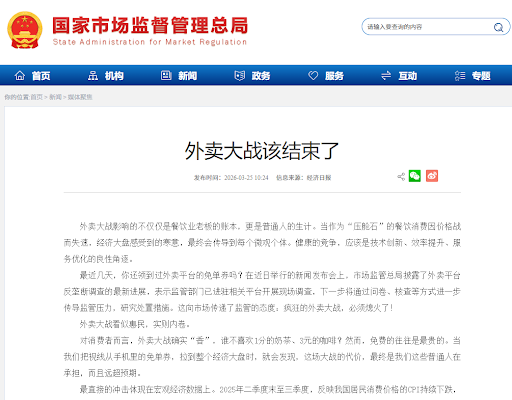
The trigger was the State Administration for Market Regulation re-posting an article by state-owned Economic Daily on its official web site.
The article, titled “The food delivery war should end soon”, details the negative consequences of the Meituan-Alibaba food delivery subsidy war on the merchants, consumers as well as China’s consumption recovery in general.
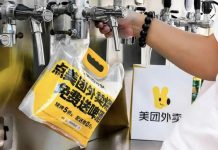
Tens of billions of dollars have been spent on subsidies during the war, which has now lasted for a year. The market, which has long resented the value-destructing war, is cheered by the signal this official article is sending.
However, we have to be mindful that over the past few months – various government agencies and official publications have sent various messages stating the same – all the way back to July 2025.
The protagonists of the war have made adjustments to their voucher mechanisms and focus, but the fierce competition is still going on. Meituan will report its Q4 2025 financials after market closure today (26 Mar) – and the market is generally expecting a very large loss.
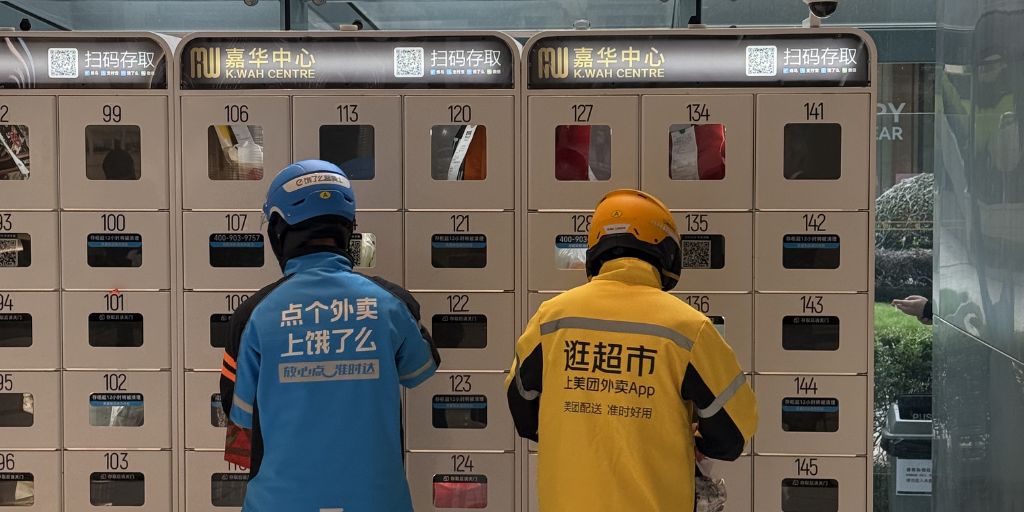
Food delivery, for Alibaba (and JD), is strategic not because of the bubble tea and coffee itself. Rather, they want to control their own large scale, nationwide, and dense fulfillment network should quick commerce take off and threaten ecommerce platforms’ existence.
Bear in mind, ecommerce platforms in China are threatened by Douyin (TikTok’s China version), which has unlimited consumer traffic, and Pinduoduo, which has unbeatable price advantages. They can’t afford to lose the “fast” value proposition which premium city customers increasingly rely on.
Here is the English translation of the full article by Economic Daily. You can form your own judgement on the tone, and the weight it might carry.
The food delivery war should end soon
Economic Daily 25 March 2026
The impact of the food delivery price war goes far beyond restaurant owners’ balance sheets—it directly affects the livelihoods of ordinary people. When dining consumption, a key stabilizer of the economy, loses momentum due to destructive price competition, the chill felt in the broader economy will ultimately be transmitted to every individual. Healthy competition should be a virtuous contest of technological innovation, efficiency improvement, and service optimization.
In the past few days, have you still been receiving free-order coupons from food delivery platforms? At a recent press conference, the State Administration for Market Regulation disclosed the latest progress of its antitrust investigations into food delivery platforms. Regulators have already entered the relevant platforms to conduct on-site inspections, and next steps will include surveys and audits to further intensify regulatory pressure and study potential measures. This sends a clear signal to the market: the frenzied food delivery price war must come to an end.
At first glance, the food delivery price war appears to benefit consumers, but in reality, it is a form of excessive internal competition.
For consumers, these subsidies do feel attractive—who wouldn’t like milk tea for one cent or coffee for three yuan? However, what is free often turns out to be the most expensive. When we shift our focus from the free coupons on our phones to the broader economy, it becomes clear that the cost of this price war is ultimately borne by ordinary people like us—and far exceeds expectations.
The most immediate impact is reflected in macroeconomic data. From the end of Q2 to Q3 in 2025, China’s CPI, which reflects consumer prices, continued to decline, signaling a cooling consumption market. Yet intriguingly, if food and energy are excluded, core CPI has been steadily rising. This suggests that consumption should have been recovering, but something has been forcefully dragging it down.
What is dragging it down is the catering sector.
In China’s CPI basket, food, tobacco, alcohol, and dining-out expenses account for nearly 30%—the highest among all categories. This means that when dining prices rise, CPI tends to follow; when they fall, CPI drops accordingly.
With this context, the data becomes clearer: from the end of Q2 to Q3 in 2025, the growth rate of China’s catering revenue slowed, and its decline closely overlapped with the downward trend of overall CPI. Meanwhile, other heavily weighted categories such as housing and transportation/communication did not experience similar declines.
This period coincided exactly with the peak of the food delivery price war, when platform subsidies were at their most aggressive. Financial reports show that during the price war, Alibaba, JD.com, and Meituan collectively spent between RMB 80 billion and RMB 100 billion on subsidies. The China Hospitality Association noted that large-scale subsidies between platforms drove price declines and became a key factor constraining the growth of the catering industry since June 2025. According to Meituan’s observations, the price war effectively pushed the average dine-in spending per customer back to levels seen a decade ago.
On the surface, the price war looks like platforms giving concessions, but from a macro perspective, it represents a severe disruption to the pricing system of the catering industry. To survive the subsidy war, restaurants are forced to sacrifice quality and compress margins, pushing the entire industry into a vicious cycle of operating at a loss just to maintain visibility. This ultimately drags down the broader recovery in consumption—directly contradicting the central government’s policy goal of boosting consumption and adding unnecessary resistance to macroeconomic stabilization.
The impact of the food delivery price war goes beyond restaurant owners—it affects the livelihoods of ordinary people. Consumption is the primary engine of economic growth. When dining consumption, a key stabilizer, loses momentum due to destructive price competition, the resulting economic chill will inevitably be transmitted to every individual. When corporate profits become razor-thin—or businesses operate at a loss from day one—where will jobs come from? How can wage growth be sustained?
This is precisely why regulatory intervention to halt the price war is necessary: it safeguards the normal functioning of the economy, prevents destructive competition from disrupting the pace of recovery, and ensures that businesses and workers can maintain stable incomes and livelihoods.
Healthy competition should be a virtuous contest of technological innovation, efficiency gains, and service improvements—not a capital-driven cash-burning game, nor a zero-sum struggle that leverages monopolistic power to control traffic and force exclusivity. Allowing delivery prices to return to a reasonable range, freeing the catering industry from the dilemma of “no subsidies means death, subsidies mean chaos,” and shifting competition from burning cash to improving service—this is what truly benefits both businesses and consumers.
Price wars do not last; destructive competition produces no winners. It is time for the food delivery price war to end.