




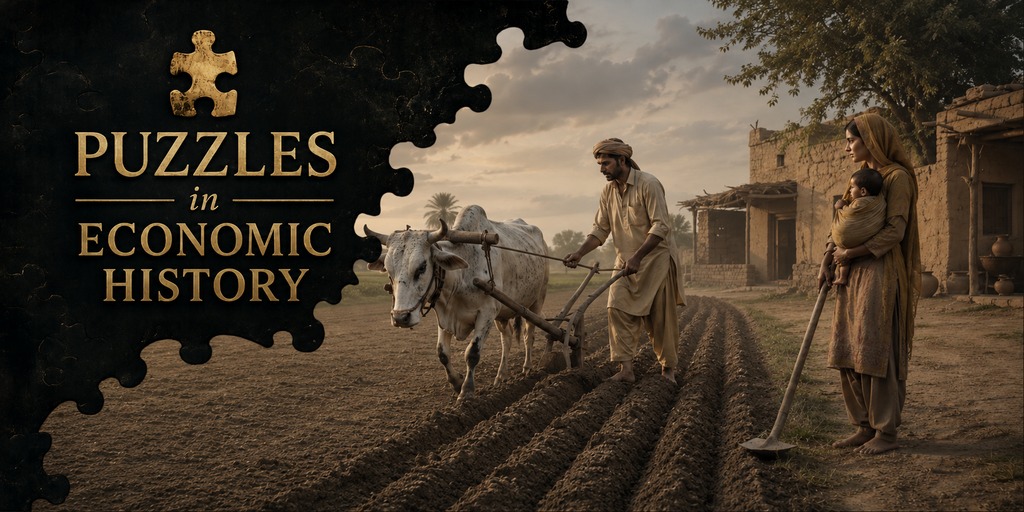
This series is adapted, with permission, from a Chinese-language series by our friend Marcus Ji, who looks at historical events through an economic lens. We have condensed and adapted the original for an international audience.
The share of women who work outside the home varies enormously between countries. In 2000, only 16% of adult women in Pakistan were in the labour force; in Burundi, in East Africa, the figure was 90%. One society where women are almost all at home, another where they are almost all in the fields.
Stranger still is what happens when you move people. Take a Pakistani family and a Burundian family, settle both in the United States, and let their children and grandchildren be born there, attend the same schools, take the same jobs, and never touch farm work again. Statistically, whether their daughters go out to work still carries the imprint of the ancestral homeland. The attitude travels across the ocean with the people, long after the thing that created it has vanished.
That long-vanished thing is a farm tool: the plough.
This article draws on the work of economists – chief among them Alberto Alesina, Paola Giuliano and Nathan Nunn, whose 2013 study traced how far this variation in women’s work still lines up with ancestral farming methods – to work through three questions:
- Where does the household division of “who goes out to work and who stays home” come from?
- Is the cause economic, i.e. the product of wealth and the means of production; or is it due to human nature, the way things have always been?
- And, most tellingly: if it really is economic, can it be reverse-proven – change the economic input, and does the whole arrangement flip?
In short, their hypothesis is that the division is not nature and not eternal tradition. It is downstream of economic structure – and the strongest evidence is that it can be turned on and off like a variable.
The argument: men were better suited to the field
It starts with two ways of turning soil. In 1970 the Danish economist Ester Boserup noticed that traditional farming came in broadly two kinds. Hoe farming – loosening soil with a handheld hoe or digging stick – takes moderate effort, can be stopped and restarted at will, and needs no great strength; anyone can do it, women and children included. Plough farming – dragging a plough behind an ox or horse – means turning a large area of soil quickly, which demands upper-body strength, grip and the power to control a big animal.
The two tools give opposite answers to “who is better suited to the field.” Two mechanical details make the logic concrete:
- Childcare is compatible with the hoe but not the plough – you can hoe with a baby on your back, but you cannot mind an infant while steering an ox.
- The plough eliminated weeding – its deep blade buries weeds directly – and weeding had been the main field contribution of women and children.
So where the plough was used, men became far more useful in agriculture, the household slid towards “man outside, woman inside,” and that division hardened into a belief: that women naturally belong at home. The starting point was a tool and a mode of production – an economic starting point.
What supports the argument
A nice story about ploughs favouring men is not enough; you have to show it reaches all the way to today rather than being a coincidence. Alesina, Giuliano and Nunn pinned it down in their 2013 paper using geography as a natural experiment. Grains split into two kinds: plough-positive, where the plough greatly raises yield: wheat, barley, rye; and the rest, where it does not: sorghum, millet, root crops.
Which one a piece of land is naturally suited to grow is an accident of climate and soil, and has nothing to do with whether the local people happened to value men over women. And yet simply whether a region’s land was naturally suited to plough-positive crops predicts, today:
- more conservative gender attitudes;
- lower female labour-force participation;
- fewer women in business and politics.
Geography, through a single farm tool, reaches across several thousand years into the present.
What doesn’t support the argument
If men’s advantage at the plough were simply natural and permanent, it would follow those people wherever they went, and it would not depend on the plough still being in use. Neither turns out to be true.
Culture travels; the plough does not. The same authors looked at second-generation immigrants born and raised in the US and Europe – people who had never farmed, let alone held a plough, and who grew up alongside neighbours in every way like them, differing only in ancestry. Women whose ancestors came from plough-farming traditions still had lower labour-force participation and more conservative gender views. Same environment, same institutions; the only difference was whether their forebears used the plough. The plough is long gone, yet the division it created travels across the ocean as an economic-cultural inheritance, independent of any land. The boundary case makes the same point in reverse: in Mongolia the plough effect is weak, because Mongolia was traditionally nomadic, with little farming, so the plough’s role is diluted. Change the economic base and the prediction changes – exactly what you’d expect if the thing doing the work is economic structure, not a universal law of nature.
Change the input, and the whole family flips. If the arrangement is truly economic, a stronger claim should hold: change the core economic input, and not just the division of labour but the entire organisation of the family should flip. That experiment exists. First, a distinction: whether a society is patrilineal (property and name pass down the father’s line) or matrilineal (down the mother’s line) is itself downstream of a deeper economic variable – whether the society’s main inheritable wealth can be monopolised by men and passed to heirs of their own choosing.
Anthropologists had long noticed that societies keeping large livestock are almost never matrilineal. But a correlation isn’t enough – related tribes might just happen to both keep cattle and be patrilineal. So Holden and Mace (2003, in a Royal Society journal) used a method that strips out shared ancestry, tracing 68 Bantu-speaking groups, and tested the sequence: did matriliny disappear only after cattle arrived? It did. Groups that had been matrilineal turned patrilineal once they acquired cattle. Their summary line: “cattle are the enemy of matriliny.” The mechanism: cattle are hard wealth a man can monopolise and accumulate. In a matrilineal society a man is meant to pass his property to his sister’s son – his nephew – but a man holding a herd wants it to go to his own son, and works to get around the matrilineal rule, dissolving it from within.
Two boundary cases seal it. The first is where cattle cannot survive, matriliny survives: Central Africa’s “matrilineal belt” maps roughly onto the tsetse-fly zone, where the disease the fly spreads makes cattle nearly impossible to keep – so men could never accumulate the lockable wealth that forces patriliny.
The second case is where wealth cannot be monopolised at all, matriliny is stable. One study, echoing the cattle line, is titled “the fish is the friend of matriliny” – the denser the reef and the harder the fishery is for any individual to control, the more matrilineal inheritance persists.
Add the input – monopolisable inheritable wealth – and the family structure flips from matrilineal to patrilineal; take it away, and it doesn’t.
This also rules out a popular but weak explanation: that matriliny comes from uncertain paternity. On its own that doesn’t work – it would require far more uncertainty than is ever actually observed. The explanation that holds is economic: whether wealth can be monopolised.
What’s actually the case
If the division is economic, it should change as economic structure changes, rather than run in a straight eternal line – and it does:
- Foraging societies: the division by sex was flexible and interchangeable; women’s gathering often supplied most of the stable food, wealth could barely accumulate, and kinship was usually reckoned on both sides.
- Agriculture: the road split in two – hoe farming (women productive, more equal) and plough farming (male-dominated).
- The industrial era: the arrangement many people feel is timeless – the male breadwinner and the female homemaker – was actually pushed to its peak here, when the factory first separated “the workplace” from “the home” physically. The “traditional family” is largely a product of 19th- and 20th-century industrialisation, not an ancient inheritance.
- Today: as women re-enter the market in large numbers, the gains from that division fade and it loosens again.
At every stage, the division shifted – and each shift followed a change in what counted as wealth and who was able to control it.
The division is downstream of the economy
So the household division of who works outside and who stays home is neither biological nature nor eternal tradition. It is downstream of economic structure, shaped by two things:
- which mode of production makes whom more useful – the plough favoured men in the field;
- whether wealth can be monopolised and inherited by one side – cattle let men lock in patriliny.
And it behaves like a variable you can push both ways: carry the plough-shaped attitude to a country with no ploughs, and it still shows up; swap out the economic base it depended on, and the effect disappears; add monopolisable inheritable wealth to a matrilineal society, and the whole family structure flips.
That gives a reading for today. The scarcest, most-transmitted asset in a modern economy is shifting from land, cattle and factories to human capital – the education and skills a person carries. And human capital has a feature none of the older forms had: it lives inside the child, sons and daughters alike, and no one sex can monopolise it. By the same logic, when the core inheritable wealth becomes something neither sex can corner, the output should be a convergence of gender roles and a return to dual-earner households reckoned on both sides. What we are seeing now is largely that same ancient machine, producing a new output from a new input.
So is “man outside, woman inside” human nature, the way things always were? Neither. It is the answer to an economic problem written jointly by a Bronze Age farm tool, a herd of cattle, and land that could or could not raise them. Change the problem, and the answer changes with it.
Previously in this series: Can anything stop the human desire for profit?
Next in this series: Why have both marriage and birth rates declined?