




When we first wrote about Migoo in June, we had quite a few questions about what Sea Group was trying to do with it.
The project was clearly being taken seriously. Sea was putting meaningful resources behind it, and Group President and Shopee CEO Chris Feng was spending a lot of his own time on the initiative. Yet Migoo itself looked deliberately detached from Sea: it was launched through a separate entity, carried no obvious Shopee, Garena or Monee branding, and was positioned as a general-purpose personalised AI companion rather than an ecommerce product.
We also had our doubts about the product proposition. Migoo was entering a consumer AI market already occupied by OpenAI, Google, Meta and others with substantially larger model, research and compute resources. Its early version also required broad access to a user’s Google account before they could properly use it, creating another fairly obvious adoption hurdle.
A few friends inside Shopee joked to us at the time that, in the worst case, all the work going into Migoo could still produce a pretty useful internal productivity app.
Four months later, Sea seems to have found another place to test it: inside Shopee itself.
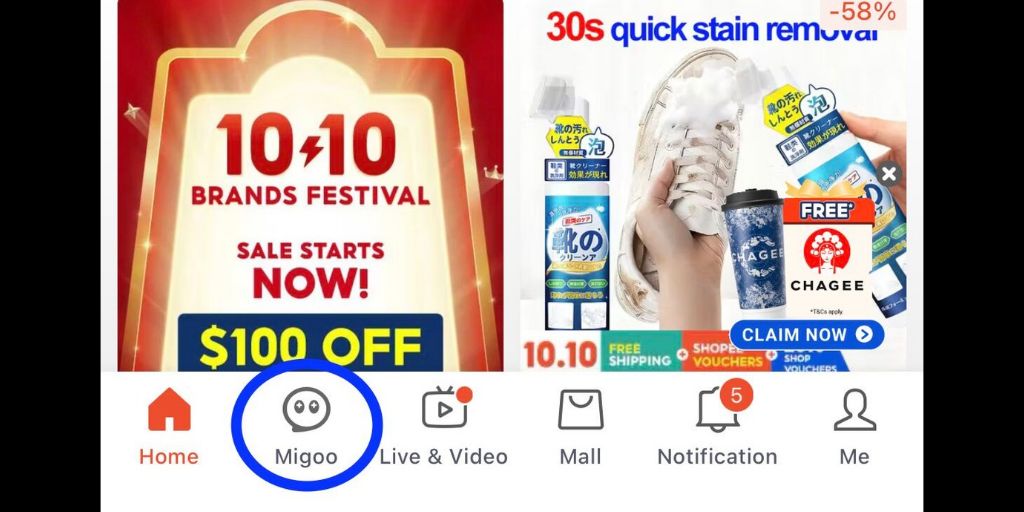
One of our colleagues in Singapore recently opened Shopee and found Migoo sitting directly in the bottom navigation, next to Home, Live & Video, Mall and Notifications. Another colleague did not have it, and a quick check among people around us found several fairly frequent Shopee shoppers who could not see it either. This is anecdotal, of course, but it suggests Sea is running a limited test rather than rolling the feature out broadly.
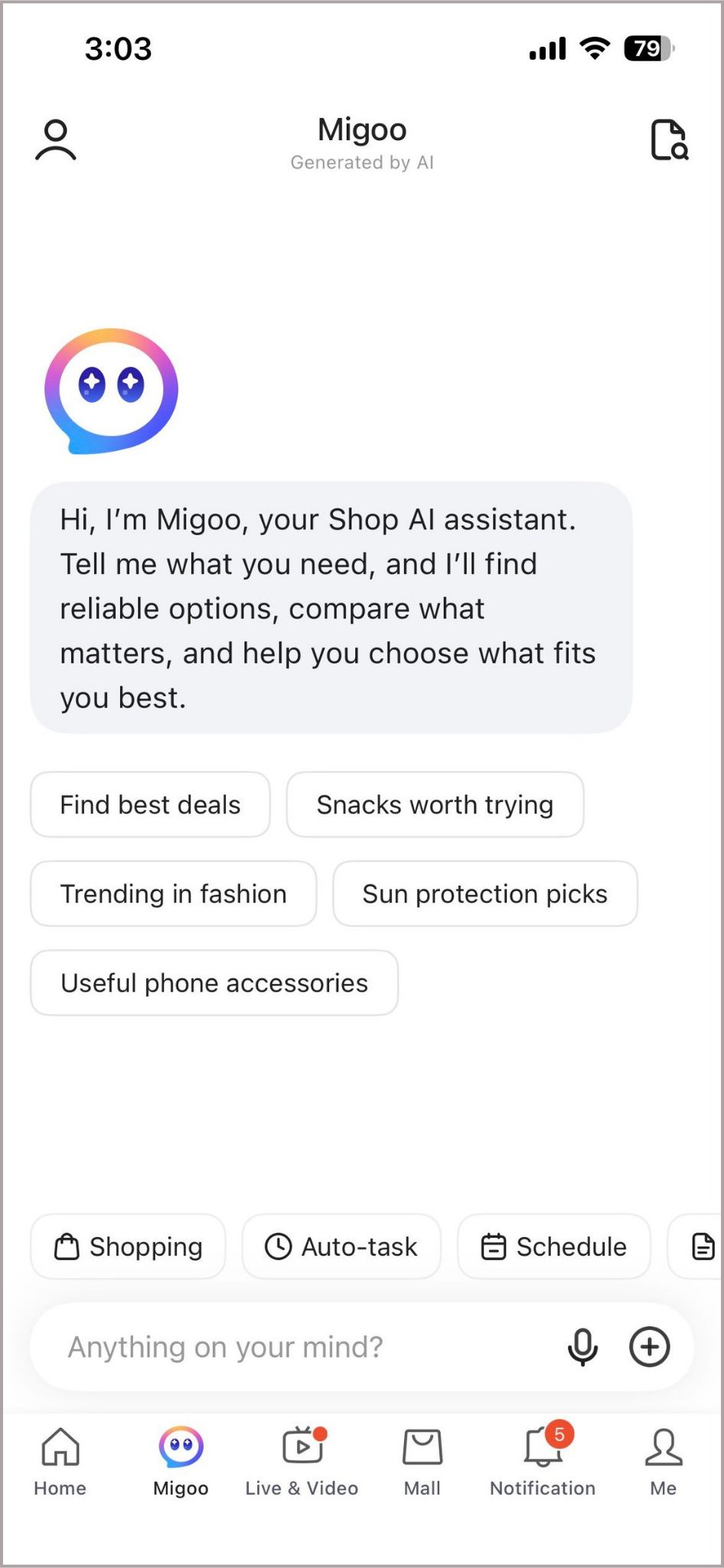
The version appearing inside Shopee is also much more specific than the Migoo we saw in June. It introduces itself as a “Shop AI assistant”, offering to find options, compare products and help users choose. The suggested prompts include “Find best deals”, “Trending in fashion”, “Sun protection picks” and “Useful phone accessories”.
 That is quite a change from the original positioning. Migoo initially talked about remembering users, helping them plan and organise information, and completing tasks across different parts of their lives. Shopee was barely visible in that proposition.
Putting Migoo inside Shopee gives Sea a much easier environment in which to work out whether people actually want to use it.
A standalone consumer AI product needs to give people enough reason to download or visit it, build a habit around it, and trust it with increasingly personal information. Shopee already has a large base of users opening the app with an immediate task in mind. There are also products, merchants, prices, promotions, payments and transaction histories for Migoo to work with.
We discussed a related problem in another Momentum Works Intelligence piece earlier this year, when looking at the economics of AI shopping agents. Product discovery sounds like an obvious application for agents, but standalone players face an awkward combination of high technology costs, expensive consumer acquisition and uncertain monetisation. A marketplace integrating an agent into its existing product starts from a rather different position.
Sea can also measure the experiment fairly directly. Do people ask Migoo to find products? Do they compare more items? Does conversational discovery lead them somewhere search and recommendations would not? And, eventually, does any of this improve conversion or transaction value?
The fact that several heavy Shopee shoppers around us do not appear to be part of the test makes the experiment slightly more intriguing. If the immediate objective were simply to get maximum usage, frequent shoppers would seem like an obvious audience. There could be plenty of mundane explanations – random cohorts, device differences, app versions or other targeting criteria – so we would not read too much into this yet.
But it is worth watching who actually receives Migoo, because that might eventually tell us more about what Shopee is trying to learn.
There are still several possible paths for the product. Migoo could gradually become a shopping feature within Shopee. Sea could be using Shopee as a convenient environment to test and improve a broader consumer assistant. Or the company could continue experimenting with Migoo both inside and outside its existing apps and see where users respond.
That would also be consistent with something we pointed out in our first piece on Migoo. Sea has historically been fairly opportunistic about new products. Shopee itself emerged from a period when Chris Feng, then Garena’s Head of Mobile, was pursuing multiple possibilities around the shift to smartphones; other bets from that period went nowhere.
The limited Shopee test still does not tell us what Migoo will ultimately become. It does, however, give Sea a much more practical place to find out whether consumers have any use for it at all.