




In 2016, when Didi and Uber merged their China businesses, major investors were already looking at what Southeast Asia’s emerging tech platforms could become. Having seen how WeChat used its partnership with Didi to grow payments and digital financial services, they expected the region’s ride-hailing and ecommerce platforms to follow a similar path.
Ten years on, they have quite a bit to show for it.
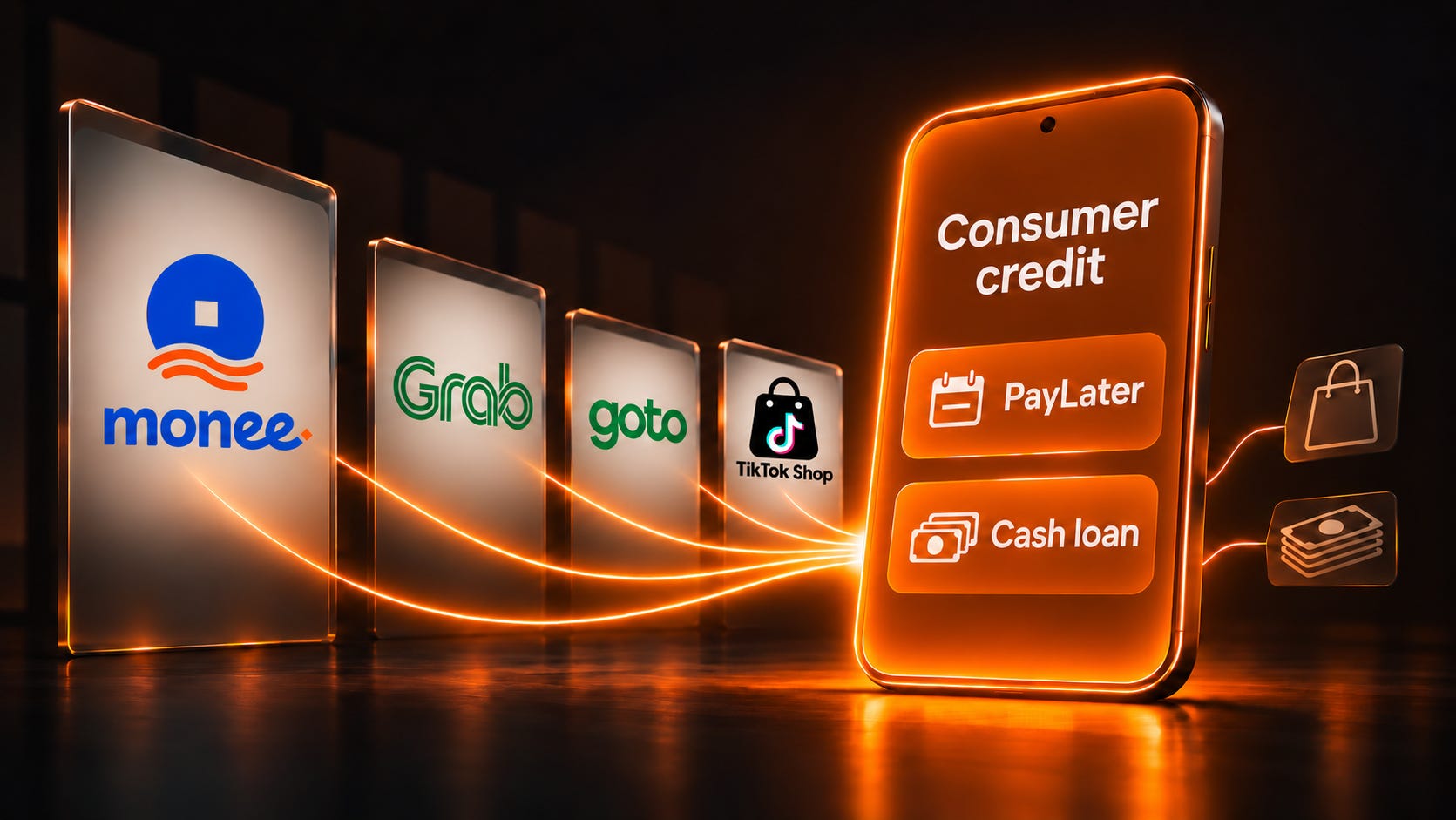
Southeast Asia’s digital consumer credit loan book reached an estimated US$19.8 billion at the end of H1 2026. Monee, Sea Group’s consumer credit and digital financial services business, accounts for about 45%. Together with Grab, GCash and GoTo, the four players account for approximately 60%.
Indonesia makes up 43% of the regional loan book, followed by the Philippines and Thailand. These estimates cover BNPL and cash loans offered by platforms, wallets and independent fintech lenders, rather than the entire consumer lending market.
Interestingly, while expanding rapidly, the leading players have generally kept their non-performing loan (NPL) ratios under control. Monee’s reported ratio of loans overdue by more than 90 days has stayed between 1% and 1.3% for 11 quarters.
And Monee is no longer just financing purchases on Shopee. Personal cash loans and off-Shopee BNPL now account for about 60% of its reported loan book. In Thailand, its ShopeePay Unlimited Card allows consumers to use their SPayLater limits wherever Mastercard is accepted.
Shopee helped Monee build its lending business. Monee is now finding more ways to grow outside Shopee.
Many of these developments follow the Chinese “internet finance” playbook. Ant’s investments, former employees and operating approaches have influenced much of Southeast Asia’s fintech landscape, directly or indirectly.
But having the same playbook does not mean getting the same results. Players have made different choices on growth, profitability, funding and risk. Licences, payment infrastructure and borrowing habits also differ across countries. We are seeing the outcomes of those choices today.
The market has been consolidating, but it has not settled yet. TikTok Shop is almost certainly going to disrupt it.
Its parent company already has considerable experience: analysts put Douyin’s loanbook in China to exceed CNY550 billion (US$82 billion) by the end of 2025; TikTok Shop’s own PIPO entities already offer financing in Thailand, the Philippines and Malaysia, and it has recruited Monee executives to help build its regional lending operations.
The new standalone TikTok Shop app also gives it more room to introduce and promote credit alongside shopping.
What does this leave for wallets and independent lenders? The answer differs. Leading independent cash lenders in Indonesia still have profitable businesses and loyal repeat borrowers. Independent BNPL providers face more pressure as platforms bring lending in-house. Grab’s proposed majority acquisition of Atome Financial is one indication of where things are heading.
Today, we are releasing Momentum Works’ Consumer Credit in Southeast Asia 2026 report, an assessment of the region’s BNPL and cash loan landscape. The report covers:
- Loan book estimates and market shares across six Southeast Asian markets;
- How China’s tech majors monetise their customer base through consumer credit, and how their operating playbooks evolved;
- How Monee, Lazada, Grab and GoTo have adapted those approaches;
- How Monee built the region’s largest digital consumer credit business, and the case for TikTok Shop to scale its own;
- The outlook for wallets and independent fintech lenders;
- Our perspectives and predictions.
The market has room to grow. Who captures that growth will be interesting to watch.
Find out more in Consumer Credit in Southeast Asia 2026. [Get the report]
Paying subscribers to Momentum Works Intelligence, please find your special discount coupon in our latest subscriber post.