



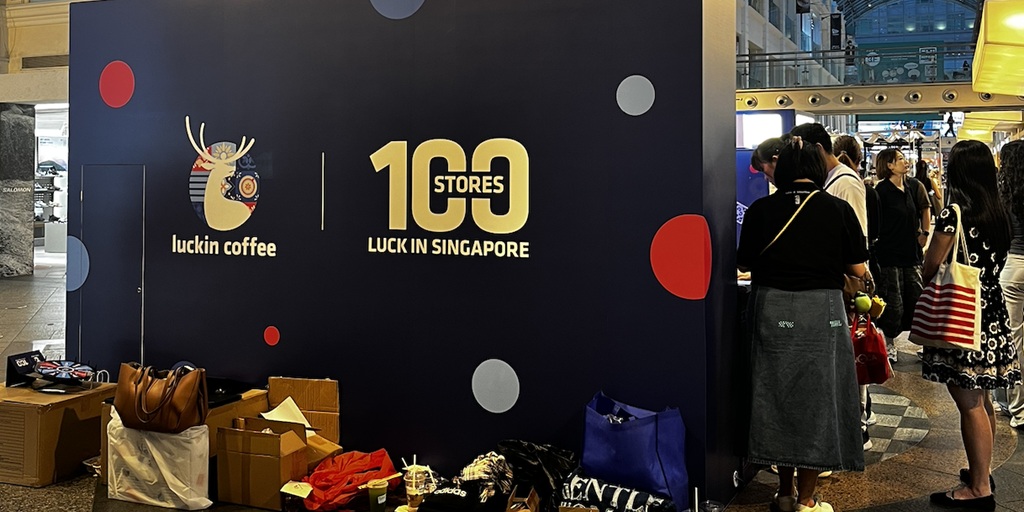
Luckin Coffee opened its 100th store in Singapore at Bugis Junction mall on 28 September, a little over three years after choosing the city-state for its first overseas market.
For people who have followed Luckin’s expansion here, getting to 100 was not particularly surprising. The company has expanded fairly steadily since arriving in 2023, and by the second half of 2025, management said both the business model and store-level economics in Singapore had been “largely validated”.
That last point is more interesting than the store count.
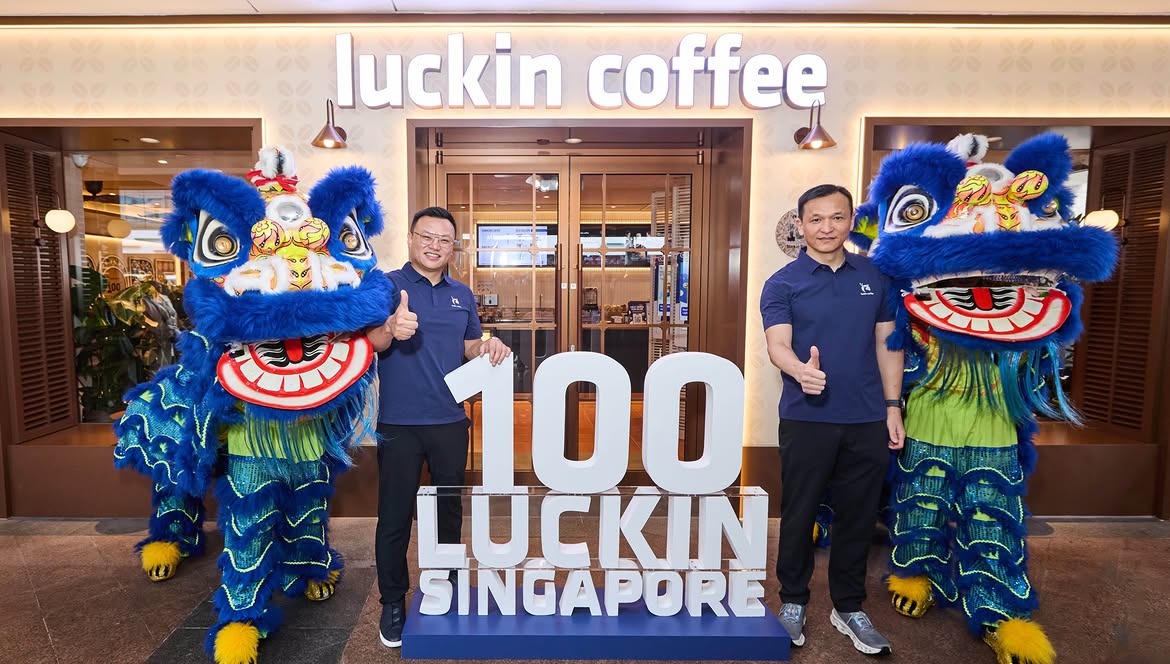
When Luckin entered Singapore, there was a reasonable question over how much of its success depended on China: an unusually competitive consumer market, dense cities, highly developed mobile commerce and a supply chain that had already been built around enormous scale.
Singapore removed some of those favourable conditions. Labour and rent are much more expensive. Coffee competition is mature. Yet the model still seems to work.
Luckin is often described as a low-priced coffee chain, but price is only part of it. Its stores are generally small and geared towards pickup; ordering and customer engagement are heavily digital; product launches are frequent; and technology runs through store operations and supply-chain management. As of the end of 2025, 99.1% of Luckin’s self-operated stores were pickup stores.
We went much further into the mechanics of this in our earlier report, Inside Luckin Coffee. The short version is that Luckin built a system that allows it to put a large number of relatively lightweight outlets close to consumers, keep them coming back through the app and new products, and manage the whole network centrally.
A few years ago, we described Luckin as looking more like an ecommerce company using physical stores as fulfilment points than a conventional coffee chain. That still seems a useful way to think about it. And that is also what makes Luckin’s overseas expansion interesting: the question is no longer just whether Luckin can sell coffee outside China, but whether the operating system it built in China can travel — both with Luckin itself and, increasingly, without it.
Singapore is a good place to test whether such a system travels. The market is small, commercial nodes are concentrated, logistics are straightforward and operating rules are predictable. Luckin also runs the business directly, so it can adjust pricing, products, promotions and store expansion without having to negotiate those decisions with a master franchise partner.
But Singapore is also only a compact city of six million people, which validates a model without answering how far it can scale internationally. And Luckin is now trying to find out.
Luckin now has more than 150 stores in Malaysia as well. Instead of operating stores itself, Luckin entered through an exclusive local franchise partner. It described in its annual report: a local partner brings market knowledge and operating capabilities that can support more efficient entry and expansion.
The U.S. market is back to the self-operated model and is probably where most of Luckin’s overseas attention is now concentrated. Luckin entered New York in 2025 and has opened 20+ stores there. After building more than 35,000 stores in China, there are not many overseas markets large enough to materially change Luckin’s growth trajectory. The U.S. is one of them.
The opportunity is larger. So is the difficulty. The U.S. already has a deeply established coffee culture, powerful incumbents and very different labour and real-estate economics. If Luckin can eventually reproduce its economics there at scale, that would say considerably more about the portability of the model than another 100 stores in Singapore would.
In September, Abu Dhabi sovereign investor Mubadala agreed to make a significant minority investment in Luckin. Later that month, Luckin chairman David Li said management was looking at other markets, potentially including Gulf countries.
And as Luckin tests how its model travels, something else is happening: other companies are learning from the same playbook. Malaysia’s ZUS Coffee may be the clearest example in Southeast Asia.
ZUS now has more than 1,000 stores and has expanded beyond Malaysia into markets including the Philippines, Singapore, Thailand and Indonesia. More recently, it has also started moving beyond Southeast Asia, entering Pakistan and preparing for Morocco.
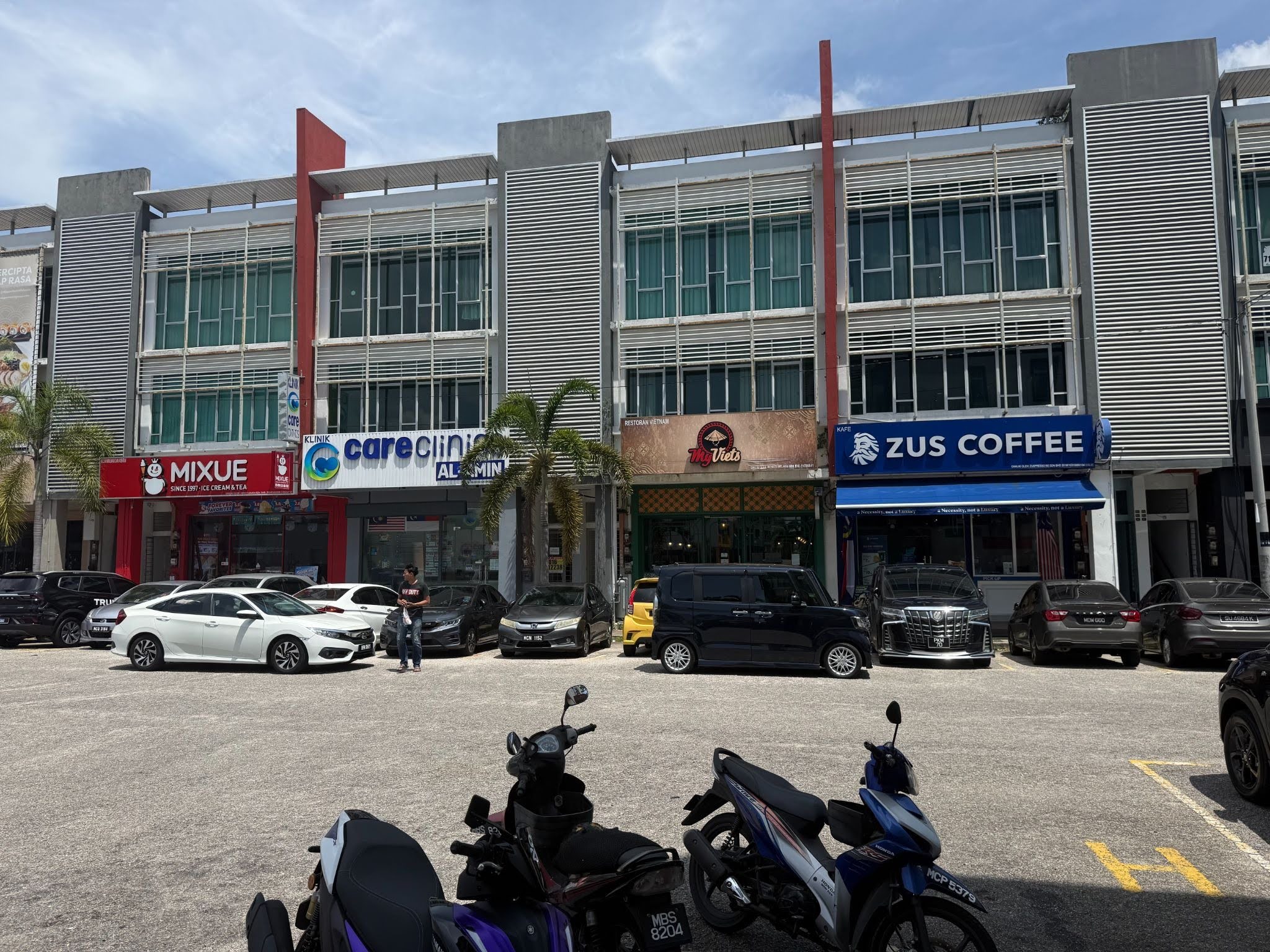
The resemblance goes well beyond the blue branding. More importantly, the operating logic is similar. ZUS has also built around compact stores, affordable everyday consumption, app-based ordering, frequent product launches and a network designed for convenience rather than long dwell time.
But there is a paradox in Luckin’s success. The more convincingly it proves the model works, the easier it becomes for others to study the playbook.
What Luckin did in China was combine pickup stores, loyalty apps and centralised supply chains, push them to an unusual level of intensity, and prove that they could support tens of thousands of outlets. That proof matters not only to investors or operators inside Luckin. Competitors are watching too.
ZUS is one example of what happens next. It does not need to reproduce Luckin exactly. In fact, the more important test is whether a local player can take the same broad logic — small stores, high frequency, digital ordering, fast product iteration — and adapt it better to its own market.
Luckin’s coffee is travelling overseas, and so is its playbook. The next few years should show how well Luckin can make the model work across very different markets — and how far local players can go with their own versions of it.