




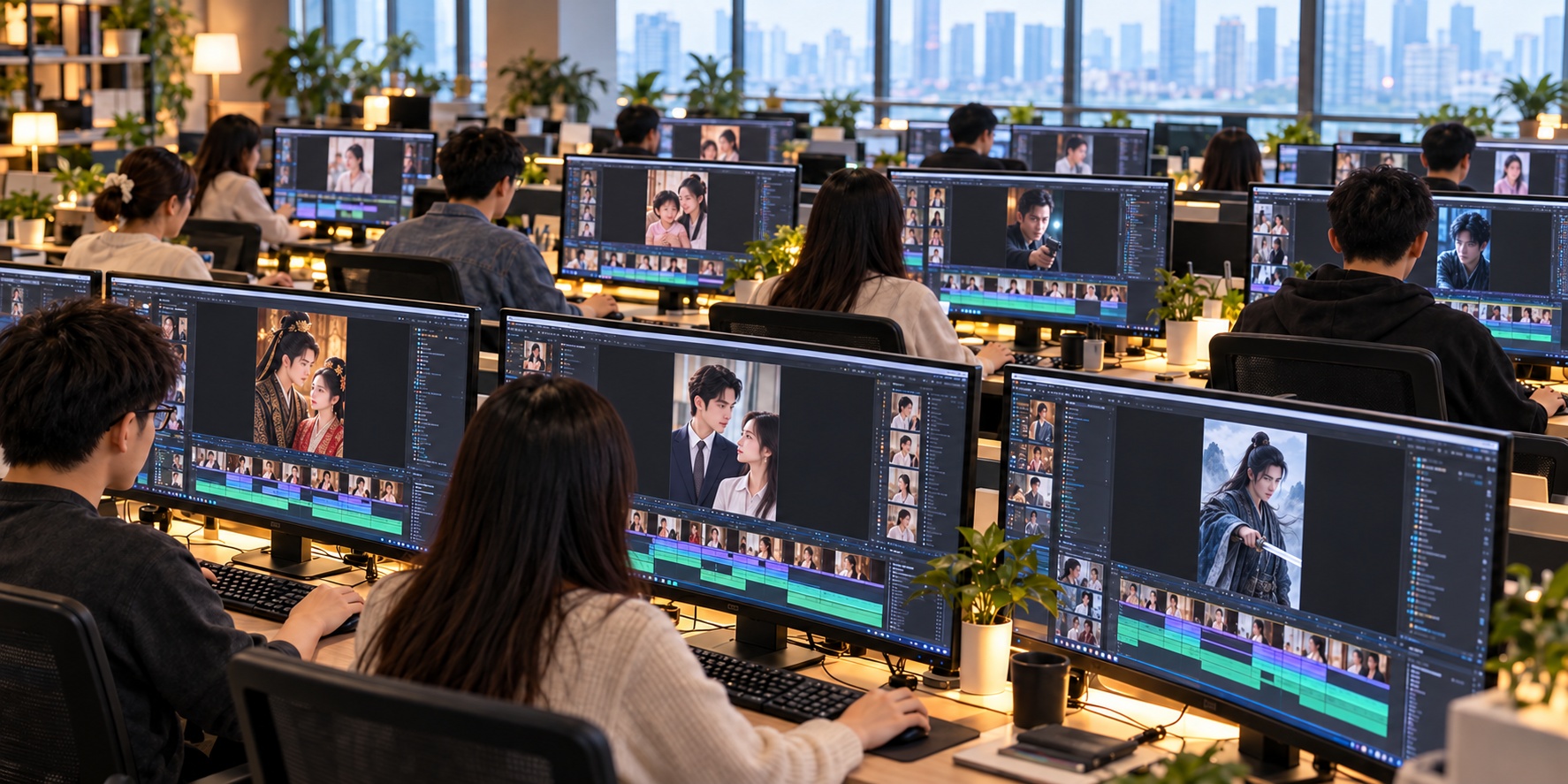
China’s AI short-drama industry is now producing more than 1,500 new titles a day.
A short drama that previously cost hundreds of thousands of yuan to shoot with actors can now be produced using AI for less than RMB 50,000 (US$7,000). Scripts that once took weeks to develop can be turned into finished videos within days.
Yet the people making these dramas are finding it increasingly difficult to earn a living.
In a recent investigation by Chinese technology publication Leiphone (雷峰网), journalist Hu Qingwen interviewed writers, directors and production studio founders working in China’s booming AI short-drama industry. Their accounts paint a rather chaotic picture: production volumes are exploding, platforms are repeatedly changing their payment rules, and even experienced creators are struggling to keep up.
One screenwriter interviewed by Leiphone estimated that only around 0.4% of AI short dramas become hits. For most productions, the window to succeed is brutally short.
Three days to survive
In traditional filmmaking, a production can take months or years to develop, shoot and distribute. AI has compressed much of that process into days.
One screenwriter told Leiphone that during her busiest period, she was expected to deliver four scripts in a single month. Her employer understood that AI-assisted writing might produce scripts of lower quality, but preferred four reasonably good scripts to one excellent one.
The economics partly explain this preference.
A conventional live-action short drama might cost RMB 300,000–400,000 at the low end, while higher-quality productions can require RMB 1–1.5 million. An AI-generated drama can cost less than RMB 50,000, including a few thousand yuan for the writer and RMB 20,000–40,000 for production.
At those prices, producers can afford to test far more stories, hoping that a handful of hits will cover the cost of everything else.
The problem is that producing a drama is only the beginning. Getting people to watch it is another matter.
According to the creators interviewed, a new drama typically has about three days to prove itself. Platforms and distributors concentrate their paid promotion during this initial period. If the drama fails to gain traction, spending is quickly redirected to the next production.
There is little opportunity for a slow-burning success.
An experienced director told Leiphone that skilled advertising buyers can sometimes turn an otherwise unremarkable production into a hit. In an industry where thousands of new titles compete for attention, distribution has become at least as important as production.
AI has dramatically increased the supply of content. The amount of attention available to consume it has not increased at anything like the same pace.
New jobs, old skills and lower wages
One of the more interesting findings from Leiphone’s interviews concerns what AI is doing to creative work.
The industry has developed a new role known as a chouka shi (抽卡师), or literally a “card drawer”. These workers take scripts, break scenes into individual shots and translate them into detailed prompts for AI video-generation tools. They then repeatedly generate footage until they obtain usable results.
The name reflects the unpredictability of the process: each generation is somewhat like drawing a card and hoping for the desired outcome.
It sounds like a technical job, and it is increasingly indispensable to production. Yet many employers consider it relatively low-skilled work. According to the interviews, salaries can be as low as RMB 3,000 a month, accompanied by demanding output targets.
Meanwhile, experienced film directors may actually have become more valuable.
In live-action production, directors can depend on cinematographers, lighting crews and other specialists to help execute their vision. In AI production, the director must understand these functions well enough to specify precisely what the generation tools should produce.
One director interviewed by Leiphone observed that inexperienced directors could previously survive with the support of a competent crew. In AI production, a director lacking the necessary visual and technical judgement might struggle to last even a week.
AI is therefore changing the composition of production teams, while making individual skills and productivity differences much more visible.
Who is actually making money?
Perhaps the most revealing part of Leiphone’s investigation concerns where the money ends up.
Yue Qiaochu, a former ByteDance employee who founded an AI content studio in Beijing in late 2024, described an uncomfortable reality: the closer one gets to producing the content, the further one seems to be from making money.
His studio has worked on advertisements, AI-generated content and virtual idols, with some projects selected for international film festival programmes. Yet even with a relatively strong portfolio, he described tight margins, uncertain payments and limited opportunities to scale.
He also pointed to the remarkable extent to which one company can participate in the production chain.
Consider a typical workflow in China’s AI short-drama industry:
– AI video generation: Seedance, developed by ByteDance
– Video editing: Jianying (the Chinese version of CapCut), also ByteDance
– Distribution: Hongguo, ByteDance’s short-drama platform
– Paid promotion: Qianchuan, ByteDance’s advertising platform
ByteDance is positioned to capture revenue or economic value at multiple stages, regardless of whether any particular drama becomes successful.
Meanwhile, the economics for independent studios are getting tougher.
Leiphone reported that Hongguo reduced its revenue-sharing coefficients for certain categories of AI-generated dramas in April 2026. In September, it also removed a bonus mechanism that had benefited producers making series of sequels around existing intellectual property.
These adjustments have made it harder for smaller producers to recover their costs.
The underlying dynamic is familiar from other digital industries. When technology makes something much cheaper to produce, more suppliers enter the market. Competition increases, and the cost savings do not necessarily remain with those doing the production.
In AI short dramas, much of the economic advantage appears to be accumulating around distribution, advertising and the platforms controlling access to audiences.
The rush continues
Despite the difficult economics, new entrants continue to arrive.
Many are driven by the fear of missing the next major AI opportunity. But the industry is also experiencing rapid turnover.
According to DataEye figures cited by Leiphone, the number of active AI short-drama production companies fell from 1,216 to 698 in the first quarter of 2026 — a decline of 42%.
Some companies have already discovered that introducing AI into production does not automatically mean they can eliminate experienced staff. One industry source described a major producer that cut employees after believing it had successfully automated its workflow, only to find that the loss of key execution personnel damaged its operations.
Others are turning to overseas markets, attracted by consumers’ greater willingness to pay for entertainment. But overseas production introduces its own challenges, including expensive customer acquisition, different audience preferences and unfamiliar cultural sensitivities.
For now, the Chinese AI short-drama industry is running an extraordinary experiment in what happens when the cost of creating content collapses almost overnight.
The experiment has already demonstrated how much production can be automated. Whether the resulting content businesses can become sustainably profitable is much less clear.
And there is another question worth examining: what has actually happened to employment?
Traditional production roles are disappearing or shrinking, while new AI-related jobs are emerging. Experienced creative professionals may become more productive and valuable, even as lower-paid workers take on much of the repetitive generation work.
The net effect is far from straightforward, particularly when production volumes are increasing so rapidly.
We explore this question further in Momentum Works Intelligence: Is AI creating or destroying jobs in China’s short-drama industry?
*Editor’s note: This article is adapted from original reporting by Hu Qingwen (胡清文), edited by Xu Xiaofei (徐晓飞), and published by Leiphone (雷峰网). Momentum Works has condensed and contextualised the reporting for international readers, with additional analysis of the industry economics. Read the original article in Chinese.