



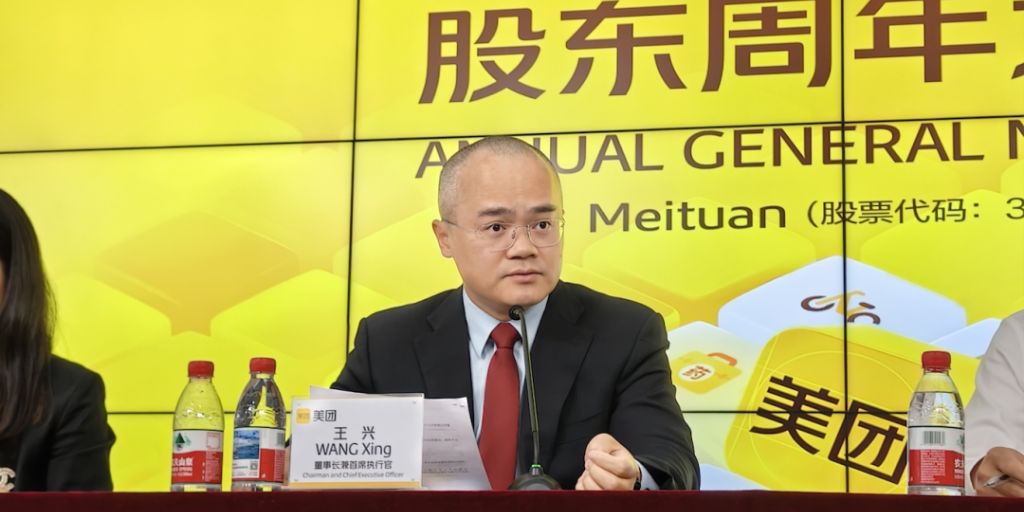
On 26 June 2026, Meituan held its annual general meeting in Hong Kong.
Facing the fierce subsidy war in the industry over the past year, as well as continued pressure on the share price this year, Meituan CEO Wang Xing, CFO Chen Shaohui and other members of management had an in-depth exchange with shareholders. Here is the transcript we translated from the executives’ Chinese responses in the Q&A part of the annual shareholders meeting. The views expressed here are those of the speakers and not of Momentum Works.
Q&A Session
Q1: The (Meituan’s) stock has already fallen below its issue price. How does management view the current share price, and what are your thoughts for the future? Are there any share buyback plans?
A1: Wang Xing – CEO
First, thank you all for attending the shareholders’ meeting. I am especially glad to see some familiar faces, which shows that quite a few companies have supported us for a long time.
On the share price, the performance this year, and even over the past few years, has indeed not been especially ideal. We feel a deep sense of responsibility. We will do our best to operate the company well where we can control the outcome. As for broader external factors, or some less rational moves by competitors, on the one hand we will actively respond, and on the other hand we also call on the whole industry to develop in a more rational way.
For Meituan, our company’s mission is very specific: to help everyone eat better. In this process, there have been changes in technology, industry growth, and our continuous progress in how we deliver orders. For example, from the earliest group-buying business to later food delivery; from food delivery as only a transaction business to building and running our own delivery network; from initially only delivering meals from restaurants to doing instant retail, which covers more categories, including medicine, flowers and supermarket goods. Around food, I believe there is still a lot of room.
The share price performance over the past few years is partly related to competition, and partly perhaps related to overall market liquidity. But these are not things we can control. What we can do is still to run the parts of the business that we can control well.
In food delivery and instant retail, we have seen that since the beginning of this year, the situation in several major areas has already been improving. The past year was a period of very intense competition. Irrational competition* set the entire industry back for nearly a year, but now things are finally gradually returning to the right track. On new businesses, **Xiaoxiang Supermarket (小象超市) is a very promising business. It is growing well, the economics of each order are also good, and user feedback is very positive. In how we use capital, we will actively exit some external investments when appropriate. For areas where the business outlook is still unclear but would require a lot of money, we will invest carefully and with financial discipline.
MW Note:*“Irrational competition” is referring to China’s quick commerce war, which Meituan fought mainly with Alibaba’s Taobao Instashopping since mid-2025.** Xiaoxiang Supermarket (小象超市) is Meituan’s instant retail grocery business, combining online delivery and offline stores to sell everyday supermarket goods with fast fulfilment.
A1: Chen Shaohui – CFO
This is also an issue that management pays great attention to and takes very seriously. Let’s face reality: The share price performance over the past period has certainly not been ideal, and there are multiple reasons for this. But what is more important is that we are very optimistic about the company’s core business. Although there are all kinds of risks, challenges and competition, we are very firm in our belief that what Meituan does creates enormous commercial value and social value. Today’s share price, in my view, seriously underestimates the value of the company’s core business.
We do intend to actively provide returns to shareholders, including through share buybacks. In fact, we have always regarded share buybacks as the main means of shareholder return. From January 2024 to May 2025, we bought back shares equivalent to about 4% of the company’s share capital, worth nearly US$3.6 billion in total.
In a more normal year, our plan is to at least cover the portion of shares issued for long-term staff incentives, which is roughly around 1%. That is the baseline. Last year was a cycle of relatively heavy investment and vicious competition, so after May we paused share buybacks. But we have kept thinking about and paying attention to what kind of timing would be appropriate. We have also continued to receive support from the board, with approval that allows us to act when the timing is suitable.
I would also like to add one point: the company’s share price will not ultimately be fixed by buybacks alone. Management spends more energy on improving the core business. We believe that Q3 last year may have been the worst moment. From the Q1 results this year, we can see the industry moving in a better direction. We will actively seize this time window and use a combination of improving the core business, share buybacks and other means to ultimately maximise returns to shareholders.
Q2: My first question is about AI development. Over the next three years, how do you think about using AI to help the business and the scale of capital spending? Many shareholders are worried that the company will make aggressive, large-scale investments in AI, hurting the core business. The second question is that the company has made some external investments in the AI industry. These companies have risen very strongly recently. What is the exit plan?
A2: Chen Shaohui – CFO
Meituan’s mission is “retail + technology”. Retail, including both goods and services, is a huge market, and technology can do a lot to improve it. Conversely, this market also pushes technology forward. We will accumulate a large amount of behavioural data, which it itself has a huge demand for. We are actively exploring autonomous vehicles and drones. Although they are not yet fully commercialised today, these efforts are exactly an example of the “retail + technology” strategy.
We believe that these types of minority stakes in innovative companies have both financial value and strategic value for Meituan. From a financial value perspective, assets related to AI can indeed receive higher valuations in the market. From a strategic value perspective, we hope Meituan will be the first leading company to apply AI in real use cases.
We currently hold shares in several very good innovative technology companies: about 12% in *Li Auto, about 3.9% in **Zhipu AI, and about 7.6% in ***Unitree Robotics. The value of shares we hold in these listed companies exceeds about RMB50 billion. Adding the shares in unlisted companies, based on book value, the total exceeds RMB65 billion.
For companies that are already listed, after the shares are no longer locked up, we will actively consider selling some shares. We will take into account how easy it is for the company to sell, the market environment, whether valuations are reasonable, and short-term funding needs, including the split between money inside and outside China. Overall, we will treat this as a very important part of our overall portfolio and weigh it based on overall ROI.
MW Note: *Li Auto (NASDAQ: LI) is a Chinese electric vehicle company best known for family-oriented premium SUVs.; **Zhipu AI (HKG: 2513) is a Chinese AI company behind the GLM family of large language models.; ***Unitree Robotics (HKG: 9880) is a Hangzhou-based Chinese robotics company best known for its low-cost robot dogs and humanoid robots.
A2: Wang Xing – CEO
On AI, I have to answer in several parts.
First is the impact on the company’s existing businesses. All companies have to face two questions: how to use AI in products, and how to use AI in day-to-day work. The shift to AI is not optional. It is something every company has to answer. Today’s AI is different from the simple chatbots of three or four years ago. After agents emerged, their power exceeded most people’s imagination, and they will have a major impact on day-to-day work. This is quite a major transformation.
Second is how to use AI in products. We have made active attempts, including the *”Xiaotuan” function in the Meituan app. But at present, we have not yet seen the most explosive results. I believe that in the future, typing will become less common and voice will become more common.
Third is how we spend capital. As we shift toward AI, AI usage itself can consume a lot of tokens. Whether we should have our own capital spending to set up our own computing capacity or buy AI usage from outside providers is something we are actively evaluating. At present, we are using both. We will take into account the company’s own cash flow situation, and will not blindly make investments that exceed our financial capacity. We still believe AI is a very positive productivity tool and will invest within our ability, but we will not make reckless investments beyond our financial capacity.
MW Note: *Xiaotuan (小团) is Meituan’s AI assistant.
Q3:Please introduce in detail the development strategy and potential of Xiaoxiang’s darkstores, offline stores and Happy Monkey. Also, I live in a tier 4 city and often buy from Xiaoxiang after it opened, but I feel the product quality is somewhat lacking. For example, nuts can be damp, and there are quite a lot of additives in breakfast items. How does the company plan to improve product quality?
A3: Wang Xing – CEO
Thank you very much for supporting the Xiaoxiang business. I personally also like Xiaoxiang’s service very much. My whole family are loyal Xiaoxiang users. My mother is even more extreme. In Beijing, she buys two orders every day, averaging more than two orders per day. Instant retail has already changed people’s shopping habits in a very real way.
Xiaoxiang’s overall strategy is to combine online and offline, with both sides supporting each other. Last December, we opened the first offline Xiaoxiang store in Wanliu, Beijing. In April this year, we opened the second store in Ningbo. There will be several more stores opening this year. The reason we believe the next generation of supermarkets needs online-offline integration is that online can cover cities broadly, have dense locations, and deliver quickly, but there are still some needs where seeing things offline is more helpful. When you walk into a store, the product presentation you can see is better than on any mobile phone screen, and you can also smell things. After visiting, you will have more confidence in the brand quality of Xiaoxiang Supermarket, and when you repurchase, you can order directly on your phone.
Another important trend is that this model can work in more cities. At least county-level cities in developed regions and prefecture-level cities in other regions have consumption power, because this is not a luxury business. It is a daily supermarket business.
On product quality, I very much agree that there is still a lot of room for improvement. China now has very strong production capacity. How to use good distribution channels to bring good things to consumers is not something that can be achieved only by an online platform business. The less standardised a product is, the more that if everyone only competes on price, eventually the competition will go below the acceptable limit. We hope to build a good environment where people do not only look at price, but can make choices across more dimensions.
Everyone knows that Sam’s Club has been very popular in recent years, but Sam’s supply chain is also mainly domestic. China’s supply chain serves Chinese consumers. What is needed in the middle is a good commercial entity. We believe there is a major opportunity here.
As for Happy Monkey, it follows a community supermarket route with a high proportion of private-label products and fewer SKUs. Each Happy Monkey store is about 700 to 800 square metres, located in communities and serving nearby users. Through fewer SKUs and a high proportion of private-label products, it achieves extreme cost-performance. The product positioning of the two businesses will have some differentiation.
In the past, the largest local supermarkets in China reached around RMB100 billion, but the overall market is very large. Walmart in the US has annual sales of US$600 billion to US$700 billion. China’s overall consumption is roughly comparable to that of the US. In the future, leading players can reach a scale of several hundred billion RMB or even more than RMB1 trillion. So Xiaoxiang will expand rapidly, strengthen its product supply chain capabilities, and achieve broader regional coverage by opening online and offline stores at the same time.
Q4:Competition between Meituan and Taobao Instashopping in food delivery is very intense. Can you introduce the latest competitive situation? What are Meituan’s advantages, and why can it maintain a significant lead over Taobao Instashopping? Also, can food delivery be profitable this year?
A4: Chen Shaohui – CFO
From last year to now, for more than a year, competition has been quite crazy. Based on our rough calculation, the entire industry may have invested RMB200 billion, which is an astronomical figure for many industries. We strongly oppose this kind of ineffective involution: low price and low quality, mainly using subsidies to acquire traffic, which does not bring incremental value to the industry beyond subsidies, and even to some extent disrupts and damages the operations of merchants and the industry.
After this round of noise, we see things more clearly. Meituan still clearly maintains its overall leading advantage in food delivery and instant retail. It is still the absolute number one brand, and the first choice for users and merchants. We believe that for truly valuable orders above RMB30, we have maintained a market share of more than 70%. In this process, the gap between peers and us in the unit economic model has in fact widened rather than narrowed.
This process also reflects the competitive barriers of the business. This competitive cycle was an extreme stress test of the business’s barriers and moat. Under this level of investment, maintaining such a position is a relatively convincing answer. For the leader, this business still has extremely strong network effects and scale advantages. User repeat purchase and retention are significantly better than the second and third players.
We have also gone deeper into the industry chain and operated some core categories ourselves, better combining the platform business and the self-run business to provide users with a more comprehensive set of choices. In the long term, we are very confident about the development prospects of the industry after it returns to rationality.
Q5: Last year’s involution had a major impact on our company’s external policy. I would like to ask how this year’s overseas strategy is being planned.
A5: Wang Xing – CEO
Among Chinese internet companies, Meituan is relatively late in overseas expansion. We began preparations at the end of 2022. In May 2023, Keeta opened in Hong Kong. In 2024, we opened in Saudi Arabia. In 2025, we entered some other countries in the Gulf, including the UAE, Qatar, Kuwait and Bahrain. At the end of 2025, we opened in Brazil.
The more the environment changes, the more we need to focus. At the overall company level, we will do more around instant retail. Some other small overseas use-cases we had before, such as power banks (rental), have already been shut down. Overseas, we are focusing on instant retail.
As for which markets we enter, we will not rush into new markets blindly, but we have achieved good results in the regions where we have already expanded. We entered Hong Kong in May 2023 and became number one by number of orders within one year. By October last year, we achieved positive unit economics ahead of schedule. It took less than two and a half years from launch to reach a more stable position. In some countries in the Middle East, the improvement trend is even faster. Brazil is a very large market. We are using São Paulo as the initial point to get familiar with the local environment. Overall, overseas we will continue to invest steadily and carefully, but it will not be a very aggressive push.
Q6: First, over the past five years, what wrong paths does Meituan think it has taken? Second, regarding AI in the physical world, the combination between autonomous vehicles and robots, what improvement can this bring to Meituan’s efficiency in the future? Is there any way to quantify it?
A6: Wang Xing – CEO
Thank you to shareholders who have supported us so firmly. We feel an even greater sense of responsibility. Personally, since Meituan was founded in 2010, I have never sold any shares. There were previous records showing that I had sold shares because in 2021 I donated 10% of my personal shareholding to a charitable foundation. This was entirely for charitable purposes. The foundation needed to gradually sell some shares to have money to support public welfare projects. But personally, I have not sold a single share.
On reviewing the past few years, I want to talk about two things.
First, what we should have done but did not do: go overseas earlier. Looking back, perhaps we should have gone overseas earlier, especially before the pandemic, at the end of 2018 or in 2019. During the two years of the pandemic, overseas penetration rates rose rapidly, and we missed the stage when foreign penetration rates increased quickly during the pandemic.
Second, a reflection on *Meituan Select. As everyone knows, we worked very hard on Meituan Select and invested a lot of resources, but in the end did not achieve better results. Meituan Select was an attempt in our “broader retail” direction. It was not expansion without limits. It was always centred on Meituan’s mission. In 2020, we saw that the community group-buying model had very high delivery efficiency and explosive growth potential. We entered in July that year, and by last year, over nearly five years, there had been a large amount of investment.
But the reason it did not achieve results sufficiently in line with expectations is that this field is the market that competes most on cost-performance and is most sensitive to price. The less standardised the products are, the more that everyone only competes on price, eventually (it) will go below the acceptable limit. We also do not want to do things below the acceptable limit. After several years of effort, once we saw this clearly, we felt we needed to change the model. Happy Monkey, to some extent, continues what Meituan Select wanted to do, but uses a different model. It achieves extreme cost-performance by going deep into the supply chain, rather than only operating a platform where sellers compete and push prices below the acceptable limit.
MW Note: *Meituan Select is Meituan’s community group buy initiative.
Q7: Consumer retail data in April and May this year was not very ideal. I would like to ask whether this will put pressure on the company’s in-store, hotel, and travel business. Facing intense competition with Douyin, in the short term, should the company protect market share and growth, or protect profit? Also, what is the outlook for in-store, hotel, and travel after 2026?
A7: Chen Shaohui – CFO
By today, we see Douyin and Meituan increasingly showing different kinds of competition in this area. The natural strengths of the two platforms are very different. One is naturally a content and entertainment platform. The other is a platform centred on one-stop local services.
In Meituan’s core products, what we provide merchants is a one-stop set of tools and services. For users, it is a combined experience that includes content, continuous discovery, and a full membership system connected with the merchant system. This is a truly distinct value. On investment, we will pay more attention to ROI and will not make ineffective investments purely to chase order share. At present, the in-store, hotel and travel segment still maintains a profit margin of between 20% and 30%. There are some seasonal fluctuations in different seasons, but it is in itself a very good business.
I would like to add one point. We hope to view in-store and instant retail together as an integrated one-stop lifestyle platform. This is a relatively unique overall advantage of Meituan. We have frequent user traffic from food delivery and instant retail. This traffic is location-based local traffic, and is highly targeted for merchant marketing. In terms of total traffic volume, Douyin is definitely higher than Meituan, but Douyin’s traffic is broader and less tied to local purchases. It is more suitable for some specific areas, such as one-off low-price marketing promotions.
To give one detail, we have now launched many “安心服务” (peace-of-mind) services, so that users can consume with greater peace of mind. This is not just about pushing traffic to merchants. Very early on, in the early days of Meituan’s group-buying business, we were among the first to introduce unconditional refunds, so that users could consume without worries. We believe that by being a lifestyle services platform that continuously innovates, keeps bringing online and offline services together, and continuously makes use of platform advantages, Meituan will maintain its advantage in this area over the long term.
Q8: I have noticed that 50% to 60% of the people in our residential compound’s elevators are riders and delivery personnel, while elevator maintenance is the largest expense for the compound and requires use of the maintenance fund. Delivery frequency is now getting higher and higher.
People place an order for something worth RMB10, which is effectively transferring the cost to homeowners in the compound. Also, there are more and more motorcycles in Beijing now, meaning food delivery riders. From a social perspective, with so many motorcycles occupying traffic resources, what is the long-term meaning for society? The vision of “everything delivered to home” may hit a ceiling in the physical world. Xiaoxiang opening offline stores may be the right move.
Meituan’s current model is a product of the later stage of mobile internet. What is the biggest change in the AI era? It is to become the consumer’s brain. Today, the relationship between consumers and Meituan is a client-provider relationship. But in the AI era, Meituan should help me make decisions. I only need to confirm, and you deliver the items. Alibaba has signed a strategic cooperation agreement with Midea to implant large models into Midea’s home areas and capture customer needs, such as when the refrigerator needs restocking, then make suggestions, the customer confirms, places an order with one click, and delivery happens immediately. Competition in the AI era depends on whether you can become the customer’s brain or the assistant to the customer’s brain. I would like to ask Mr Wang for his thoughts on this.
A8: Wang Xing – CEO
There are not many short-term actions yet, but there is some long-term thinking. The idea of actively identifying demand through smart home devices was not something first proposed by Alibaba and Midea today. Ten years ago, Amazon’s Alexa, and even earlier attempts, had already explored this direction. But whether this can be pushed forward still depends on many practical implementation factors: whether it is accurate, whether the costs make sense, and so on. Amazon also made many attempts back then, and later, when it became more focused, many of those attempts were shut down. The direction is right, but the specific implementation will take time.
The changes brought by AI are enormous. Today, people still use it more on mobile phones, but the phone may not be the most natural device for AI. Typing is definitely an unnatural thing. In the future, there may be more voice commands and more other forms. Smart homes, smart glasses, earphones and other wearable devices all have many possibilities in the future.
In this process, we maintain an open mindset in understanding these developments. It is impossible for us to do everything ourselves, so we will do the things we can do well as much as possible, and cooperate more where we can. Part of our outside investment is precisely to understand the newest areas of development and which of them can combine well with us. We will continue to improve delivery efficiency, product variety and pricing, which already have a certain scale but still have a lot of room for improvement. At the same time, we will maintain an open mindset toward new ways users may access services through AI and try them out. In the short term, I do not think this will become the most disruptive thing yet, but this direction is very worth continued attention and preparation.
[THE END]
Disclaimer:
This translated transcript was compiled by Momentum Works from a publicly available Chinese-language transcript of Meituan’s 2025 annual shareholder meeting. It is intended for informational and analytical purposes only. The translation may contain unintentional errors, omissions, or differences in wording from the original remarks.
All original spoken content belongs to Meituan and the respective speakers. Please refer to Meituan’s official announcements, filings, or recordings for authoritative reference.
Any analysis or commentary by Momentum Works is independent and does not represent the views of Meituan or any other organisations mentioned.