



This series is adapted, with permission, from a Chinese-language series by our friend Marcus Ji, who looks at historical events through an economic lens. We have condensed and adapted the original for an international audience.
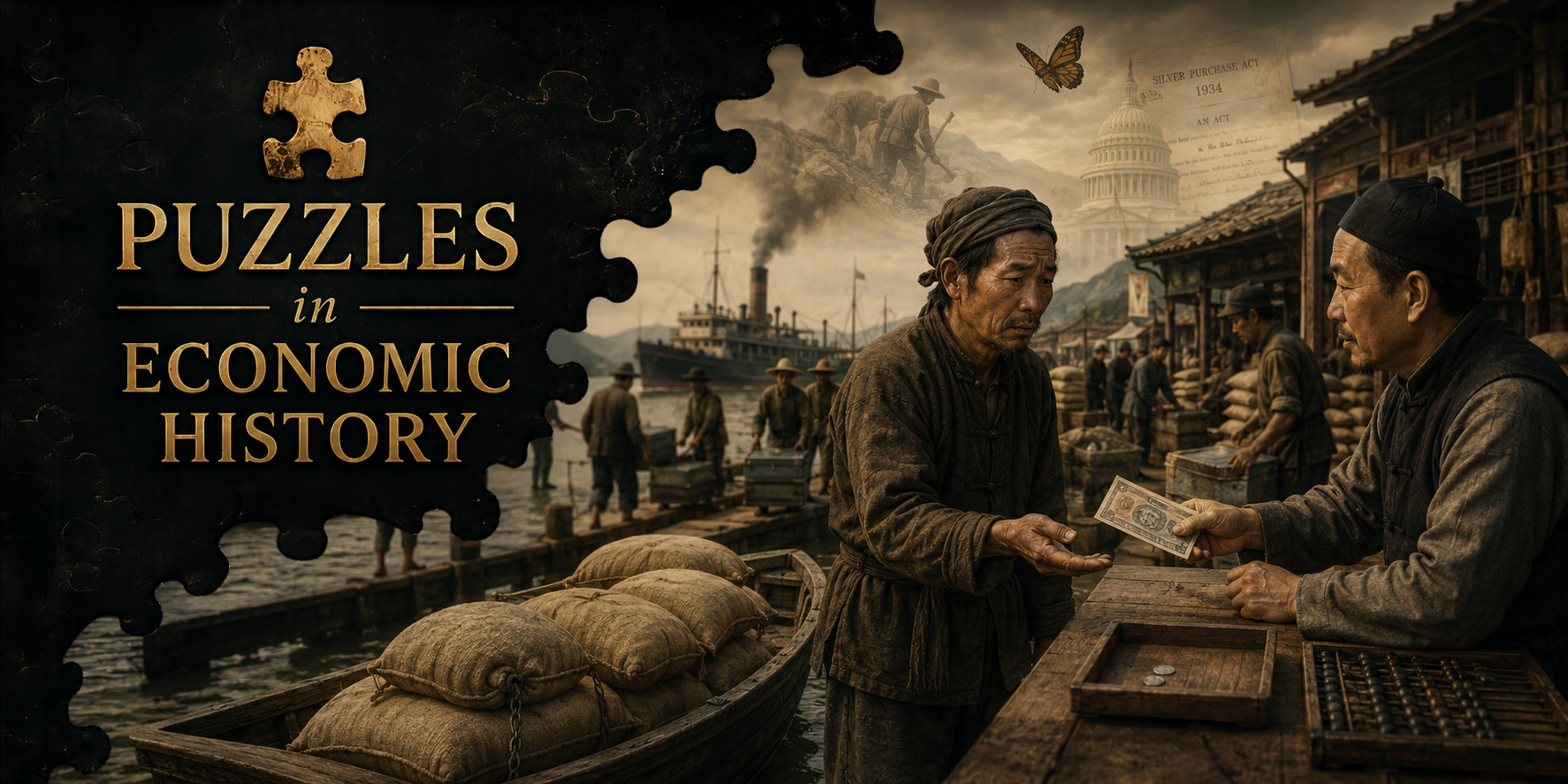
There is a short story that virtually every Chinese schoolchild reads. Written by Ye Shengtao in 1933, it follows a group of farmers in Jiangnan – the fertile rice country around the Yangtze river delta, near today’s Suzhou and Shanghai – who row their boats, loaded with a bumper harvest, to the local rice merchant. Last year rice fetched 7.5 silver dollars a picul (about 50 kilograms, or 110 pounds), and only six months earlier it was 13 silver dollars. The merchant’s offer this morning is 5. By the end of the day, after rent and debts are settled, a year of work has evaporated – as the story puts it, “not half a banknote in their pockets was their own.”
Generations of readers have taken a simple lesson from the story: good harvests can ruin farmers. But there is a much stranger story hiding inside it.
You have probably heard of the butterfly effect – the idea from chaos theory that a butterfly flapping its wings on one side of the planet can, through a long chain of amplifications, stir up a hurricane on the other. It is usually offered as a metaphor, and a loose one. What happened to these farmers in 1933 and 1934 is the real thing, traceable link by link. The butterfly was a handful of silver-mine owners in the American West who wanted a better price for their metal. The hurricane made landfall at a rice counter outside Suzhou. And the people it landed on never saw any of it – not the mine owners, not the law they lobbied for, not the ocean of finance in between. What reached them was a single number on the counter, with no explanation attached.
To see how a wing-flap becomes a hurricane, you have to follow the wind through each stage. There were two currents, and they arrived together.
The first current: the U.S. Great Depression
On the surface, a stock market crash in New York should have had nothing to do with a Chinese farmer in Jiangnan who sold his rice to a merchant in the next town. The connection becomes clear once you notice what these farmers actually lived on.
Rice was for eating and paying rent. The cash in a Jiangnan farming family’s life came from silk, cotton and tea – export goods, sold through Shanghai trading houses to customers in Europe and America. When the Depression put a quarter of the Western world out of work, demand for fine silk simply vanished, and Chinese silk exports roughly halved within a few years. The farmers’ one pipeline to cash was severed.
But the obligations denominated in cash did not vanish with it. Rent was still due, debts still accrued, mutual-aid society dues still had to be paid. With silk and cotton unsellable, the only thing a farming family could still turn into money was the grain in the barn. And so everyone in the district arrived at the same conclusion in the same few weeks of the harvest season, and pushed their rice onto the market at once. Economists call this distress selling – selling not because you have too much, but because you owe. A thousand boats converging on the same counters in the same fortnight could only end one way. The merchant in the story says as much: “rice is pouring in from everywhere like a tide; in a few days the price will fall further.”
So the Depression’s role was indirect but decisive. It did not flood China with foreign goods; it cut off the countryside’s cash supply and forced a synchronized fire sale, turning abundance into catastrophe.
The second current: a U.S. silver law
The second current is the one almost nobody in the story could have named, and it is the heart of the piece. To follow it, hold on to one fact: China’s money was silver. The United States, Britain and Europe were on gold. One world’s currency was the other world’s commodity.
On June 19, 1934, Roosevelt signed the Silver Purchase Act, directing the US Treasury to buy silver on world markets until its price rose dramatically. China did not figure in the law’s logic at all. This was domestic politics of the most parochial kind: senators from a handful of Western silver-mining states wanted a better price for their constituents’ metal, and they had the votes. One historian’s verdict captures the scale of the unintended consequence: this now-forgotten statute weakened China almost as much as the Imperial Japanese Army did.
What followed was as mechanical as the weather. America bid up the world price of silver; China’s silver – which is to say, China’s money – became worth more abroad than at home; and so it flowed out. In 1934 alone, 257 million silver dollars left the country. When a nation’s money supply drains away, the result is deflation: prices fall, whoever holds cash wins, and every existing debt quietly grows heavier, because it must be repaid in scarcer, more valuable money. The drain also ran from the inside outward – silver moved from the villages to Shanghai, and from Shanghai out of the country – so the countryside was bled first. By early 1935, banks were refusing to lend, factories were closing, and Shanghai was seeing bank runs and a property collapse.
Now go back to the story, to a line that is easy to read straight past. The merchant refuses to pay the farmers in silver dollars, offering only banknotes: “We have no silver here, only paper.” In a literature classroom this sounds like a merchant’s petty stinginess. Against monetary history, it is the nerve ending of an entire currency system failing: the physical silver genuinely was not there anymore. Inland banks at the time were issuing notes against silver reserves that had fallen to dangerous lows – the rice shop was simply the last, smallest segment of the great straw.
Here is what makes the story remarkable as a document. Ye Shengtao wrote it in 1933 – a year before the Act, as the early stages of the drain were already being felt. He could not have known about a law that did not yet exist, much less traced the route from Washington through the London silver market to a Suzhou rice counter. He simply recorded, with a novelist’s honesty, what happened when a farmer held out his hand: he asked for silver, and received paper. Statistics can tell you that 257 million silver dollars left China in a year. Literature shows you the farmer’s open palm.
The half-true scapegoat: cheap foreign rice
The merchant does offer the farmers an explanation for the price – and it is the most interesting move in the story. He blames foreign rice: shiploads of it arriving on ocean steamers, flooding the market, nothing anyone can do. The narrator notes drily that foreign rice and foreign ships were distant things the farmers could hardly argue with.
The natural assumption is that this was an invented excuse. It was not. Cheap rice from Burma, Siam and Vietnam really was pouring in through Hong Kong and Shanghai – grown on vast, freshly cleared colonial river deltas at a fraction of Jiangnan’s cost, and carried by steamers so large that crossing an ocean cost less per kilo than moving rice a hundred miles overland inside China. The imports were real, and they were pressing on the price.
So the merchant was not lying. He was doing something more effective than lying.
“Foreign rice is cheap” was true. “Blame foreign rice” was false – the imports were a real but secondary pressure, while the force that had actually emptied the farmers’ pockets was the invisible one draining silver out of the countryside. And this is precisely what made the excuse indestructible. A fabricated villain eventually gets exposed. A half-true villain never does. The farmers had seen the foreign ships with their own eyes; the culprit was concrete, foreign and satisfying, and once anger finds a target like that, it stops searching. No farmer on earth could have reasoned his way from “I got two dollars less per picul today” back to “mine owners in Nevada lobbied Congress.” The true-but-minor cause absorbed all of the rage. The decisive cause ran on, untouched and unnamed.
The story even hands us proof that the merchant’s helplessness was theater: in one breath he pleads that the market has overwhelmed him; in the next he mentions that the district’s merchants have agreed on the price among themselves. Both cannot be true – a buyer genuinely at the market’s mercy cannot fix prices. The structural pressures were real; the cartel simply passed all of them through to the people with no bargaining power, while pointing at the ships on the horizon.
The whole hurricane, from wing-flap to landfall
Assemble the chain now, and watch the wing-flap grow.
A few mine owners in the American West want a better price for silver. They lobby Congress. Roosevelt signs the Silver Purchase Act in June 1934. The US Treasury buys silver around the world, and the world price rises. China’s money drains out of the country – a quarter of a billion silver dollars in a single year – and the countryside falls into deflation, debts hardening as prices fall. Meanwhile the Depression has already severed the farmers’ cash pipeline, forcing whole districts to dump grain at harvest. Meanwhile cheap rice from (primarily colonial) Southeast Asia arrives by steamer and presses on the price. And at the end of every one of these threads stands the local rice cartel, which gathers them all into a single number and lays it on the counter: five.
That is the butterfly effect without the poetry: a system so connected that a lobbying campaign in Washington can decide whether a family outside Suzhou keeps any of its harvest – and so opaque that the family will go to their graves blaming a ship.
The machine is still running
The reason to understand this machine is not sympathy for farmers who suffered almost a century ago. It is that the machine has not retired; it just recasts its parts.
Today’s men in the boats may well be ride-hailing drivers. Autonomous vehicles push the marginal cost of a ride toward electricity and depreciation, and they do not need to replace every driver to break the market – capturing perhaps 15-25% of a city’s rides, the price-sensitive segment, is enough to collapse the pricing floor for everyone, the way a single low-cost airline reprices an entire route. No drivers’ alliance can hold a line against a competitor whose marginal cost is near zero. And when it happens, the drivers will very likely be handed their own half-true scapegoat – “the platform’s take rate,” which is real, but the accessory rather than the principal – while the structural force runs on unnamed. The same storm, on a faster clock.
What is worth carrying away? Prices tell you results, never reasons: some meaningful share of your salary, your rent and your portfolio is the echo of decisions made somewhere you cannot see. An explanation that feels instantly satisfying – of course, blame them – deserves your suspicion in direct proportion to its smoothness, because the most durable scapegoats are the half-true ones. And seeing the machine clearly will not, by itself, save anyone – the farmers’ rent was due regardless of what they understood – but the ones who cannot see it end up on the dock, shaking their fists in the wrong direction. Whether the people displaced by each great shift land softly has never depended on their individual cleverness. It depends on whether someone built them a structural exit.
Ye Shengtao was not really writing about 1933. He was writing about everyone, in every era, who gets run over by an invisible machine and handed a visible scapegoat.
A hundred years on, the boat is still on the water.
Previously in this series: Why did Dickens’s father go to prison for £40 – while Trump went to the White House?
Next in this series: How did Isaac Newton become a failed investor?