





This series is adapted, with permission, from a Chinese-language series by our friend Marcus Ji, who looks at historical events through an economic lens. We have condensed and adapted the original for an international audience.
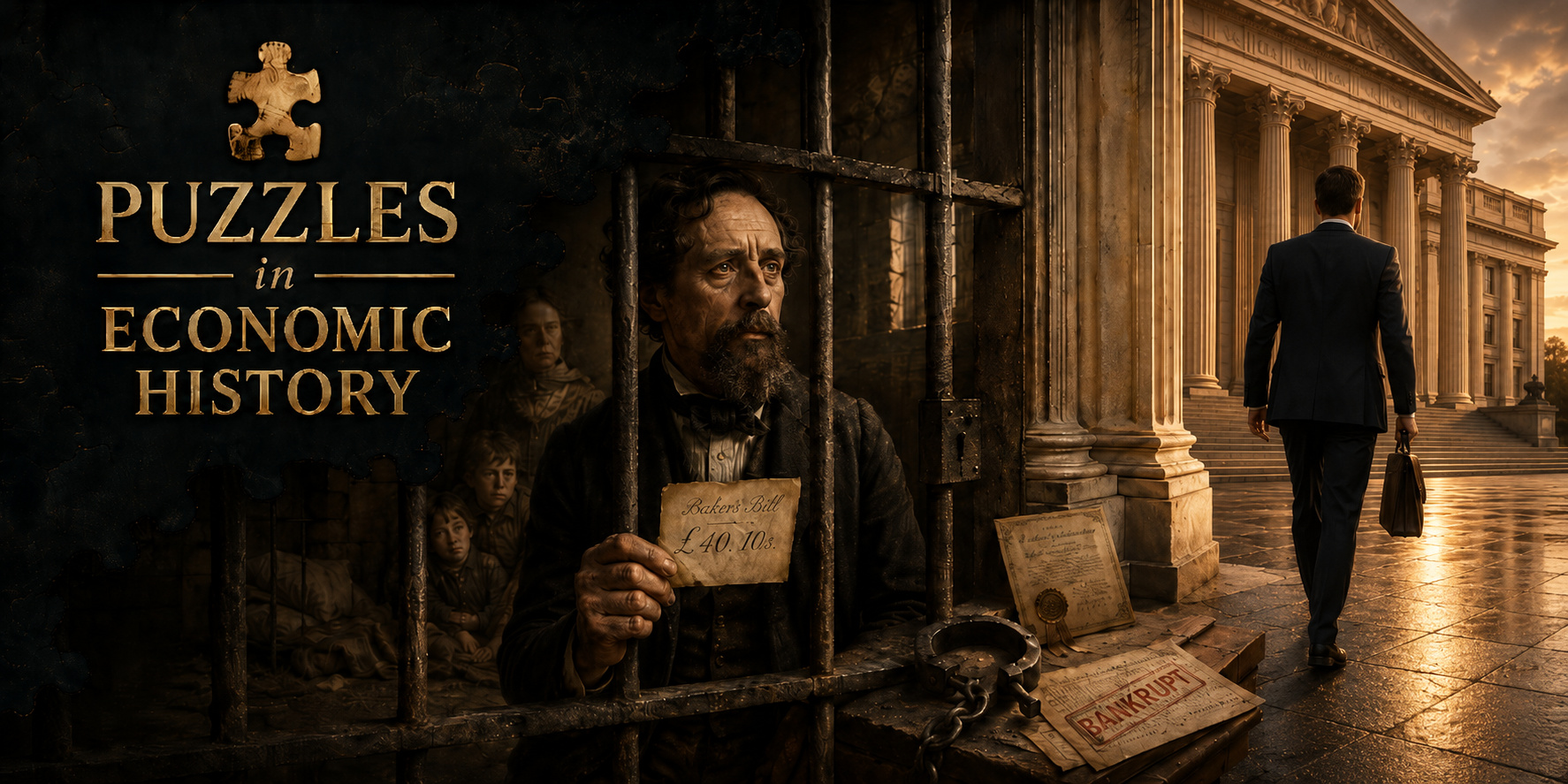
In 1824, a man named John Dickens was imprisoned for owing a baker £40 and 10 shillings he could not repay. His wife and youngest children moved into the Marshalsea debtors’ prison with him; his 12-year-old son Charles was sent to work in a boot-blacking factory. That son became one of the greatest novelists in history, and put his father – forever borrowing, forever hopeful, forever in prison – into David Copperfield as Mr. Micawber.
Nearly two centuries later, another man’s hotel and casino companies filed for bankruptcy six times between 1991 and 2009, with debts running into the billions. His personal fortune survived intact. He was twice elected President of the United States.
Same human situation: borrowed far more than he could repay, and couldn’t pay. One man lost his freedom and his family’s future over a baker’s bill; the other kept his wealth, kept his reputation – arguably enhanced it – and reached the most powerful office on Earth. The difference is not character, not the amounts, not even ability. Between the two men stand three legal inventions that quietly rewrote what “failure” costs.
Five thousand years of the body as collateral
For most of recorded history, an unpayable debt was not a financial event. It was a crime, payable in flesh, freedom and family.
The earliest written debt law – Hammurabi’s code, ~1750 BC – allowed a creditor to seize the debtor, his wife or his children for forced labor. Note, though, the two limits: a maximum of three years, and no killing. Humanity’s first debt law already drew a boundary around the creditor’s violence; that boundary is where civilisation on this subject begins.
Rome went further. The Twelve Tables (450 BC) prescribed a timetable: thirty days after default, the debtor could be hauled to court, chained with irons of no less than fifteen pounds, and after sixty days sold into slavery across the Tiber. One clause – partis secanto – appears to permit multiple creditors to divide the debtor into pieces; scholars have argued for two millennia over whether it meant his body or merely his assets. Either way, the principle was explicit: the debtor’s person was the final collateral. It took a scandal – a creditor’s abuse of a young man handed over for debt – to trigger the Lex Poetelia in 326 BC, history’s first partial decriminalisation of debt.
Imperial China reached the same place by a different road: the state itself served as debt collector, folding default into criminal law. Under the Tang, late repayment earned floggings on an escalating schedule; under the Song, if the debtor’s labor wasn’t enough, every male in his household could be conscripted. Cruelest of all was the pricing: labor was credited against debt at rates so low that a debtor’s daily work often couldn’t cover the daily interest. The harder you worked, the deeper you sank – de facto permanent bondage. West and East differed on method (private seizure versus state machinery) but agreed on essence: insolvency was a moral crime, and the sentence fell on the whole family.
The Marshalsea: a machine that manufactured debt
Debtors’ prison, the system John Dickens fell into, is best understood not as punishment but as a collection technology. The explicit purpose, per Britain’s National Archives, was leverage: the shame of a father in prison was expected to make his relatives open their wallets. That’s also why whole families moved in – a debtor alone in prison leaves relatives outside who might hide assets or flee; a family inside is a live pledge. More than nine in ten debtors were released only because someone outside paid.
The darkest feature was that the prison generated debt. Interest on the original obligation kept accruing – and the Marshalsea itself charged fees: admission fees, bedding fees, weekly rent (up to 22 shillings 6 pence, collected privately by jailers – more than an ordinary worker’s weekly wage), release fees, even a “garnish” extorted by older inmates from new arrivals. Food and beer had to be bought from the prison’s operators above market price. Records show prisoners whose original debts had been fully settled remained locked up because they couldn’t pay their accumulated prison debts. A 1729 parliamentary committee found roughly 300 prisoners had died in the Marshalsea within three months, eight to ten per day at the summer peak, mostly of starvation and disease.
This was what “can’t pay” meant in the pre-modern world: not bankruptcy – a slow death penalty. The Dickens family escaped after about fourteen weeks only because John’s mother happened to die and left roughly £450, just enough to clear everything. “Something will turn up,” Micawber’s catchphrase, wasn’t a comic invention. It was the family’s actual survival strategy, transcribed.
The modern Micawber who never went down
Now jump two centuries, back to the man in the opening.
Trump’s casino and hotel businesses filed for bankruptcy six times between 1991 and 2009. But look closely at how, because every detail matters. He himself never went bankrupt – all six filings were made by companies he held shares in. When those companies collapsed, their creditors could pursue the companies’ assets – and could not touch his house, his other businesses, or his personal fortune. And the companies themselves weren’t dismantled: they entered “Chapter 11,” an American legal procedure that lets a failed business keep operating while its debts are reduced and rescheduled, with Trump giving up slices of ownership in exchange for softer terms. He has been entirely candid about all of it: “I’ve used the bankruptcy laws – they’re very good for me,” he told an interviewer in 2011.
One precision, in fairness: the US abolished debtors’ prisons in 1833, so Trump was never going to share John Dickens’s cell under any legal regime. The real contrast is economic substance. Under the rules of 1824, a six-time-failed, billions-in-debt casino owner would have been stripped by his creditors down to the last asset and permanently finished as a borrower and a brand – an ending economically indistinguishable from John Dickens’s, just without the bars.
So what actually stood between the two men? Not virtue, and not luck. Three legal inventions, built across roughly seventy years – worth understanding one by one, because together they are the operating system every founder and investor works inside today.
The three inventions that repriced failure
Invention one: you can only lose what you put in. This is limited liability (Britain, 1855), and it’s now so familiar that it’s hard to see it was ever invented: when you buy shares in a company, the most you can ever lose is what you paid for them – the company’s debts belong to the company, and its creditors cannot reach your home or savings. Before 1855, the opposite was true. Put £100 into a shipping company, and if it collapsed owing £1 million, creditors could take everything you owned. Only the very rich dared invest at all. The reform was fiercely opposed as immoral – a scheme for merchants to escape their debts – and its greatest defender, the philosopher John Stuart Mill, made the argument that still stands: without it, ordinary savers can never participate in capital accumulation, and wealth must concentrate among the few who can bear unlimited risk. This is the invention that built the wall around Trump’s personal fortune.
Invention two: not paying became a misfortune, not a crime. The US abolished imprisonment for debt at the federal level in 1833, France in 1867, Germany in 1868, England in 1869. (It still isn’t universal – Greece’s courts only struck down imprisonment for tax debt in 2008, and some jurisdictions jail civil debtors today.) The economic meaning runs deeper than mercy: when the worst outcome of a failed venture is losing your property rather than your freedom, the risk of starting something collapses from unthinkable to calculable. This is the invention that closed the Marshalsea.
Invention three: the right to start over. England’s first bankruptcy law (1542) treated the bankrupt as a criminal – punishable, in extremes, by death. The modern idea – surrender your assets, wipe the remaining debt, begin again – first appeared in 1705 and matured through America’s bankruptcy acts into today’s system. Chapter 11, the procedure Trump’s companies used six times, is this idea applied to businesses: restructure and restart, instead of liquidation to the last penny. The effect on innovation now has hard evidence: a 2024 NBER study of 33 countries found that after bankruptcy laws were reformed in the debtor’s favor, patent filings in affected industries rose 27.6%, citations to those patents rose 33.5%, and first-time inventors rose 24.1% – gains driven by small young firms, not incumbents. Disruption comes from small, risk-taking founders – exactly the people who borrow against personal guarantees and therefore fear “failure = personal catastrophe” most. (Walt Disney borrowed against his own life insurance policy to make his early films.)
One honest caveat Marcus insists on: none of this flipped like a switch. Limited liability took nearly half a century to become the mainstream form of British business. These were accelerators that spread slowly – but the direction, once set, never reversed.
What this prices, and what it costs
A society’s tolerance for failure directly prices its appetite for risk. America’s position as the world’s startup capital owes something real to the 1978 bankruptcy code: a failed founder can liquidate in months, discharge most unsecured debt, and borrow again within years. Germany, whose pre-1999 regime kept bankrupts under court-supervised repayment for up to seven years, had a correspondingly cautious founder culture – and the NBER data show its patenting rose after reform. Readers building in Asia will recognize the live version of this question: China still has no national personal bankruptcy law (Shenzhen began piloting one in 2021), which means “unlimited personal liability” remains a real possibility shaping founders’ risk calculus – and arguably the region’s deep cultural shame around debt is itself the residue of those centuries when the state flogged defaulters.
The counterweight belongs in the same breath: pro-debtor rules are not free. Every discharge is a creditor’s loss – Trump’s six restructurings were paid for by bondholders, banks and unpaid small suppliers – and easier discharge means pricier credit for everyone. The NBER authors’ conclusion is that the restart effect has dominated recent reforms, but it is a balance to calibrate, not a dial to turn up forever.
Five thousand years of debt-punishment history reduces to one question a society must answer: is “can’t pay” a misfortune, or a crime? Societies that answered crime built iron chains, family imprisonment and the Marshalsea – and got Charles Dickens’s childhood. Societies that answered misfortune built limited liability and Chapter 11 – and got a man who failed six times and twice won the presidency. How a society treats its failures determines how many successes it produces. What separates us from 1824 is not an improvement in human nature. It is a set of inventions – and inventions can be unmade.
Previously in this series: Did the Dutch really invent the modern company?
Next in this series: How did a US law destroy China’s economy in 1934?