


This series is adapted, with permission, from a Chinese-language series by our friend Marcus Ji, who looks at historical events through an economic lens. We have condensed and adapted the original for an international audience.
Business history’s first lesson is always the same sentence: “1602, the Dutch East India Company (VOC) – the world’s first joint-stock company.”
The year is fine. The word “first” is not. The truth is that the modern company had no inventor. Its components – tradable shares, limited liability, a board of directors, a secondary market, bank clearing – were not conceived by anyone in Amsterdam in 1602. They were built by Italians, Frenchmen and Flemings over the preceding four centuries, each for a completely different business. What the Dutch actually did was assemble old parts, scattered across Europe and never before in one place, into a single machine – and even the assembly wasn’t designed. It was forced, patch by patch, by cash-flow crises.
The oldest “company” is 650 years old – and still generating electricity
The earliest entity that genuinely qualifies as a modern company wasn’t a trading house and had nothing to do with the age of sail. It was a row of grain-grinding watermills on the Garonne river in Toulouse: the Société des Moulins du Bazacle, chartered in 1372 and continuously operated until nationalised by France in 1946 – a lifespan of 574 years, nearly three times the VOC’s. Stranger still: it never really died. In the late 19th century the mills converted from grinding flour to generating hydropower, and the turbines on the original site still feed the French grid today under EDF. A 14th-century company supplies 21st-century electricity.
Economic historians (Goetzmann and colleagues at Yale/NBER, working from a 12-foot parchment scroll and centuries of surviving ledgers) verified that this medieval mill had virtually the complete modern toolkit: freely tradable shares whose price fluctuated with profits; independent legal personality; limited liability for shareholders – five hundred years before it became a general legal right in Britain and America; and an annual shareholders’ meeting electing directors, with regular audits. Dividends were initially paid in flour; the long-run real return worked out to roughly 5% a year, almost all from dividends – precisely the profile of a modern high-yield utility stock, which, fittingly, is what it became.
The shares even crashed like modern ones. A share normally traded for the equivalent of over 20 tonnes of wheat; after a catastrophic ice flood destroyed the dam in 1709, the price collapsed to under one tonne. The company then demanded capital contributions per share, and shareholders who couldn’t pay had their shares seized and auctioned – a rights issue and a forced liquidation, running exactly to the modern script, three centuries early.
Genoa, meanwhile, turned creditors into shareholders
The other ancestor sat in Genoa. In 1407, the war-indebted republic consolidated its scattered state debts into standardised, tradable shares called luoghi: creditors stopped being people waiting for repayment and became permanent, yield-collecting, tradable-stake-holding shareholders of an institution – the Casa di San Giorgio. The bank grew so powerful that Machiavelli called it “a state within a state”: it governed Corsica outright and held Europe’s monarchs in its debt. In 1502, before his final voyage, Columbus – a Genoese – wrote the bank a letter pledging a tenth of his income. As the historian Macaulay put it: when this bank was already taking deposits and making loans, Columbus had not crossed the Atlantic, and a Christian emperor still sat in Constantinople.
Lay out all the components of the modern company, and each has its own birthplace, its own century, and its own business problem it was built to solve:
- Limited liability, and owners separate from managers – 12th-century Mediterranean shipping partnerships (the commenda, adapted from the Islamic mudaraba), invented to persuade risk-averse money to back a voyage that might sink.
- Tradable shares – the Toulouse mill and Genoese debt, with 16th-century England adding permanent capital that stayed in the company instead of being paid out after each venture.
- A dedicated exchange building – Antwerp, 1531, though it traded commodities and bills of exchange, not yet stocks.
- Clearing and account-to-account payment – Venetian banks, centuries earlier.
Four components, four countries, four different industries, four hundred years – and never once in the same place. Until Amsterdam.
Why Amsterdam – and the strange proof from the book trade
Five conditions stacked, roughly in causal order. First, Spanish troops sacked Antwerp in 1585, and the great trading city’s Protestant and Jewish merchants fled north to Amsterdam with their capital, skills and networks. Second, the Dutch Republic’s religious tolerance kept attracting whatever talent and money other states expelled – not as moral posture but as profitable policy. Third, it was a republic of merchants: the people setting policy were the people doing the trade. Fourth, all that refugee capital piling up made Dutch interest rates the lowest in Europe – cheap money for ventures that wouldn’t pay back for years. Fifth, independence from Spain meant the Dutch could trade with anyone, on their own terms.
There’s an elegant way to verify that it was this institutional soil – not luck – that mattered: the same soil grew a completely different crop at the same time. Gutenberg’s printing press was German, yet 17th-century Europe’s publishing capital was the Netherlands: over 67,000 titles printed between 1601 and 1700, per-capita book consumption nearly four times France’s, and the place where Descartes, Locke and Spinoza printed what their own countries banned. Why? Power in the federated republic was too fragmented for effective censorship, and the merchants in charge mostly didn’t care what a profitable book said – in 150 years, banned titles amounted to less than 0.1% of output. A place where expelled thinkers could safely print was, for identical reasons, a place where expelled capital could safely invest. Free money and free thought require the same soil.
The machine was assembled by crisis, not genius
Even in Amsterdam, nobody drew a blueprint. Research by economic historians Gelderblom and Jonker on the VOC’s first two decades concludes its modern form emerged “less from foresight than from continual, piecemeal patching” of holes in the original design. Two patches mattered most.
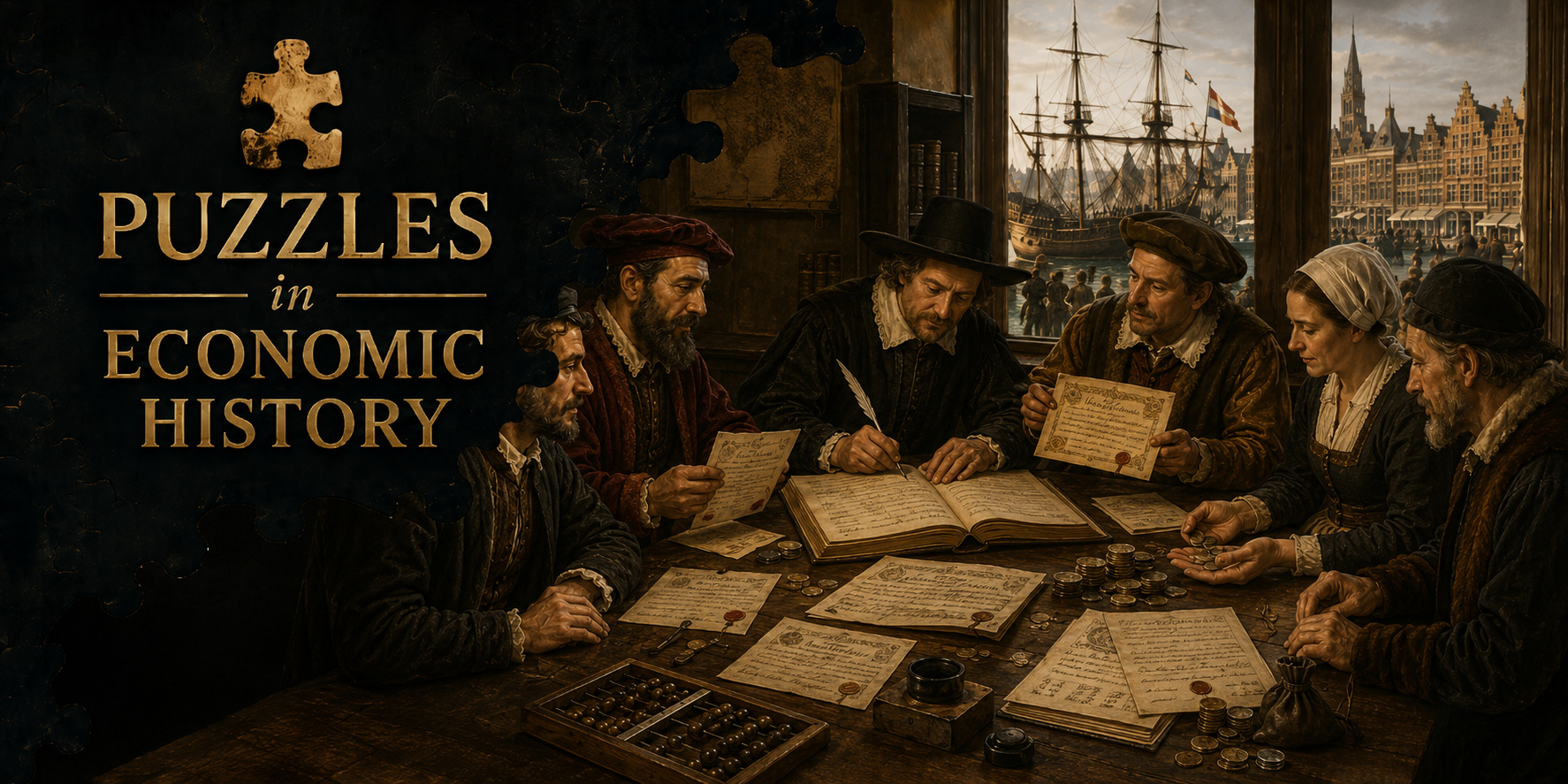
First, when the VOC raised its founding capital in 1602 – what we would today call its IPO – the share offering was open to any resident of Amsterdam. Over 1,100 people put money in, from merchants down to household maids, raising about 6.5 million guilders (on the order of half a billion US dollars in today’s gold terms). For the first time in history, an ordinary person could buy a slice of a great enterprise.
Second – the accident that created the stock market. To sustain multi-year Asian trade, the VOC locked in its capital: no redemptions until roughly 1612. Shareholders who wanted their money back had exactly one option – sell the share to someone else. So a secondary market self-organised on Amsterdam’s bridges, in coffeehouses and inns, with no involvement from the company at all. Note the causality, because it inverts the textbook: the stock market wasn’t built so that stocks could trade; locked-up capital forced shareholders to invent the market themselves.
And everything we consider modern about markets appeared essentially immediately. In 1609, an ousted VOC director named Isaac Le Maire organised history’s first documented short-selling ring – selling shares he didn’t own while spreading rumours of shipwrecks. The response, in 1610, was history’s first securities regulation: a short-selling ban, reissued so many times over the following decades that we can be confident nobody obeyed it. (Le Maire’s short failed and nearly ruined him – so he funded an expedition to find a route around the VOC’s monopoly, which discovered Cape Horn. The strait there still bears his name: a failed short seller’s mark on the world map.) By 1688, an Amsterdam trader had published the first book about the stock exchange, describing fake orders, planted news, bulls and bears – perfectly legible to any trader today.
No patents, no secrets – the hundred-year open-sourcing
Once running, the machine could not be hidden. Denmark copied it in 1616, France in 1664, Ostend in 1722, Sweden in 1731 – some founding documents openly citing the Dutch model. The Ostend Company poached experienced English and Dutch employees by offering private cargo allowances, the 18th-century equivalent of signing bonuses and equity – and when Austria’s emperor shut this profitable company down in 1731 (traded away, remarkably, as a diplomatic concession to secure his daughter’s succession), its capital and veterans simply reseeded the new Swedish company. Institutions were copied, talent defected, capital changed flags – capital flowing to the highest return, exactly as it does now. The deeper infrastructure was open-sourced too: Amsterdam’s exchange bank (1609) became the template England imported wholesale after 1688, chartering the Bank of England in 1694; marine insurance crystallised the same year in a London coffeehouse called Lloyd’s.
So what protected the Dutch, if anyone could copy the model? For decades, nothing they hid – everything they had accumulated: the deepest capital market, the densest information networks, the most trusted clearing. The lesson holds for every founder reading this: anything copyable will be copied; the moat is never the secret, it’s the head start compounding.
The answer, and the coda
Who invented the modern company? Nobody. Twelfth-century shipping contracts, a fourteenth-century flour mill, fifteenth-century Genoese debt, a sixteenth-century Antwerp trading floor – forced together in early-1600s Amsterdam by one cash-flow problem after another. No blueprint, no patent, no name to engrave. And precisely because no one could own it, all of Europe could copy, improve and inherit it. Companies dissolve, commodities crash, technologies age – but a good way of doing things replicates like a gene onto new hosts. The mill outlived flour itself: it grinds nothing now, and still sells electricity.
One more thing, because it’s the part worth remembering longest. The soil that grew both the stock market and the free press was institutional, not national character – and the proof is what happened when the institutions changed. In the 18th century, as the Dutch economy declined and its authorities tightened, Voltaire’s and Rousseau’s books began to be banned in the Netherlands too. In the same period, the center of world finance moved to London. Freedom follows institutions: while they hold, it stays; when they change, it leaves – capital and ideas on the same ship.
Previously in this series: How did the largest banknote in the world become worthless?
Next in this series: Why did Dickens’s father go to prison for £40 – while Trump went to the White House?