




This series is adapted, with permission, from a Chinese-language series by our friend Marcus Ji, who looks at historical events through an economic lens. We have condensed and adapted the original for an international audience.
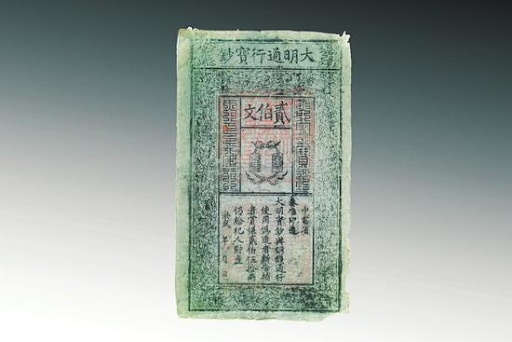
In 1375, the founding emperor of China’s Ming dynasty issued what was probably the largest banknote ever printed: the Da Ming Baochao, roughly 30 by 20 centimeters – wider than a sheet of A4 paper. At launch, one note was worth 1,000 copper coins, or one tael of silver.
Within seventy years, Chinese records describe the notes “piled up in the marketplace, where passersby would not even glance at them.” It is the coldest epitaph ever written for a currency. By one numismatic estimate, the baochao had already lost 99.986% of its issue value by 1425.
What killed it was not war, counterfeiting, or incompetence. It was the most radical monetary experiment in history running exactly to its logical conclusion – and the story explains, better than any modern textbook, why the world’s central banks are built the way they are.
The four nothings
Paper money was not new in 1375 – China had been using it for four centuries. What was new was the design. Song dynasty jiaozi notes were backed by roughly 28% reserves. The Yuan dynasty’s notes were convertible: you could walk into a government office and exchange paper for silver at a 2% fee. Those notes were, in essence, warehouse receipts – paper with something real behind it.
The Da Ming Baochao had no reserves, no convertibility, no issuance cap, and no expiry. Behind it stood nothing but the emperor’s word: this is money, and refusing it is a crime.
The enforcement told you everything about the currency’s real strength. Printed on each note: counterfeiters would be beheaded, and informers would receive 250 taels of silver plus the criminal’s entire property. Using the most durable measuring stick across centuries – an unskilled laborer needed about 40 working days to earn one tael – that bounty equaled roughly 33 years of a laborer’s income. A currency that requires death penalties and life-changing bounties to circulate is confessing that nothing else is holding it up.
The depreciation curve did not wait politely:
| Year | Value of one baochao note |
|---|---|
| 1375 (issue) | 1,000 copper coins |
| 1390 | ~125 coins in parts of the south (Value dropped by 87%) |
| 1432 | 5 coins (Value dropped by 99.5%) |
| 1440s | Effectively zero |
The twist: the emperor understood money perfectly well
The lazy explanation – a medieval ruler who didn’t grasp finance – collapses on inspection. Emperor Zhu Yuanzhang designed a complete monetary system: fixed exchange ratios between notes, copper, silver and gold; anti-counterfeiting measures; a program for swapping worn notes. He understood the rules in detail. He simply refused to be bound by them.
The real cause was not ignorance but incentives. For a ruler holding the printing plates and facing unlimited expenses – armies, salaries, imperial rewards – printing money is a form of invisible taxation (economists call it seigniorage): no tax collectors, no revolts, no complaints; every holder of the currency pays automatically as it dilutes. So the equation was fixed from day one: printing rights + unlimited spending + zero external constraint = overissue, not as a risk but as a schedule. Monetary historians note the baochao began depreciating by 1380 – five years in. The countdown started the moment the system was designed.
This is the article’s first takeaway, and it has nothing to do with the fourteenth century: what restrains the issuer of money has never been knowledge or virtue – only institutional constraint. The smartest ruler with an unconstrained printing press arrives at the same place. That, in one sentence, is why modern states separate the central bank from the treasury.
The referendum: 100 million people vote with their feet
Here is the part the textbooks skip. When the baochao collapsed, the Ming court did not switch to silver. It repeatedly banned private silver transactions to protect its paper.
The population simply refused. For roughly a century, the court decreed paper while the market quietly priced everything in silver; punishments were issued and ignored. In 1436 the state conceded silver’s legality, and by 1581 it had surrendered completely – the “Single Whip” tax reform required taxes themselves to be paid in silver. What China ran, in effect, was a hundred-year currency referendum, decided from the bottom up.
The logic is durable: when the sovereign’s monetary credit hits zero, the market automatically selects a money that requires no one’s promise. Silver’s value came from scarcity, not from anyone’s word. Every modern fiat collapse – people fleeing into dollars, gold, or hard assets – is the same referendum, re-run.
The dependency nobody voted on
The strangest fact in the whole story: the silver that became the lifeblood of the world’s largest economy was almost none of it Chinese. China had few silver mines. Between the 16th and 18th centuries, the Americas produced roughly 85% of the world’s silver – and researchers estimate at least a third of it ultimately ended up in China, much of it via the Manila galleon trade: American silver buying Chinese silk, porcelain and tea for resale in Mexico and Europe, at documented margins of 100–300% per voyage (one Spanish naval officer recorded 400% on silk). By the 18th century, more than 3.5 million taels flowed in annually – the equivalent of the entire yearly income of some 460,000 laborers, shipped across the Pacific.
Those galleon profits came from no technology and no production advantage – purely from the price gap between two separated markets and the license to connect them. Readers who build cross-border businesses will recognize the model; the galleon was the platform economy of 1600.
But the dependency cut both ways. The Ming empire could control its printing press, its salt fields, its household registry – and had no control whatsoever over mine output in Peru or export policy in Japan. When global silver flows contracted in the 17th century, China slid into monetary famine and deflation, which historians count among the triggers of the dynasty’s collapse. The empire had tied its monetary lifeline to ships and mountains on the other side of the planet, without ever quite realizing it.
The four-hundred-year hangover
The baochao’s failure was so complete that it disciplined the next dynasty better than any law could. The Qing, whose Jurchen ancestors had run their own paper money into hyperinflation four centuries earlier, treated the printing press as a memory of trauma: from their conquest of China in 1644 until the military emergency of 1853 – two hundred and nine years – they issued essentially no paper currency at all. In 1814, an official who merely proposed printing notes was rebuked for it.
Literature preserves the proof. Jin Ping Mei, the great Ming novel of merchant life, records – by one count – 456 monetary transactions, 430 of them in physical silver. Not a single banknote appears in the entire book. That is not authorial oversight; it is a precise, accidental footnote to monetary history.
China invented paper money – and then, having watched an unconstrained issuer destroy it, punished itself with roughly four centuries of abstinence. The lesson was paid for in silver, literally.
One law, twice demonstrated
Two experiments, one verdict. The Ming printed an unbacked currency and forced a nation to accept it: the currency died and took the state’s monetary credibility with it. The Ming banned the money its people actually trusted: the people ignored the ban for a hundred years until the state surrendered. When unconstrained power sets itself against economic law, the law wins – and it wins brutally.
The final irony is who held the real monetary lever. Not the emperor. A silver mine in the Andes and a galleon schedule in Manila had more influence over Ming prices than any edict ever did. The most absolute ruler on Earth discovered that he could command everything in his empire except what his subjects would accept as money.
Previously in this series: Why did the British Parliament free slaves but leave Oliver Twist starving?
Next in this series: Did the Dutch really invent the modern company?