



This series is adapted, with permission, from a Chinese-language series by our friend Marcus Ji, who looks at historical events through an economic lens. We have condensed and adapted the original for an international audience.
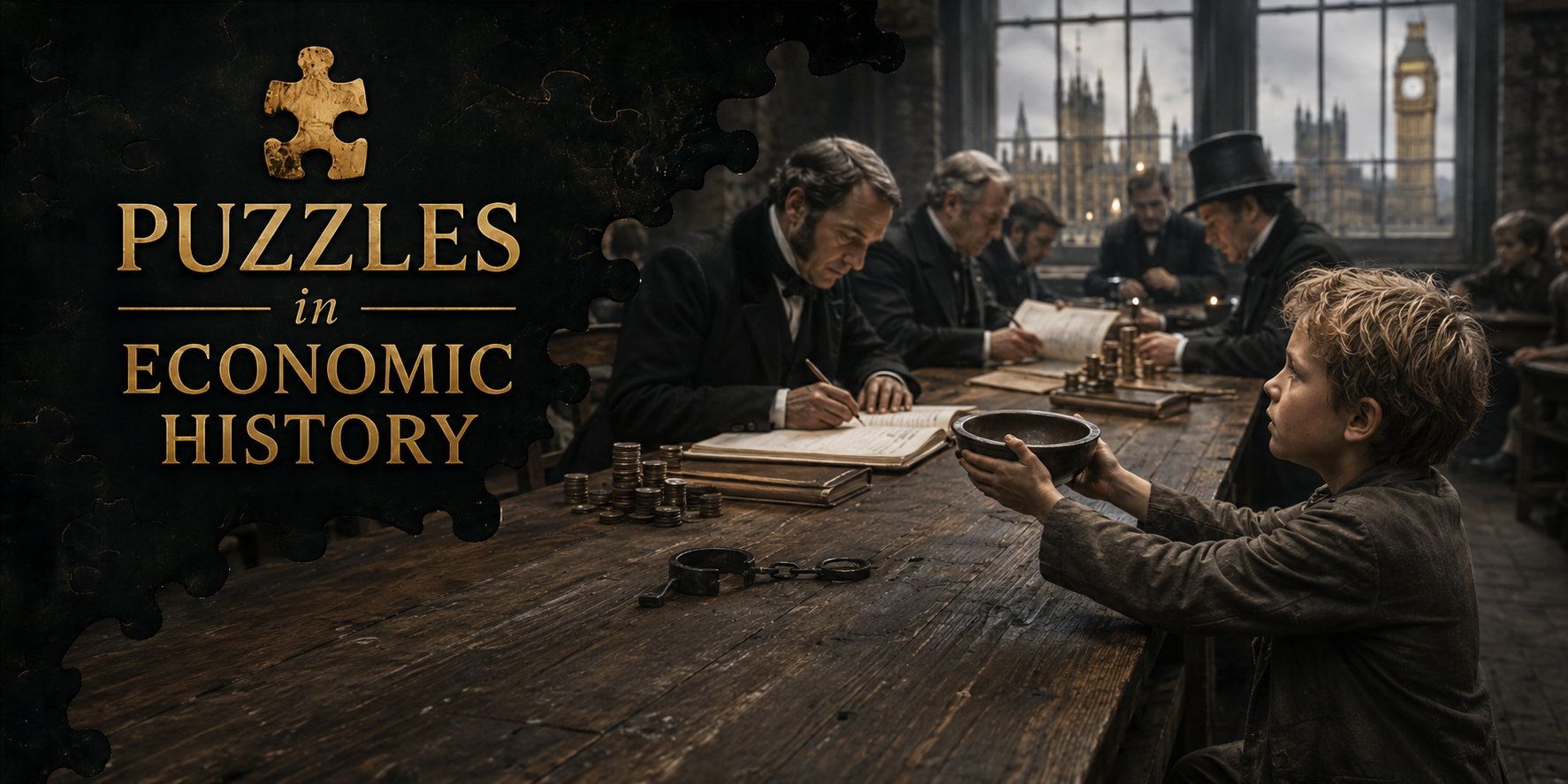
The most famous scene in Oliver Twist is a starving boy walking up to the pot with an empty bowl: “Please, sir, I want some more.”
Dickens published the novel in 1837 as a direct attack on a law passed three years earlier. The Poor Law Amendment Act of 1834 had made the workhouse – a state institution where England’s destitute were confined and put to forced labor in exchange for survival rations – the near-exclusive channel of poor relief. Oliver’s workhouse was not a gothic invention; it was current affairs.
What happens in the scene is stranger than the scene itself. Oliver isn’t just punished – he’s treated as a threat to order, and the workhouse decides on the spot to sell him. Why would one extra ladle of gruel from a hungry child endanger a system?
Stranger still: the people behind that calorie-calculated gruel were not villains. They were the most educated, self-consciously progressive reformers in Britain, sincerely convinced they were saving the poor. And in the same 18 months that they legislated Oliver’s generation into the workhouse, the same Parliament did something remembered as one of history’s great moral landmarks: it freed the roughly 800,000 enslaved people of the British Empire.
The noblest law and the coldest law came from the same pen, in the same season. That is not a coincidence, and neither act was an aberration. They were two fruits of a single set of good intentions – and the accounting survives, item by item.
The gruel was not fiction – it was legislation
Dickens’s workhouse menu – thin gruel, onions twice a week, half a bread roll on Sundays – matches surviving institutional diet sheets, several of which explicitly prohibited second helpings. Using an ordinary laborer’s wage (about 3 shillings 9 pence a day in 1834) as the measuring stick across two centuries:
| Item | 1834 price | In a laborer’s wages |
|---|---|---|
| State allowance for fostering an orphan | 7.5 pence/week | ~1/5 of one day’s wage |
| Price that Oliver was sold for | £3.5 | ~19 days wage |
| Archbishop of Canterbury’s annual income | £19,000 | ~338 years of a laborer’s income |
The first line is the coldest: the state valued a child’s entire weekly survival at less than a fifth of what one workman earned in a day. And the workhouse itself was governed by a principle written into the 1834 Act, with a name worth memorising: less eligibility. Life inside had to be worse than the life of the poorest free labourer outside – otherwise, the reformers reasoned, the poor would choose relief over work. Hence the precisely inadequate gruel, families separated into segregated wards, and compulsory labor: men breaking stones and crushing bones for fertiliser, picking old ship’s rope apart until their fingers bled, with the proceeds kept by the workhouse. The relief was never free; it was purchased with labor, priced to deter.
Now Oliver’s crime makes sense. The food was engineered to sit exactly at “not quite starvation, never comfort.” One extra ladle cracked the entire deterrent.
The two ledgers
Here is what makes 1834 legible. Put the two decisions of that Parliament side by side.
The old poor relief system cost about £7-8 million a year – roughly 2% of national income – covering millions of poor people across England and Wales. Parliament judged this ruinously expensive and cut it.
In August 1833, one year earlier, the same Parliament passed the Slavery Abolition Act. Buried in it: the government would pay £20 million – about 5% of national income and roughly 40% of that year’s government expenditure – as compensation. Not to the 800,000 people who had been enslaved; they received nothing, and were required to keep working unpaid for their former masters for four to six more years as “apprentices.” The £20 million went to approximately 46,000 slave owners. The government borrowed to pay it, and the debt was not fully retired until 2015. Living British taxpayers have serviced the slave owners of the nineteenth century.
Relief for millions of the poor: unaffordable. Compensation for 46,000 owners: paid without blinking, at 2.5 years’ worth of the entire national relief budget.
Why the slave owners were paid – and the poor were not
Nothing legally required the payout to the slave owners. Parliament had an abolitionist majority (built by decades of petitions and boycotts, plus the 1832 Reform Act’s destruction of the rotten boroughs through which plantation interests had bought seats). It could have abolished slavery by statute and paid nothing.
It paid for two reasons. First, purchase: the House of Lords was thick with West India interests capable of killing the bill, and £20 million was the toll for passage. Second — deeper – precedent: a law that confiscated legally held “property” without compensation terrified every landowner in the Commons. Enslaved people were, in law, registered property, the same category as land and livestock. If the state could take theirs today, it could take mine tomorrow. The £20 million didn’t buy the slave owners’ consent so much as it re-purchased, for all property holders, the principle that property is inviolable.
Turn that principle 180 degrees and point it at the poor, and 1834 follows automatically. To the slave owner: you own property, so ending it is a taking, and we will pay you. To the pauper: you own nothing – and in this logic, owning nothing is not misfortune but personal failure, to be corrected by deterrence and forced labor. One yardstick, one gradation: what do you hold? And it mattered that the yardstick-holders had just changed: the 1832 Reform Act had enfranchised precisely the middle-class ratepayers who paid the poor rate. Historians rate the cost of relief as likely the main driver of the reform. Property outweighed lives because property held the franchise.
There is a colder footnote. By the late 1820s, Caribbean sugar had collapsed – Britain’s share of the world market had fallen from ~60% to ~20%, and plantations had become nearly unsellable. The £20 million was, in substance, a state buyout of distressed assets at generous valuations. And research finds that industrial capital accumulation around Liverpool, Bristol and London correlates strongly with local compensation payouts. The tax money that freed the slaves took one turn and flowed into the Industrial Revolution.
Not hypocrisy – one project with two instruments
The obvious accusation – they pitied slaves an ocean away while starving the poor next door – misses the actual mechanism.
The deeper connection is that, to the reformers – disciples of Adam Smith’s political economy – abolition and workhouse reform were the same project. Slavery was an artificial intervention in the labor market: it locked labor in place by force. Poor relief was also an artificial intervention: it let people survive without selling their labor. Both, in this framework, had to go – for the same stated reason. Slaves were “liberated” into the labor market; paupers were “deterred” into it. One loosening, one tightening, a single destination: a world where everyone must sell their labor, with no second exit. That is why the same men could do both within 18 months and feel no contradiction whatsoever.
The premise was false, and the bill still came
Everything above is at least internally coherent. The final turn is that the coherence rested on an unverified assumption.
The entire 1834 reform was built on the Royal Commission report of Nassau Senior and Edwin Chadwick, which held that the old relief system bred idleness and over-breeding at vast social cost. Nearly two centuries later, two UC Davis economic historians tested this against parish-level wage and rent data from before and after the reform – and found no evidence of any of it. No idleness effect, no fertility effect, no labor-market distortion. The old Poor Law had been, in effect, a simple transfer to the poor. Their paper’s verdict: “Political economy, it seems, was born in sin.”
The costs of acting on the false premise, however, were measurable. A 2025 study in the Economic History Review found that where relief was cut, mortality among children under four rose 8-10%, and rural life expectancy fell more than 2%. An analysis of 250,000 court records in The Economic Journal found property crime rose about 17% more where cuts were deepest, concentrated in winters of agricultural unemployment – people steal when stealing outperforms starving. Fagin’s den of child thieves is not a plot device; it sits exactly on that curve, one of the two real destinations for a pauper child who fled the workhouse.
The savings were never saved. They were rebooked – under child mortality and crime.
Back to the bowl
Oliver, remember, is not rescued by the system correcting itself. He is rescued because he turns out to be a gentleman’s son – Dickens made the moral explicit: in this machine, a propertyless child’s only exit was luck of blood.
And the most uncomfortable part is that nearly everyone on this road believed they were good – the abolitionists, the reformers, the economists, all sincere. The cruelty came not from malice but from a self-consistent, widely believed set of good intentions whose premise nobody checked – and the more scientific it sounded, the fewer people checked it. Whenever the argument surfaces today that relief must be kept below the lowest wage “or it will breed idleness,” that is 1834’s principle speaking, and 1834 already ran the experiment at national scale.
The wish was good. The premise was false. The costs were real. And the debt was serviced until 2015.
Previously in this series: Why has “Rich dad poor dad” sold 40 million copies for almost 30 years?
Next in this series: How did the largest banknote in the world become worthless?