



This series is adapted, with permission, from a Chinese-language series by our friend Marcus Ji, who looks at historical events through an economic lens. We have condensed and adapted the original for an international audience.
In August 2012, a company called Rich Global LLC filed for bankruptcy in Wyoming. Four months earlier, a New York federal jury had ordered it to pay $23,687,957.21 to The Learning Annex – the seminar promoter that had built its founder into a stage celebrity, on a promised revenue share he never paid. The bankruptcy filing showed about $1.8 million in assets. Court documents cited by the Wall Street Journal showed the same company had collected roughly $45 million in “Rich Dad” seminar licensing fees in 2007-2010 alone.
The company belonged to Robert Kiyosaki, author of Rich Dad Poor Dad – the best-selling personal finance book in history.
That judgment is the key to the whole book. The book teaches readers to stop working for money and let assets work for them. Its author’s documented fortune came from relentlessly working for money – books, stages, licensing – and when a $23.7 million creditor finally arrived, what saved him was not passive cash flow but corporate bankruptcy and entity firewalls: precisely the legal machinery, not the doctrine, that the book sells.
The book was never the product
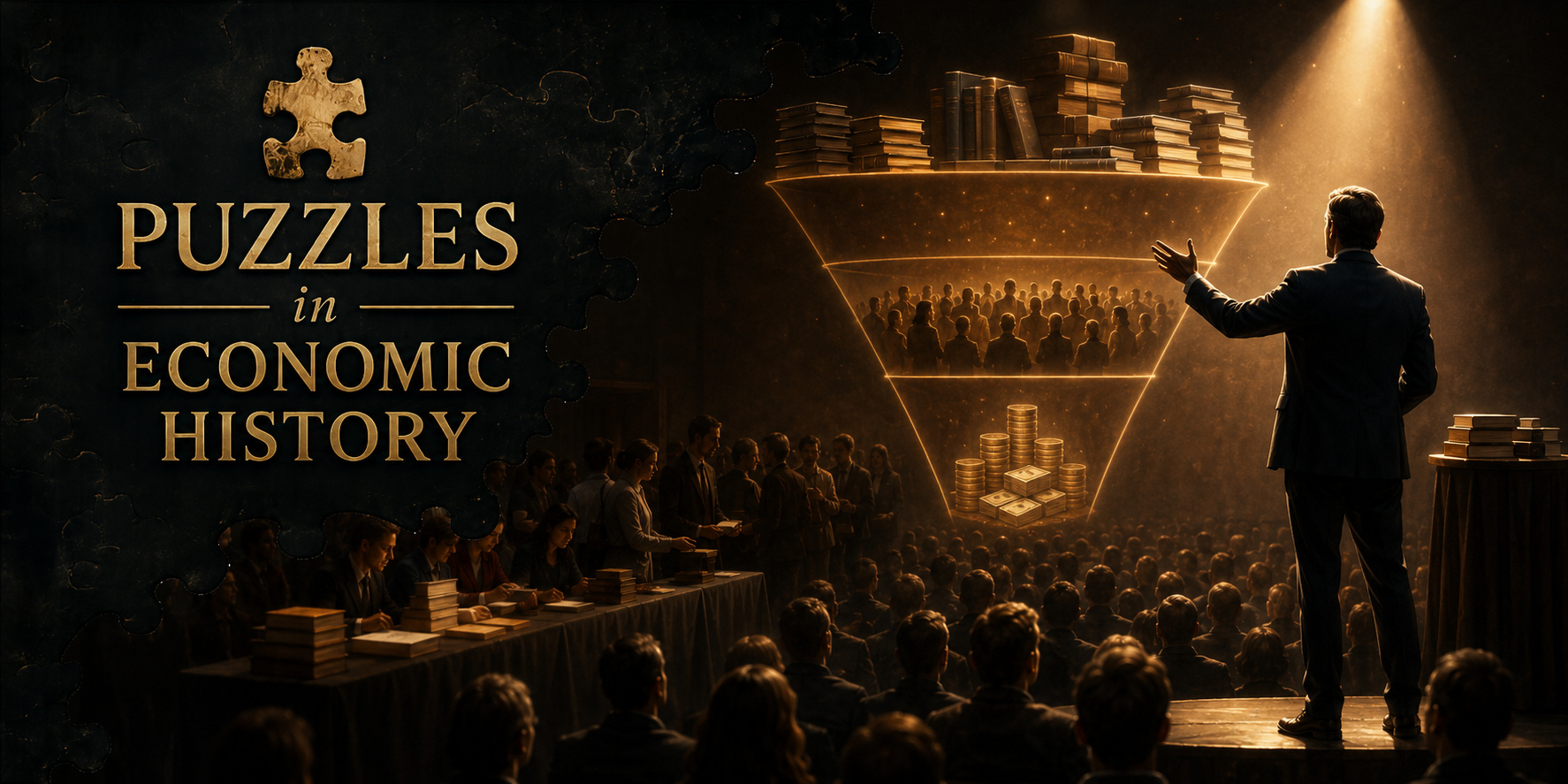
Rich Dad Poor Dad has sold roughly 40 million copies since 1997, priced around $15. It is cheap by design. Kiyosaki told the Canadian broadcaster CBC directly: his books are advertisements for his seminars. Canada’s Profit magazine reported the “Rich Dad” seminar ladder ran from about $12,000 to $50,000 per person. A CBC Marketplace hidden-camera investigation in 2010 recorded the mechanics: free introductory talks funneling attendees toward the four- and five-figure tiers, with one instructor’s showcase “investment property” turning out, on inspection, to be a vacant lot.
The funnel explains the book’s most criticized feature – its vagueness. There are no verifiable numbers anywhere in it: no actual salaries, no property costs, no rental yields, no auditable case studies. Specificity invites falsification; vagueness is a design requirement for a product whose job is to arouse anxiety and then sell the antidote.
The two fathers themselves don’t survive checking. “Poor Dad” was Ralph Kiyosaki – Superintendent of Education for the state of Hawaii, a senior civil servant with a stable salary and pension, recast as a cautionary tale because the narrative needed one. “Rich Dad” has never been verified to exist; investigations cited by CBS and SmartMoney concluded he was likely composite or fictional, and Forbes found no documentation of any significant Kiyosaki wealth before the book’s 1997 publication. The book’s one durable framework – assets versus liabilities, cash flow – was substantially built by co-author Sharon Lechter, a CPA, who later sued Kiyosaki and settled for a reported $10 million. The verifiable part of the book came from the accountant. The parts only Kiyosaki could supply are precisely the parts nobody has ever verified.
The paradox, stated precisely
Kiyosaki is genuinely rich today – estimates run around $100 million. But split his income by verifiability and the paradox is exact. The verifiable income – royalties on 40-plus books, speaking fees, the $45 million in licensing that sits in court records – is all active income, requiring him to keep appearing, keep publishing, keep generating controversy. The claimed passive empire – apartment blocks, hotels, golf courses producing “$1-2 million a month” – comes entirely from his own statements and has never been third-party audited.
A man genuinely living on passive cash flow has no reason to spend thirty years as a permanent touring show. He sold a book about exiting the rat race, and ran on his own without a break for three decades. His behavior is the most rigorous refutation of his doctrine on record.
The prediction record points the same way. Every time-stamped Kiyosaki forecast has missed: a 2016 crash call (the S&P 500 rose ~9.5%), hyperinflation and $500 silver in 2022, “the crash is here” in early 2023 (the index rose ~24%), “the biggest crash in history” for 2024 (record highs). His two claimed hits dissolve on inspection: predicting a crash continuously from 2002 until 2008 obliged is not forecasting – an arrow fired forever eventually lands – and permanent gold bullishness was falsified for twenty straight years (1980–2000, gold down ~70% while the S&P rose more than tenfold).
Contrast what a real prediction looks like. In 2007, Warren Buffett publicly bet Protégé Partners that a low-cost S&P 500 index fund would beat their hand-picked hedge funds over exactly ten years – dates fixed in advance, instruments specified, his own money staked, results published annually. He won, 126% to 36%. Whatever the outcome, that structure deserves respect: it agreed in advance on what losing would look like. Kiyosaki’s model inverts every element – no timestamps, no positions, no exit conditions, no cost for being wrong. And each crash call is itself content: the revenue comes from the audience’s fear, not from accuracy.
The actual puzzle: honest options were already on the shelf
None of the above is hidden. All of it – the judgment, the Forbes investigation, the CBC footage – is public, findable in an afternoon. So the real question is not “is the book sound?” It’s an economic one: why did this outsell the honest alternatives forty to one?
The timing supplies half the answer. The late 1990s were the hinge of a great risk transfer in American life: defined-benefit pensions giving way to 401(k)s, lifetime employment loosening, the long-term financial risk of old age shifting from institutions onto individuals. The old safety narrative – good degree, stable job, company pension – was dying, and nothing had replaced it. Into that vacuum, the book poured the simplest possible fable.
But here is the sharper half: in 1997, Americans were not short of honest, cheap, verifiable options. John Bogle had launched the first retail S&P 500 index fund in 1976 – it raised $11 million against a $150 million target and was derided as “Bogle’s folly,” even “un-American.” Peter Lynch, with a fully public 29%-a-year record over 13 years at Magellan, had published his investing book in 1989; it sold on the order of a million copies. Buffett’s shareholder letters had been free to anyone since the 1970s. The unverifiable fable outsold the verified track record roughly 40 to 1.
That ratio is the article’s most important number, and it does not prove readers are stupid. It reveals what this market selects for. The index fund offers “market-average returns plus decades of patience” – no identity upgrade, no enemy, nothing that makes you sound clever retelling it. The fable offers a story, a set of villains (school, bosses, taxes), and a new identity: I have seen through the game. Human brains transmit good-versus-evil stories far more efficiently than data. The market for financial wisdom filters for narrative transmissibility, not accuracy – and it can do so indefinitely, because wealth advice has the longest verification cycle of any product: a bad doctor is exposed in weeks, while a bad investment guru can explain away failure for decades.
The free audit: people who still recommend it
Which brings this to the present. When a guru, blogger or book list today still ranks Rich Dad Poor Dad as essential reading, there are logically only three possibilities.
- They haven’t read it, and the list is copied – in which case the list carries no information.
- They read it and believed it – in which case a judgment that missed the loudest red flags in an entry-level book should be discounted on everything else it endorses.
- Or they read it, saw through it, and recommend it anyway – knowing that a reader who finishes the book is at peak anxiety with zero method, which happens to be the psychological state in which expensive courses convert best.
That third person is not Kiyosaki’s reader; they are his colleague, operating a smaller funnel.
The practical good news: you never need to diagnose which of the three you’re facing. All three cases lead to the same action – discount the entire list. The one exception cuts the other way: a recommendation that ships with explicit failure conditions (“take the cash-flow-awareness concept only; the operational advice is void; the author’s own wealth path contradicts the book – here’s the evidence”) is a positive signal of judgment. The test of a recommender is the same as the test of a book: not what they endorse, but whether they state in advance where it fails.
That is also the fairest thing that can be said for Rich Dad Poor Dad itself. It gave tens of millions of people their first encounter with the idea that assets and liabilities are different words. That awareness is real – it was just available, more honestly, from a 1976 index fund and a free shareholder letter. From Bogle’s fund to Buffett’s bet, everything in finance that survives verification shares one trait: their authors specify in advance the conditions under which they would fail, and expose their reasoning to examination. Only genuine claims dare to define beforehand what losing looks like.
Previously in this series: How did a Guangzhou merchant become richer than the whole U.S. government?
Next in this series: Why did the British Parliament free slaves but leave Oliver Twist starving?