
This series is adapted, with permission, from a Chinese-language series by our friend Marcus Ji, who looks at historical events through an economic lens. We have condensed and adapted the original for an international audience.
In 1834, a tea merchant in Guangzhou assessed his own net worth at 26 million Mexican silver dollars. That year, the entire United States federal government collected about 21 million dollars in revenue – customs duties and land sales combined. One man in southern China was worth more than a year of the American government’s income.
His name was Wu Bingjian, known to every Western trader of the era as Howqua. Multiple Western sources call him the richest man in the world at the time: the biggest Rothschild fortune in Europe was then estimated at around $5.3 million; the richest American was worth under $7 million. Converting his silver into gold at period exchange ratios and gold into today’s money puts the fortune somewhere around $7-11 billion – the figure is directional, but every method lands on the same conclusion: this was wealth on the scale of nations.
The interesting question is not how big the fortune was. It is where it came from, where it went – and why the man himself could not follow it.
Where it came from: one word – monopoly
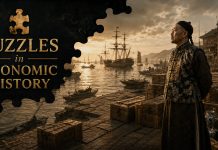
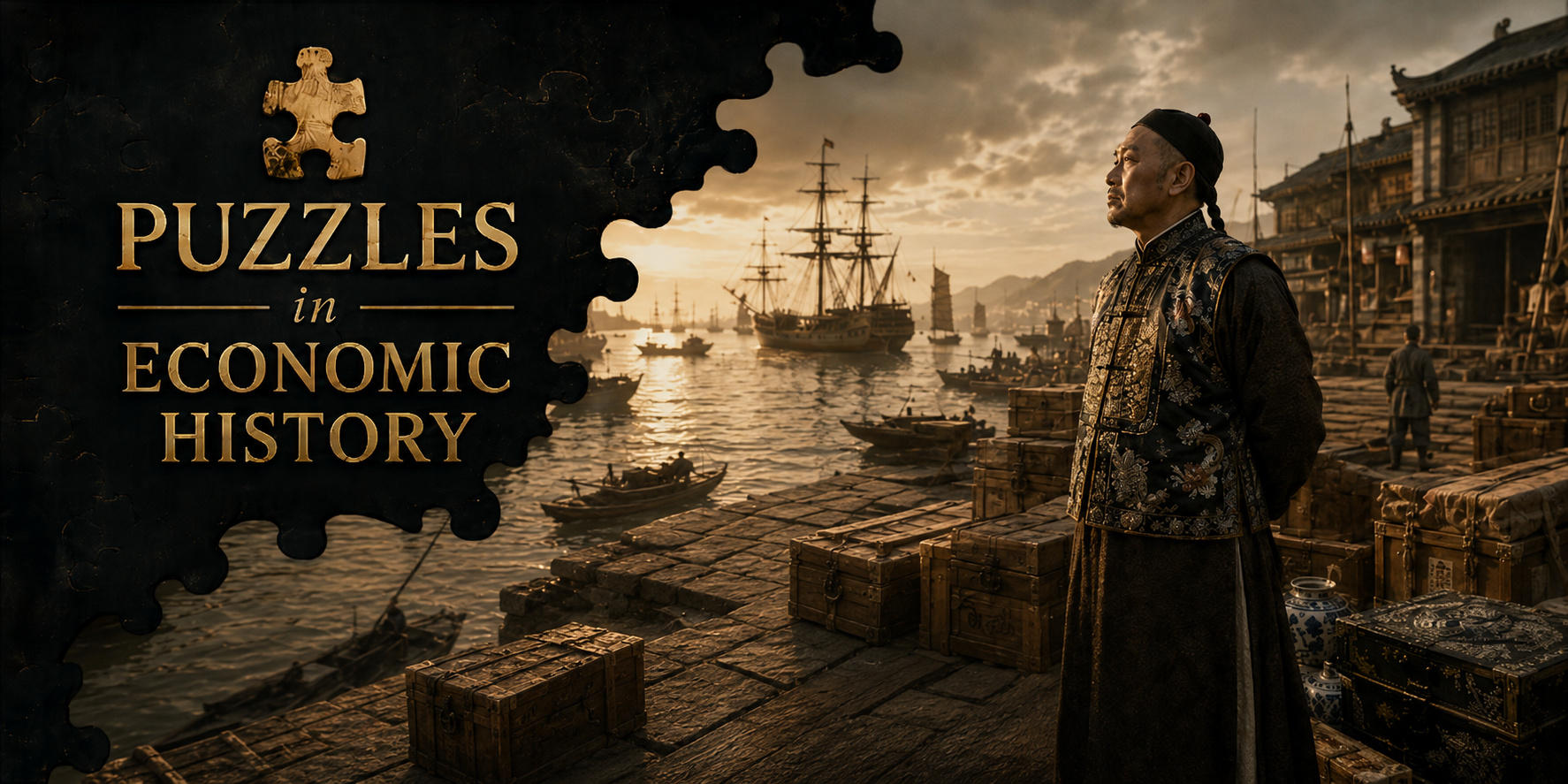
From 1757, the Qianlong Emperor funneled all of Qing China’s trade with the West through a single port: Guangzhou (Canton). Foreign ships could not enter the city or deal with ordinary Chinese; their crews were confined to a row of riverside compounds – the Thirteen Factories – from October to March, after which they had to withdraw to Macau. Every transaction had to pass through a small group of licensed Chinese merchants, the Cohong. The system lasted for 85 years (1757–1842).
Howqua’s firm, Ewo (怡和行), was the top house among the thirteen. One number captures its scale: in 1830 alone, Ewo sold the British East India Company about 50,800 chests of tea – 18.6% of the EIC’s entire tea procurement in China. A single private firm supplying nearly a fifth of the world’s dominant multinational.
The essence of the business was a government-issued license. Tea, silk and porcelain going out passed through him; Western goods coming in passed through him. He didn’t need to do the job better than anyone else. He needed everyone else to not be allowed to do it. Guangzhou folklore claimed that when fire swept the Thirteen Factories in 1822, the silver melting in the Wu family vaults ran out in a stream nearly two miles long. Historians label the story an exaggeration – but a fortune has to reach a certain size before people start inventing legends like that about it.
What he did with it – including the move nobody expects
Howqua was not a rentier sitting on a license. He was arguably the person in early-19th-century East Asia who best understood how Western capital worked, and he made three moves his peers didn’t.
He locked in the biggest client, building a long-term alliance with the East India Company that made volume itself his moat. He built a brand – tea carrying the Ewo chop commanded a premium in Western markets in the 1820s, one of the earliest recorded cases of a Chinese brand premium abroad. And then the move that sounds invented: he became an early investor in American railroads.
In 1830, a 17-year-old American named John Murray Forbes arrived in Guangzhou as a clerk at Russell & Co. Howqua took to him, treating him almost as an adopted son – working capital, loans, a share in the business. Through Russell & Co., Howqua then channeled his own capital across the Pacific. Forbes returned to Boston in 1837 carrying both his own China fortune and money entrusted by Howqua; by 1846 he was president of the Michigan Central Railroad, driving track from Detroit to Chicago, and later ran the Chicago, Burlington & Quincy. Part of the seed capital that opened the American Midwest – and founded a Boston dynasty that persists today – was a Guangzhou tea merchant’s money.
Put plainly: in the 1830s, the richest man on Earth quietly and successfully emigrated his capital to America.
He himself could not go.
The locks: why the money could move but the man couldn’t
Western merchants could sail to Guangzhou and observe the Chinese market firsthand. Howqua knew exactly where Western profits were – he was one of the EIC’s largest creditors, and knew a picul of tea bought for twenty-odd taels in Guangzhou sold for three to five times that in London. Knowledge was not the constraint. Five locks were.
The political lock, above all. Under the Qing system, Cohong merchants were hostage-intermediaries: they managed and guaranteed the foreigners on the court’s behalf. Leaving the country as a private trader was a serious crime, and his family, estates and official rank all sat in Guangzhou. Emigration would have been political suicide.
The capital lock. There was no legal channel to move a fortune abroad. His only route was proxies – which is why everything ran through Russell & Co., and why the risk never left: when an agent fails, the assets vanish. (Russell & Co. eventually went bankrupt in 1891, taking part of the family’s remaining stake with it.)
The capability locks. Operating in London or Boston required local networks, legal knowledge and language he entirely outsourced to foreign agents. And knowing a product’s margin is not the same as knowing how to build supply chains, brands and distribution in a foreign market – information parity is not capability parity.
The cognitive lock. In a culture where the examination system ranked commerce beneath scholarship, even the world’s richest man paid to purchase a mandarin’s rank for respectability. The Chinese who dealt with Westerners saw themselves as compradors – intermediaries serving foreign principals – not as potential principals themselves. A value system in which trade itself needed apologising for does not produce the thought “I could open my own firm in London.”
The same lock shaped the next generation. The Wu family’s wealth went into Confucian tutors and examination prep – the classics, not English or commercial law. (One rival Cohong family, the Pans, taught their children Western languages; they were the exception.) China would not systematically send students abroad until 1872 – a full generation after the Canton system’s peak. By then, the Forbes children were learning to manage transcontinental railroads.
The ending: the license disappears overnight
The Opium War settled the question of whether any of this was sustainable. The 1842 Treaty of Nanking required the Qing to pay $3 million in “Cohong merchant debts” – Howqua personally paid $1 million of it. He died the following year. Article V of the treaty abolished the Cohong monopoly outright: the license Ewo lived on became void overnight. With five ports open, trade shifted north to Shanghai and Hong Kong, and Guangzhou’s centrality ended. Within two generations – through the Russell bankruptcy and Taiping-era war levies – the family of the world’s richest man had shrunk to minor tea traders.
What the story is actually about
Two fortunes came out of the same trade. Howqua’s was built on a license: when the privilege vanished, the base went to zero. The Forbes and Russell fortunes seeded by his own money survived every loss of protection – because they were built on transferable capabilities, networks and institutions, not permissions. A monopoly is an accelerator of wealth and, simultaneously, the foundation of its destruction.
And the deeper lesson is about mobility. Howqua’s capital globalized; Howqua stayed imprisoned. Seeing an opportunity and being able to act on it are separated by an entire institutional apparatus – exit rights, legal channels for capital, education pointed at the future rather than the past.
Near the end of his life, Howqua told Forbes something that survives in the American’s papers, to this effect: if I were a young man, I would seriously consider boarding a ship for America and settling somewhere near you. He saw everything clearly – from inside the locks. That is what it sounds like when insight arrives without the freedom to use it.
History doesn’t repeat, but it rhymes, and today’s version is simple: whoever can move their information, their capital and themselves most freely holds the long-term odds. What Howqua lacked was never money.
Previously in this series: Why your job might be replaced in the next ten years?
Next in this series: Why has a debunked finance book sold 40 million copies for almost 30 years?