




This series is adapted, with permission, from a Chinese-language series by our friend Marcus Ji, who looks at historical events through an economic lens. We have condensed and adapted the original for an international audience.
Here is a peculiar fact. For most of the last three thousand years, the thing an ordinary worker could least afford was not a day’s food. It was a single piece of clothing. A day’s calories usually cost an unskilled labourer somewhere between a few minutes and a couple of hours of work. A plain garment cost days, weeks, sometimes months – and in the earliest written records we have, it cost about five months of wages.
Clothing has since collapsed, almost alone among the things we buy, from something precious into something disposable. Today, according to the Ellen MacArthur Foundation, a truckload of textiles is landfilled or burned every single second – a fate that would have stunned nearly everyone who came before us. This is the story of how a garment fell from asset to rubbish, and what broke to make it happen.
Measured in hours of work, clothing was staggeringly expensive
Using ancient prices in silver or copper to gauge value can mislead, because the money itself keeps changing – the same coin buys very different amounts from one century to the next. Economic historians use a sturdier ruler: how long an ordinary unskilled labourer had to work to buy a thing. Here is the cost of a single basic garment, measured that way, across three thousand years.
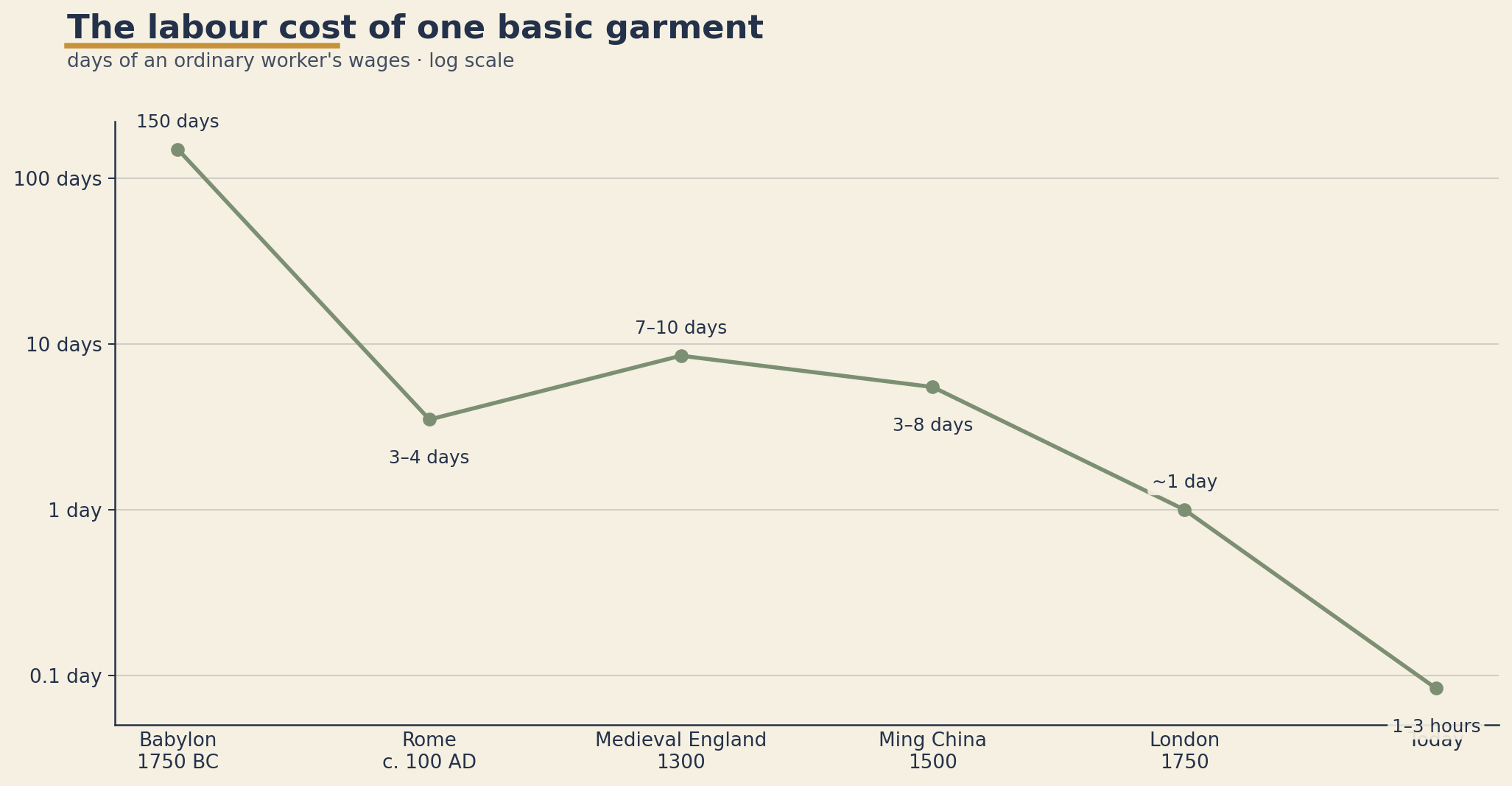
Reading off the chart, one garment cost:
- Babylon, c. 1750 BC – about 150 days’ wages (the same price as five sheep);
- Rome, 1st–2nd century AD – 3–4 days’ wages;
- Medieval England, c. 1300 – 7–10 days’ wages;
- Ming China, c. 1500 – 3–8 days’ wages;
- London, 1750s – about 1 day’s wages;
- Today – 1–3 hours.
From 150 days to a quarter of a day: a fall of roughly 600 times, a collapse no other necessity – not food, housing or fuel – ever came close to. Food nearly always cost only minutes of work. Clothing was the thing that fell.
Why it was so expensive: one step held up everything
Clothing was dear not because cloth was scarce, but because one particular part of making it was agonisingly slow. Turning raw material into cloth takes two steps: first you twist raw fibre – wool, cotton, flax – into thread, which is called spinning; then you interlace the threads into cloth on a loom, which is called weaving. Back when everything was made by hand, the two were wildly unequal. Feeding a single weaver’s loom took the thread of four to ten spinners working full-time, so spinning alone was about 80% of all the labour in making cloth. An 18th-century Indian hand-spinner needed over 50,000 hours to spin 100 pounds of cotton yarn.
That one slow step shaped society for millennia. Thread was so hard to make that it was expensive, which made the cloth woven from it expensive too – beyond what ordinary families could afford. So families made their own clothing instead, and a permanent production line formed inside the household. China’s “men farm, women weave”, and the ever-turning European spinning wheel was a price structure.
How the bottleneck broke: sixty years, three hundred times
For all of history, the choke point was spinning. It broke in three steps:
- In 1733, John Kay’s flying shuttle sped up weaving – and made things worse. With spinning still the slow step, faster weaving simply meant weavers ran out of thread, and yarn grew scarcer and dearer. Speeding up the fast step could not lower the price of clothing.
- The spinning jenny (1764), water frame (1769) and mule (1779) sped up the slow step at last. The labour to spin 100 pounds of cotton yarn fell from India’s 50,000-plus hours to about 300 by 1795 and 135 by 1825 – roughly 370 times in sixty years.
- Prices crashed. Fine cotton yarn fell from 38 shillings a pound in 1786 to about 3 by 1832 – more than 90% gone in under fifty years – and cloth and clothing fell with it, never to return.
The collapse also ruined a generation of workers. In the brief window after spinning was mechanised but before weaving was, hand-loom weavers boomed on cheap yarn – then the power loom arrived, and their weekly wage fell from around 23 shillings in 1805 to about 6 by the 1830s. Their response was to work harder: as piece rates fell, they wove longer hours to survive, and the extra cloth pushed prices lower still, so their diligence became the engine of their own ruin. The historian E.P. Thompson called their fate one of the darkest chapters of the Industrial Revolution. The same event freed consumers from a three-thousand-year tax on thread and wiped out the largest skill-asset women had ever held – while the inventors who triggered it kept almost none of the gain: the economist William Nordhaus estimated that innovators capture, on average, only about 2.2% of the value they create, the rest flowing to consumers as lower prices.
Two kinds of bottleneck – and today’s “expensive garment”
The useful idea to carry away is this: a thing is rarely expensive because it is hard to make overall – it is expensive because one specific step in making it is choked. For clothing, that step was spinning, and it stayed choked for three thousand years until a handful of machines killed it in sixty.
But bottlenecks come in two kinds. A technological one dies the moment someone invents past it, and stays dead – once the machine exists, no one can put the price back up. In our own time, SpaceX did this to the cost of space travel, cutting the price of reaching orbit by roughly 95% simply by reusing a rocket’s first stage instead of throwing it away after each flight. An institutional bottleneck is different: it lives inside rules, and lasts as long as the people it protects. American healthcare is the clearest case – the US spends about 18% of GDP on it against 10–12% in peer countries, and the gap is mostly higher prices, not more care, partly because the supply of doctors is deliberately restricted (federally funded training places were frozen in 1997 and barely moved for 25 years). Milton Friedman once likened medical licensing to a medieval guild. Technology is now pressing on the door – AI can already handle basic triage – but here the two kinds part ways: a physical bottleneck falls the moment the machine exists, while a legal one does not, because no algorithm can grant itself a licence. It waits until the rules change.
Which points to where the “expensive garment” now sits in a household budget. It is no longer clothing. It is housing, education and care – the sectors machines have not yet made dramatically cheaper, or have been blocked from doing so. Three thousand years ago the line item crushing the family ledger was a thread; today it is the industries still waiting for their own spinning jenny.
The machine that breaks bottlenecks keeps changing
The way we break bottlenecks has itself changed through three phases. The inventors of the spinning-jenny age worked by simple arithmetic: they were weavers and spinners themselves, they saw that human labour was expensive while a machine was cheap, and they swapped one for the other and kept the difference. By the late 19th century came organisation – Edison’s “invention factory,” Bell Labs – which turned invention from a lone craft into an industrial process. After the Second World War came betting – government-funded basic research and venture capital, which made a business of financing likely failures, shifting the aim from “solve today’s expensive problem” to “build a market that doesn’t yet exist.” Three phases, one unchanging logic beneath them all: the bottleneck is where the profit is.
Previously in this series: Is it true that successful women in Asia find it harder to marry?
Next in this series: Why did the Black Death lead to very different economic realities in Eastern and Western Europe?