



This series is adapted, with permission, from a Chinese-language series by our friend Marcus Ji, who looks at historical events through an economic lens. We have condensed and adapted the original for an international audience.
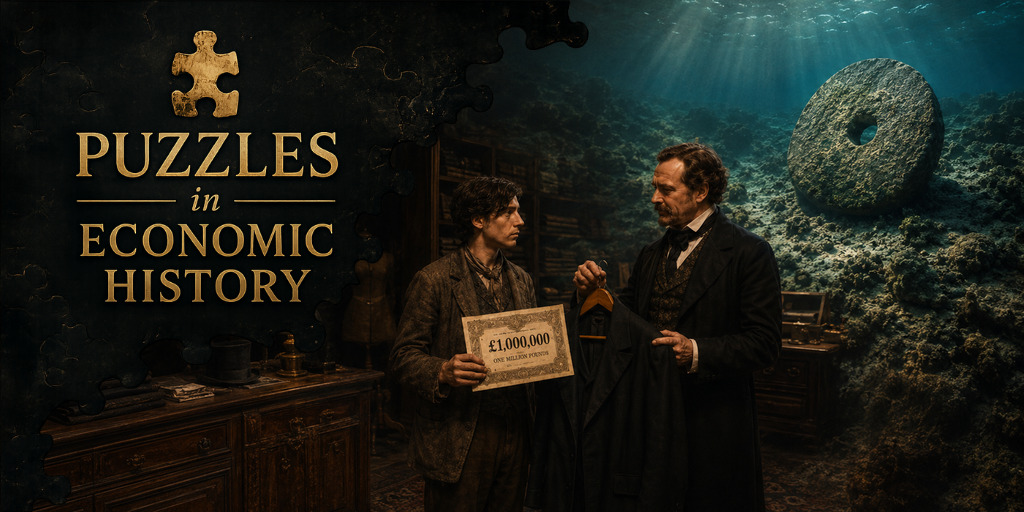
In 1893, Mark Twain published a short story called “The £1,000,000 Bank-Note.” It opens with a bet. Two rich, eccentric brothers in London cannot agree on a question: suppose an honest, intelligent man found himself in London with no friends and no money – nothing except a single banknote worth one million pounds, which no shop could change, no bank would cash for a stranger, and which he could not explain having. Would he starve, or could he live on it? To settle the matter, they obtain the note, hand it to a penniless young American named Henry Adams – recently shipwrecked, down to his last dollar, eyeing a discarded pear in a London gutter – and leave the country for a month.
Henry does not know it, but he has been made the subject of a live experiment on the question: what is money, actually?
A banknote that fed a man without being spent
Henry’s first act is to walk into the cheapest eating-house he can find, devour a meal, and prepare to confess he cannot pay. Then he produces the note.
The owner’s face travels, in about three seconds, from contempt to reverence. Not only is the meal free – the man begs Henry to come back any time, to run a tab indefinitely, and finally offers to lend him money. Word spreads through London like fire. At a Savile Row tailor, the moment the note appears, the cheap cloth Henry was shown is swept aside for the finest in the house, and the owner insists on cutting the suit himself – no charge, naturally. The restaurateur goes further: realising that “the millionaire eats here” is the best advertising in London, he puts it in the papers, watches his business boom, and ends up pleading to lend Henry money too.
Notice what has happened – and what has not. Henry never spends any part of the note; a million-pound note buying a twopenny meal cannot be changed by anyone, so as an instrument of exchange it is waste paper. What happens instead is that everyone believes there is a million behind him, and on the strength of that belief extends him food, clothes, lodging and connections on credit. The note’s value comes not from what it can be exchanged for, but from one thing only: nobody ever demands that it be exchanged.
That is the first layer of the story, and it is easy to read it as a joke about snobbery. Twain was dissecting something colder: money does not run on metal or paper. It runs on a collective agreement – one that works precisely as long as nobody tests it.
The Pacific island that proved it five hundred years earlier
If a note that can never be cashed sounds absurd, the Pacific island of Yap, in Micronesia, ran a purer version of the same experiment centuries before Twain – with real money, in real life.
From roughly five or six hundred years ago, the people of Yap used rai as money: enormous discs of limestone with a hole through the centre, the largest 3.6 metres across and weighing four tonnes. The first strange fact is that Yap has no limestone. Islanders sailed canoes and rafts some 400 kilometres to Palau, quarried the stone with shell tools, and hauled the discs home across open ocean. Men died doing it. And that near-impossibility was precisely the point: the value of a rai was written into its history. You cannot counterfeit a stone that costs lives to bring home; its scarcity cannot be faked retroactively.
The second strange fact is the remarkable one. The stones were too heavy to move, so they never moved. A rai stood where it was first placed – by a path, outside someone’s house – and when it changed hands, the stone did not shift an inch. The village simply declared, publicly, that it now belonged to the new owner. The whole island’s money ran on a shared oral ledger recording who owned which stone.
The most extreme case: one giant stone slipped off a raft during the crossing and sank into deep water, unrecoverable and invisible forever. By ordinary logic its owner was ruined. But the island reached a consensus – the stone was still down there, its value unchanged – and that sunken, invisible stone went on changing owners as money for generations.
Now place the two side by side. A stone at the bottom of the sea that nobody can see still transfers value; a note in a man’s pocket that nobody can cash still supports a millionaire. The source of value is identical: not the object, but the public ledger about the object – maintained by village memory on Yap, by the vault and the signature at the Bank of England, and by the blockchain for Bitcoin. Money, in the end, is an agreement: everyone accepts whose it is and what it is worth, and everyone quietly agrees not to put it to the test.
Yap even demonstrated how the system dies. Around 1700 the islanders acquired iron tools, and in the nineteenth century an Irish-American sea captain began shipping stones in bulk on a modern vessel. From a scarce handful, the supply exploded to more than thirteen thousand stones by 1840 – and the value collapsed. Readers of our Ming banknote installment will recognise the script: supply explodes, scarcity vanishes, the consensus dissolves, and the money stops being money.
Why 1893 was exactly the right year
Twain could hardly have picked a better year to publish the story: in 1893, the real world was tearing up its own agreements about money – twice over.
Silver – a money metal for thousands of years – was being legislated back into an ordinary commodity. The United States and Germany had begun demonetising it in 1873, and in 1893 India, the world’s largest buyer, stopped minting silver coins. Silver’s price slid from about $1.30 an ounce to $0.78, while gold sat pinned by the gold standard at $20.67 – where it had been since 1834 and would stay until 1933. The metal-to-metal exchange ratio, stable near 15:1 for centuries, blew out past 26:1. Silver itself had not changed at all; what changed was that the agreement about it was withdrawn – the same script as Yap’s stones, played out in metal.
The same year, panic struck America. Railway companies failed one after another, and as the fear spread, depositors began queuing outside banks to pull their money out; 340 banks collapsed under the runs, and unemployment reached 18%. A bank run is belief breaking down in real time – depositors stop trusting that the vault really holds what their paper claims, so everyone rushes to swap paper back into gold before everyone else can. Twain, writing in that exact year, told the mirror-image story: what happens when everyone believes, and nobody asks for proof. The note in his story is held up by exactly the agreement that was collapsing in the banks around him.
The sharpest scene in the book: renting out a belief
Near the end of the story comes the scene that matters most, though it is usually read as nothing more than a lucky plot twist. Henry’s friend Hastings holds a genuinely valuable mine – but he is unknown in London, has no credit, and cannot raise a penny against real assets. Henry, who has no money, no mining knowledge and no stake in the mine, lends the one asset he possesses: his name. With “the million-pound millionaire” behind it, the mine’s shares are snapped up, and Henry’s agreed cut comes to about £200,000 – the combined annual wages of roughly 1,400 ordinary London workers, in the order of US$40 million today.
Look carefully at the transaction. A man with real assets but no credit borrowed a belief that existed only in other people’s heads, and real money came out. Twain had worked it out completely in 1893: reputation is a financial asset that can be arbitraged, and its leverage can run absurdly high. The mechanism operates today under newer names – the SPAC sponsor who raises the money on reputation first and finds the assets later; the startup whose valuation jumps the day a famous investor’s name appears on the register; the influencer who converts an audience’s trust directly into sales. The market, in each case, is not buying the money or the product. It is buying the name.
The man who wrote it was being destroyed by the opposite belief
The sharpest irony of all sits outside the story. As Twain wrote “The £1,000,000 Bank-Note,” he was sliding towards personal bankruptcy – and every major loss came from betting on physical things. He sank about $180,000 (several million in today’s money) into the Paige typesetting machine, a four-tonne contraption so complex that only its inventor could repair it, and it dragged him into bankruptcy by 1894; before that he had chased the Nevada silver rush too late, and bought a railway stock at $78 a share, watched it climb to $98, refused to sell – and finally got out when it fell to $12. In 1877, offered a serious early stake in a young inventor’s device for as little as $500, he waved it away as wild speculation. The device was Bell’s telephone.
His recovery proved his own novel’s point. Bankrupt at nearly sixty, he set off on a world lecture tour – Australia, India, South Africa – and with the fees earned on nothing but the world’s belief in the name “Mark Twain,” repaid his $80,000 of debts in full, though the law no longer required it. The things he believed in bankrupted him. The people who believed in him saved him.
So what is money?
Line them up: the stone at the bottom of the sea that no one can see; the note in Henry’s pocket that no one can cash; and – this part is real – the nine £1,000,000 notes the Bank of England actually printed in 1948, nicknamed “Giants,” which never circulated and existed purely to back other paper with belief, cancelled within weeks. (Two survived; one sold at auction in 2008 for £78,000 – a million-pound note, worth £78,000.) Since 1971, when the last link to gold was cut, every note in your wallet has shared its structure exactly: value held up by nothing more than “we all agree.”
Which leads to the cold, practical lesson underneath Twain’s comedy. What others believe you have can, for a window of time, produce almost exactly the same effects as what you actually have. But the window closes. Henry walked away whole because he never forgot the terms: thirty days. On the thirtieth day he handed back the note, having never touched a penny of it. Most people who play this game lose – not because the mechanism fails, but because they come to believe the window will stay open forever.
Previously in this series: How did Isaac Newton become a failed investor?
Next in this series: Why do lottery winners go bankrupt?