




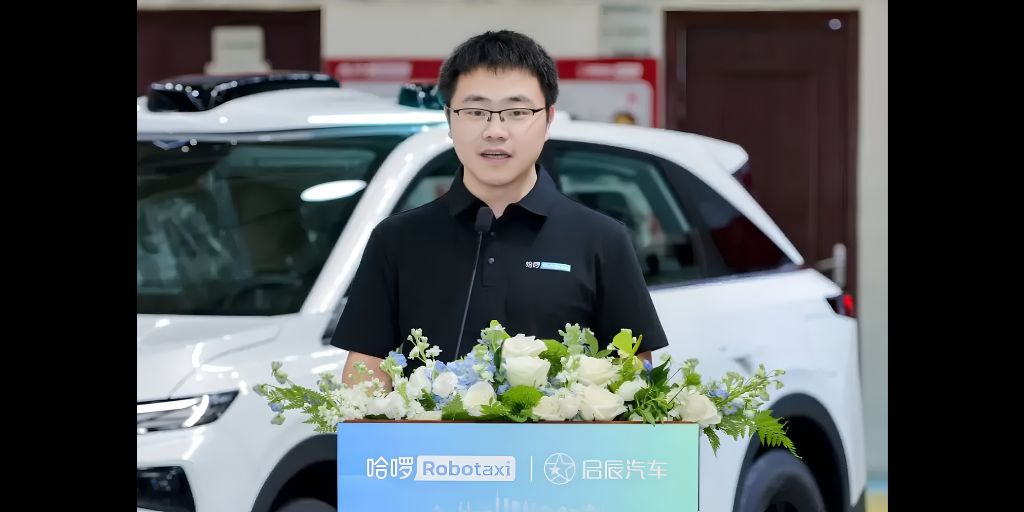
Over the past two years, a wave of Chinese ride-hailing and mobility companies have rushed into the Robotaxi business, each setting bold targets for how fast it will scale. Hello (哈啰) — the bike-sharing company — is one of them. In 2025 it teamed up with Ant Group and CATL to form Zaofu Intelligence (造父智能), and set a goal that startled the industry: 10,000 Robotaxis deployed by 2027.
The scepticism was immediate. “Many ride-hailing companies have never really done Robotaxi. They don’t understand how hard deployment is, so of course they set aggressive targets,” a senior executive at a leading autonomous-driving firm remarked a few months ago. Hello was one of the companies he had in mind.
Hello’s Robotaxi co-founder and CTO, Dr Yu Qiankun, recently held a candid interview with Chinese tech outlet Leifeng. We’ve pulled the most interesting points here:
- The entry window has already closed. Yu’s central claim is that 2025 was the last suitable moment to enter Robotaxi. Anyone starting to build autonomous-driving technology, data and operations from scratch today, he argues, is simply too late — the technical routes have converged and the leaders are too far ahead. What’s left is a narrow door for a specific profile: firms that already hold mobility licences and fleets (his example: a Guangzhou taxi operator sitting on 5,000 ride-hailing plates, adding Robotaxi as capacity on top), supply-chain players in chips, sensors and vehicles, and anyone with a cash-rich giant behind them.
- Technology is the weakest of the three moats. When asked what actually protects a Robotaxi business long-term, Yu named three barriers — and put technology last. First, licence quotas: road capacity is finite, and just as bike-sharing and ride-hailing ended up rationed by permits, he expects Robotaxi plates to become scarce. Second, operations: crisis handling, getting a person to a stranded car within minutes, dispatch and utilisation, keeping cost per vehicle down — the unglamorous machinery of running a fleet (his example: a car that blows a tyre must detect it and respond on its own). Third, data and long-tail scenarios. Technology itself, he argues, is a decaying advantage — open-source models and AI-assisted coding keep lowering the bar; the hard part is inventing new architectures, not adopting them. This is, in effect, his answer to the question in our title: most entrants treat Robotaxi as a technology race. He thinks the durable edges are regulatory and operational.
- He borrows Deepseek founder’s discipline argument. Yu explicitly cites Liang Wenfeng’s recent long interview and its insistence that companies stay restrained and focused. Applied to autonomous driving, the real question to answer is: are you a supplier fitting out other people’s cars, or a company committed to *L4 and selling an autonomous-driving service? Trying to be both — in his words, “wanting revenue, wanting profit, and wanting the L4 story all at once” — is how firms end up split against themselves. He points to Tesla as the clean counter-example: once it committed to L4, it shifted its entire R&D effort there and fed the results back down to *L2, rather than maintaining two systems forever.
MW Note: “L2” and “L4” are levels on the SAE scale of driving automation. For L2, the car can self-drive with human supervision. For L4, the car is capable of full self-driving, but only within a defined zone or set of conditions. - “First tier” isn’t about fleet size. Yu was dismissive of vehicle counts as a measure of leadership; they swing with policy, and latecomers can catch up fast. The metrics that matter are *Mileage Per Intervention (MPI) and **Mileage Per Critical Intervention (MPCI). Yu says MPI should be at least several thousand and ideally over 10,000 km; while MPCI should be on the order of 100,000 km. And all without sacrificing comfort or speed. The benchmark he keeps returning to is Tesla. MW Note: *MPI (Miles Per Intervention) and **MPCI (Miles Per Critical Intervention) are the industry’s core yardsticks for how good a self-driving system is. MPI is the average distance the car drives between human takeovers of any kind — the higher the number, the more the car handles unaided. MPCI counts only collision-related takeovers
- “L4 doesn’t lack data — it lacks data that solves problems.” One of the sharper lines in the interview. The flood of driving data coming off mass-market cars with assisted-driving features is, Yu says, largely useless for training a true driverless system: the sensors don’t match (a consumer car might have one forward *lidar; an L4 car requires several). Most drivers repeat the same fixed commute, and much of it is “dirty data” from sloppy driving. Hello’s answer is simulation plus its own fleet — staffed partly by former ride-hailing drivers who clock over 10,000 km a month. The catch: those drivers tend to be aggressive, so the team deliberately mixes in gentler drivers and fine-tunes with reinforcement learning to stop the car inheriting their habits.
MW Note: Lidar is the laser sensor self-driving cars rely on to gauge distance and shape. - The corner cases are wilder than the pitch decks suggest. Yu listed the long tail his cars have actually hit: construction-zone temporary traffic lights; a broken signal that skipped straight from green to red with no yellow, forcing the car to work out whether one bulb had failed or the whole array had; herds of cattle crossing a suburban road, where the car must keep its distance because a cow might charge it; a truck dragging a felled tree whose canopy spanned several lanes; rubbish trucks shedding debris as they drove; and children’s safety helmets lying on the road, small enough that even human drivers miss them. That last one, he said, his heavily-used test fleet met only once in a year — which is why they now manufacture such cases in simulation rather than wait to encounter them.
- The endgame he’s betting on reshapes car ownership, not just taxis. Yu wants Robotaxi costs down to under RMB1 per km — against roughly RMB2+ for a Guangzhou taxi and RMB1.8 in Wuhan today. His threshold thinking: once Robotaxis are around 30% of ride volume the experience improves noticeably, but at 50% and beyond the disruption changes category, hitting the entire passenger-car market rather than just taxis and ride-hailing. His arithmetic: a privately-owned car, held eight to ten years and driven 10,000 km a year, actually costs RMB4-5 per km once parking, insurance, maintenance and depreciation are counted — people keep buying only because hailing a ride isn’t yet convenient enough. He even floats a future where you still own a car but hand it to a platform to earn its keep while idle — the bike-sharing logic applied to cars.
- He doesn’t expect to win — he expects a “Three Kingdoms.” Unusually for a founder, Yu doesn’t forecast a winner-take-all market or claim Hello will dominate it. He expects Robotaxi to settle, like bike-sharing before it, into a roughly three-way split, with Hello’s aim simply to be one of the three and help lead the sector. For now he frames the field as collaborative rather than cut-throat — China’s Robotaxi fleet is still tiny next to the ride-hailing market — and openly welcomes carmakers like Xpeng, since Hello has ruled out building its own cars or chips and would happily operate someone else’s autonomous vehicles.
Yu provided a rare, honest look at where the real difficulty in Robotaxi lies. Food for thought.