




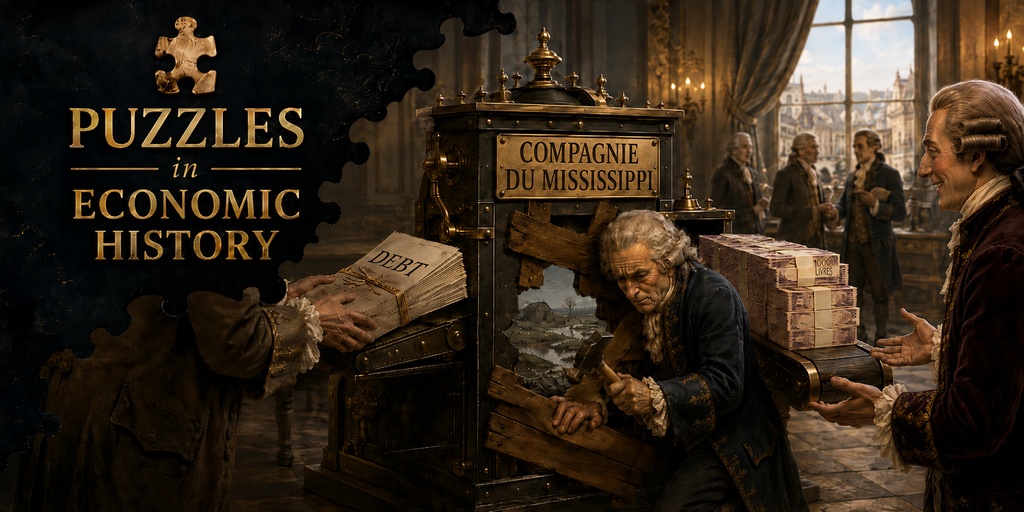
This series is adapted, with permission, from a Chinese-language series by our friend Marcus Ji, who looks at historical events through an economic lens. We have condensed and adapted the original for an international audience.
In 1715, Louis XIV died after seventy-two years on the throne, and France discovered what his glory had cost. Decades of near-continuous war had emptied the treasury. The crown’s debt was roughly equal to a full year of the nation’s output, around two billion livres. For comparison, a labourer earned about one livre a day. Tax revenue could not even cover the interest, let alone the principal. Government IOUs traded at deep discounts because nobody believed they would be repaid. The state had already tried everything respectable: the new Regent – Philippe II, Duke of Orléans – appointed a trusted duke to fix the finances through austerity and forced debt restructuring. It failed. Credit did not recover. Confidence did not return.
Then came the proposal from John Law: a Scotsman who had been sentenced to death in London for killing a man in a duel, escaped prison, and spent his exile living off his talent for odds at Europe’s gambling tables. His pitch sounded like a con: paper money can save a bankrupt nation. The Regent did not want to trust a condemned fugitive. He had simply run out of alternatives.
The proposal: paper money for a country with no money
Law’s idea, heretical for its time, is commonplace today. Money, he argued, is not the valuable thing itself – it is the measuring tool used in exchange. So it does not need to be made of scarce gold and silver. France was not poor in wealth; it was poor in circulation: farms, workshops and ports all stood ready, but with coin hoarded and credit dead, nothing moved. Print paper money, get the frozen economy turning, and taxes and debt would take care of themselves.
What made this persuasive rather than insane was that every component had already been proven abroad. Readers of our earlier instalment on the invention of the modern company will recognise the parts: Italian banks had shown that a bank could take deposits and lend most of them out; the Bank of Amsterdam had run reliable paper-based settlement for a century; the Dutch East India Company had shown that shares in a company could trade publicly and absorb a nation’s savings. Law’s pitch to the Regent was, in essence: England and Holland have already tested every piece of this machine. We will assemble them – and do it better.
In 1716 he was allowed to open a bank and issue paper notes, redeemable for coin. It worked. Trade began to move again. The notes were trusted – at first they even traded at a premium to coin. On the strength of that success, Law was allowed to build the rest.
The engine
Between 1716 and 1719, the Regent granted Law, piece by piece, an accumulation of powers no Frenchman had ever held at once:
- 1716 – a licence to open a private bank issuing paper money.
- 1717 – a company holding the trade monopoly over Louisiana, France’s vast North American colony.
- 1717–1719 – absorption of the tobacco monopoly and France’s other overseas trading companies, merged into one “Company of the Indies.”
- July 1719 – the right to mint France’s coins.
- August 1719 – the right to collect France’s taxes.
- Late 1719 – his proposal for the company to take over the entire national debt.
By the end, one man controlled the printing press, the mint, the tax system and all overseas trade. None of it was stolen; each authorisation looked like the solution to a problem, and was granted by a government that felt itself being rescued.
The final step was Law’s real invention: turning government debt into company shares. Imagine holding a royal IOU you privately know will never be repaid – nearly worthless paper. Law offered to swap it for shares in his monopoly company. In one stroke, you stopped being a creditor begging a broke government for repayment and became a shareholder in a super-company that owned North American colonies, all French overseas trade, and the tax system itself. Psychologically, you went from victim to owner. Holders of dead government paper rushed to convert. The share price climbed from 500 livres towards 10,000 and beyond. Paris went so wild that the French language ran short of words – “millionaire” was coined there in 1719 to describe people whose paper wealth had multiplied within weeks.
For about three years, this was a legitimate – even brilliant – piece of financial engineering, and it appeared to be working.
Louisiana: the lie that kept the engine running
The story holding up the share price was Louisiana: a New World territory supposedly carpeted with gold and silver, owned by the company. And here the business turned into something else – because the colony was real, but its wealth was not.
In 1719, the colonial governor reported the truth back to the company: no gold, no emeralds. The much-hyped city of New Orleans consisted of four rough houses; settlers were scraping by on swamp trade amid floods, snakes and yellow fever. Law received that report – and kept feeding the gold myth to Paris anyway, because by now the share price depended on it. He even shipped people to the swamp by force to make the colony look alive: prisoners and vagrants marched in chains to the ports, many dying en route. This is the moment a mediocre but real business became an actively maintained lie. Law had stopped being a theorist and become a swindler.
Why was the lie necessary? Because of how the engine’s two gears locked together. To keep the share price up, Law had to guarantee that shareholders could always sell for cash; to supply the cash, his bank printed notes. The more notes it printed, the more people feared the paper was losing value, and rushed to swap it for gold and silver coin. To meet those redemptions and keep propping the share price, the bank could only print more. Print to prop the price; propping triggers redemptions; redemptions force more printing. Once started, the loop could not stop – and any crack in the Louisiana story would start it.
The numbers show the loop running. From January 1719 the notes lost their metal backing; within a year, paper in circulation rose roughly tenfold. By early 1720 the bank had issued over 2.6 billion livres in notes – against about 1.2 billion livres of actual gold and silver coin in the whole of France. The paper claimed to be worth more than twice all the real money in the country. Law then banned citizens from holding more than 500 livres in coin, forcing everyone onto paper – and when a government must force its people to use a currency, it has announced the currency is not worth what it claims.
Meanwhile the governor’s “no gold” report was quietly spreading. The best-informed acted first: the Prince de Conti converted his notes into so much gold it took three carriages to haul away; in early 1720, two royal princes cashed out their shares. While the newly minted “millionaires” were still dreaming in paper, the people closest to power were carting metal home.
The collapse, and the eighty-year bill
On 21 May 1720, Law delivered the fatal blow himself: a decree cutting the face value of notes and shares by half in stages, intended to deflate the system gently. It backfired completely – the government had officially admitted its money was not worth its face. A nationwide scramble to convert paper into coin began, and every emergency measure made the panic worse. On 17 July, a crowd besieging the bank crushed fifteen people to death. The share price fell from about 12,500 livres to 200 by year’s end. In December, Law fled France in disguise, leaving nearly his entire fortune behind; he died poor in Venice in 1729.
But the real bill ran for decades. France’s trust in paper money was destroyed for roughly eighty years – the country retreated to metal coins until the Revolution forced paper back into use. The crown’s credit never fully recovered: Louis XV found borrowing ever harder while Britain financed itself cheaply, and that gap in borrowing power became one underlying reason France lost the contest for overseas empire – including North America – to Britain. Deepest of all: the crash wiped out the middle-class and noble investors alike, bred a lasting hatred of financiers and royal finance, killed serious tax reform, and quietly compounded the debts that would eventually detonate the French Revolution. Part of the fuse lit in 1789 runs all the way back to 1720.
The manual someone left behind
One of Law’s early partners, an Irish banker in Paris named Richard Cantillon, had worked out the engine’s mathematics before it blew: if the bank had to keep printing unbacked notes to hold up the share price, the French currency itself had to fall. He bet on that fall, converted his profits into gold, moved them out of France – and, in the 1730s, wrote the essay that turned the experience into a permanent lesson.
His observation is now called the Cantillon Effect: when a government or bank creates new money, the money does not spread evenly through the economy. It enters at specific points – banks, financial markets, government spending. Whoever receives the new money first gets to spend it before prices rise. Whoever receives it last – or never – faces prices that have already risen and purchasing power that has already shrunk. Picture a fire hydrant opened in the street: whoever stands at the nozzle gets drenched; by the time the water reaches the far end of the street, there is only mist. Inflation is never “everyone gets poorer at the same rate.” It is a transfer of wealth, ranked by your distance from the printing press.
That sentence threads three centuries. In 1720, the princes nearest the machine converted paper to gold first, while the last buyers went to zero. After 2008, and again during the pandemic, central banks created money on a vast scale to buy bonds – the US Federal Reserve alone bought some $4.4 trillion of them in two years – and that money reached financial markets and asset owners long before it reached anyone’s salary. Asset prices soared while wages lagged: the Cantillon Effect in modern dress, and one honest answer to “why does everything feel less affordable, despite all this money?” Crypto runs the same machine on fast-forward: whoever gets a token in the private round can sell before the price adjusts, while retail buyers arrive last – at the far, misted end of the street.
The same machine, in a novel
A hundred and sixty years later, Émile Zola wrote the machine into a novel, L’Argent (“Money”). His banker floats grand ventures in the Middle East, plants news stories, pumps his own shares; insiders exit at the top; small savers are ruined. Zola wasn’t retelling Law – he based it on a real French bank collapse of 1882. That is exactly the point: the machine re-stages itself every few decades, with new scenery. One detail to smile at: Zola’s ruined banker flees towards Belgium – the same direction Law ran in 1720.
A drowning regime handed over every power. A real colony was fed into a lie. The first people to hear the truth carted their gold home in three carriages. Law built the machine; Cantillon wrote its manual; Zola turned it into a novel; and France paid an eighty-year bill for the first test drive. We still live inside that machine today. The only differences are which end of the water pipe you stand at – and whether you have read the manual.
Previously in this series: How to not fall for a Madoff-style Ponzi scheme?
Next in this series: Was Madame Bovary a victim of Buy Now, Pay Later?