



This series is adapted, with permission, from a Chinese-language series by our friend Marcus Ji, who looks at historical events through an economic lens. We have condensed and adapted the original for an international audience.
Madame Bovary, published by Gustave Flaubert in 1857, is one of the most famous novels ever written. It is set in a quiet Normandy village in rural France, and it follows Emma Bovary – a farmer’s daughter who marries a dull country medical officer and finds provincial married life unbearably small. Dreaming of the romance she read about as a girl, she takes lovers, and she spends: cloth, furniture, gifts, all on credit extended by the local shopkeeper, Lheureux. The debts quietly compound until they are beyond any hope of repayment. Cornered and exposed, Emma swallows arsenic and dies at twenty-five. Her heartbroken husband dies soon after, and their daughter is sent to work in a cotton mill.
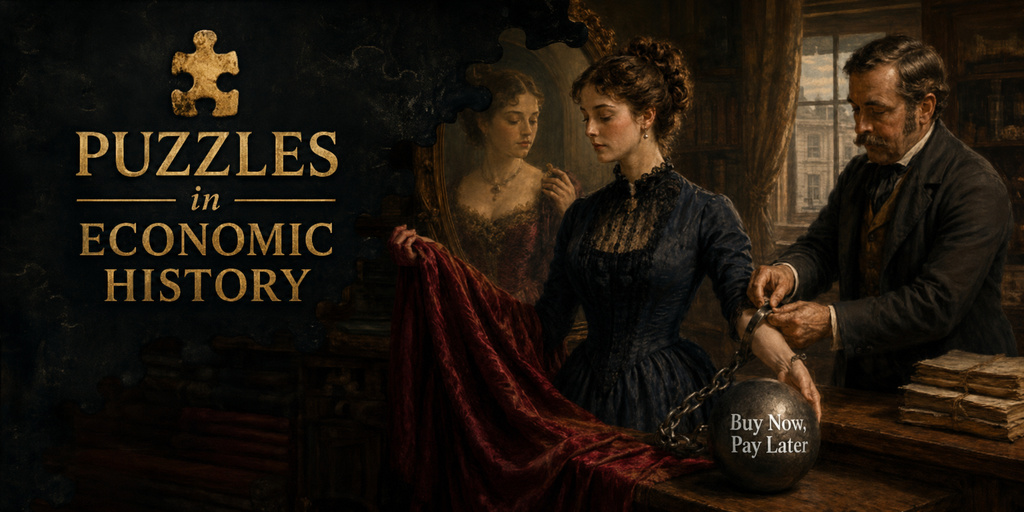
For 168 years, readers have filed this under “romantic tragedy” – a restless woman who had affairs, ran up debts, and killed herself. We would like you to see it from another angle. Look at who was actually holding the pen on those debts, and Madame Bovary turns into something else entirely: the story of a woman destroyed by Buy Now, Pay Later – a full century and a half before the phrase existed.
The shopkeeper was running a modern finance system
Buy Now, Pay Later is the model behind apps like Klarna, Affirm and Afterpay: you take the goods home today and pay in installments later, while the lender earns its money from fees on the merchant, charges on the buyer, and interest hidden inside the deal. It feels like a product of the smartphone age. It is not. Flaubert described the whole machine in 1857, in the person of a village shopkeeper named Lheureux.
Six details from the text, all easy to miss, give it away.
- Charles Bovary was not legally a doctor. Emma’s husband holds the title officier de santé – a second-tier medical officer that France created in 1803 to serve regions short of real doctors. Three years of training instead of six; barred from complex surgery; the rank was abolished entirely in 1892. Emma thought she had married a doctor. She had married the legal budget version – and Flaubert drives it home when Charles attempts an operation beyond his competence and botches it so badly the patient’s leg is amputated.
- The shopkeeper’s name is a joke. Lheureux means “the happy one” in French. He is the one character who accumulates wealth, happily, from the first page to the last.
- The “independent broker” is his accomplice. Whenever Emma cannot pay, Lheureux says the debt is out of his hands now – a broker in Rouen named Vincart is chasing it. Vincart is Lheureux’s partner. Passing Emma’s IOUs to Vincart lets Lheureux pretend he is no longer the creditor, so he can play two roles at once: the sympathetic middleman, and the real beneficiary. This is a handmade version of what banks did in 2008 when they packaged bad loans into separate shell companies to distance themselves from them.
- His cut was 10%. The text is explicit: Emma borrows 2,000 francs and receives 1,800. The missing 200 is skimmed off as “discount and commission” – for his friend Vincart, of course. A 10% bite on a single loan, higher than the effective take of most Buy Now, Pay Later firms today.
- Emma’s debt equaled three to eight years of Charles’s entire income. She dies owing 8,000 francs. A village officier de santé earned between 1,000 and 3,000 francs a year – so her debt was three to eight years of his total, pre-tax income. Even eating nothing and paying no tax, Charles would need three to eight years to clear it. Scaled to a median American household today, that is like taking on roughly US$240,000 to US$640,000 of high-interest consumer debt – repayable, in the Buy Now, Pay Later model, within months.
- Charles left his orphaned daughter twelve francs. That is the figure in the text. A family that once owned a full medical officer’s estate was reduced to twelve francs within two generations of Lheureux’s work.
Lheureux, translated into a modern business plan
Read the book again with those six facts in hand, and Flaubert has drawn a complete fintech business plan – with unnerving precision.
- Buy now, pay later. Lheureux never asks for cash. Emma admires a length of cloth and leaves the shop having signed a promissory note. Goods now, payment later – the ancestor of the “Pay in 4” that Klarna “invented” in the 2000s.
- Lending at a hidden discount. Borrow 2,000, receive 1,800. What looks like a fee is really high interest in disguise.
- Selling the debt to a shell partner. Once the debt is “transferred” to Vincart, Lheureux stops being the creditor and becomes the middleman – free to express sympathy, keep collecting, and pose as Emma’s rescuer when she needs a new loan.
- Expanding the collateral. When Emma can’t pay, Lheureux persuades her to have Charles sign a general power of attorney handing her control of his property – which she can then sign over to Lheureux. A simple consumer debt is quietly upgraded into a loan secured against the family’s entire estate, and Charles has no idea.
- Repeating the cycle. When Lheureux first appears, the novel notes he has already ruined the local innkeeper. Emma is not his first prey. He has a repeatable playbook.
Line Lheureux up against the modern industry and the script is identical, only industrialised:
| Lheureux (1857) | Buy Now, Pay Later industry (2025–26) | |
|---|---|---|
| Take per loan | 10% (200 of 2,000 francs) | 3–6% merchant fee + late fees + hidden interest |
| Default outcome | 100% – Emma dead, Charles ruined | Klarna ~0.9% (2025); rising across the sector |
| Scale | one village | ~US$560 billion global volume (2025) |
| Users | one family | ~53 million US users (CFPB, Dec 2025) |
| Missed payments | – | ~24% of users miss at least one |
| Regulation | none | US regulators first flagged it as a systemic risk in early 2026 |
| Transparency | none – Emma can’t total her own debt | credit scores only began counting it in 2025 |
Add the modules together and you have the core architecture of any fintech company in 2026. The only difference is scale: Lheureux could target one village in a lifetime; the Buy Now, Pay Later industry moved roughly US$560 billion in goods in 2025 and now has about 53 million users in America alone. Widen the lens to all consumer credit and the numbers get colder still – US credit-card issuers earned around $170 billion in interest in 2024, payday loans run at an average annual rate near 391%, and total US non-housing household debt has passed $5 trillion. Behind every one of those figures is an industrialised copy of Lheureux.
Why was Emma the only one poisoned?
If Lheureux’s system was so complete, why didn’t he strip the whole village bare? The answer sits in a character almost everyone forgets.
Early in the novel, Flaubert describes an old spinster seamstress who visits Emma’s convent school each month to mend clothes – and smuggles in cheap romance novels for the rich girls: knights, noblewomen, moonlight, nightingales, the pulp-fiction dopamine of the day. She has no scheme. She is simply a low-level content courier: a user base of trapped, dreamy teenage girls; a content pool of popular romances; monthly distribution; paid in tips and belonging; responsible for nothing. Put her in 2026 and she is not a person but a system – a recommendation algorithm plus content operations plus engagement targets. Same mechanism; the only difference is scale. The seamstress could shape a few dozen girls in a lifetime; TikTok can shape hundreds of millions in a day.
But dozens of girls read those same novels. Almost all of them left the convent and switched to reality – marriage, children, budgets, households – and left the knights behind in a drawer. Only Emma treated the stories as an instruction manual for life. The stories were never the problem. The reader was. Emma’s mental immune system had three specific holes:
- Class anxiety. Emma is a rich farmer’s daughter – enough money to imitate high society, no first-hand experience of it. She has never seen how aristocrats actually live, so third-rate aristocratic novels have an outsized pull on her.
- Sensation over logic. In Flaubert’s own words: “she loved the incense, not the religion; the officer’s uniform, not the soldier.” Her mind processes colour, scent, texture and fine phrases – never “what does this cost?” or “what is the price of this later?”
- No reality check. She cannot tell a story apart from real life, and takes fiction for how the world actually works.
Stack the three, and the moment Lheureux walks in with his velvet, Emma is already ruined on the inside. The next few years are just the outside world catching up.
This condition even got a formal name. In 1892, the philosopher Jules de Gaultier coined bovarysme – “the power of a person to conceive of themselves as other than they are.” A generation later, an anthropologist extended it to whole nations: collective bovarysme, an entire society systematically imagining itself to be something it is not. The 2026 patient list is long: everyone financing luxury on instalments; every renter curating a “middle-class life” online; every unemployed person whose profile reads “Stealth Startup Co-founder.” It is not a moral failing. It is a flaw in how the mind is built.
The only winner in the whole book
Take every major character to the last page:
| Character | Ending |
|---|---|
| Emma (the wife) | poisons herself at 25, ~8,000 francs in debt |
| Charles (her husband) | dies of grief; leaves his daughter 12 francs |
| Berthe (their daughter) | sent to a cotton mill as a child labourer |
| Rodolphe / Léon (her lovers) | walk away unharmed; one marries well |
| Homais (the pharmacist) | wins the Legion of Honour |
| Lheureux (the lender) | absorbs the Bovarys’ entire estate |
Note Homais especially – a boastful, opinion-manipulating quack who caused a serious medical injury. Flaubert hands him the book’s highest honour, France’s Legion of Honour. It is the novel’s most poisonous stroke.
Why does Lheureux win? Three rules:
- He never invests emotion. He shows feeling exactly once – faking grief at Emma’s funeral.
- He doesn’t sell products, he sells cash flow. The cloth and velvet are just the vehicle; credit itself is the real product, which is the essence of all finance.
- He harvests systematically, not case by case. Emma is neither his first victim nor his last, because he has a repeatable script.
Flaubert wrote all three rules down in 1857. Readers missed them for 168 years, because Emma’s tears blocked the view.
What a 2026 reader can actually use
The book compresses into a few workable rules.
- Before any spending above roughly 10% of your annual income, answer three questions: Does the repayment come from money you already have, or money you only expect? If your income halved for twelve months, could the debt survive it? And who actually ends up holding this debt – can you negotiate with them directly? Emma failed at the first question.
- The structure of a debt matters far more than the amount. A 30-year mortgage at 6% is low-danger; a credit card at 22% rolling on minimum payments is high; short-term Buy Now, Pay Later notes at an effective 20–40%, due within months, are the most dangerous of all. Emma didn’t borrow too much so much as she borrowed in the worst possible structure – all 8,000 francs of it in that last category.
- Above all – the stories reached Emma because she had no way to check fiction against reality. That mental defence is trainable: check whether a claim comes from a primary source or a second-hand retelling; watch for survivorship bias (is this success story from the full sample, or the 0.1% you were shown?); wait 24 hours after being excited before deciding; and think in probabilities – if this happened 100 times, what is the average outcome?
There is no smoke without fire
For all his cunning, Lheureux could only ever succeed because someone was willing to sign. His entire talent was reading two levers – information the customer didn’t have, and the customer’s own status anxiety – and there will always be another Emma with both. That is why the model never dies: one Klarna lists on the stock exchange, its share price swings, another is born, because the business feeds directly on a flaw in human cognition, and that flaw is constant.
So the moral is not that lenders are evil. It is that the bait only works on those who reach for it. The minimum standard for reading Madame Bovary is that afterwards, you are no longer Emma. The higher standard is that you can spot every Lheureux – in the news, the ads, the feed, your own shopping cart. The highest standard is that you can spot the little bit of Lheureux in yourself. A hundred and sixty-eight years on, the book has not expired. It may never expire.
Previously in this series: How did a Scottish prisoner “save” the French empire?
Next in this series: What was the critical flaw in Thoreau’s Walden?