



This series is adapted, with permission, from a Chinese-language series by our friend Marcus Ji, who looks at historical events through an economic lens. We have condensed and adapted the original for an international audience.
In 1845, an American writer named Henry David Thoreau built himself a small cabin beside Walden Pond in Massachusetts, lived there for two years, and wrote a book about it. Walden, published in 1854, became one of the most influential works in American literature – the founding text of anti-consumerism, and still the book quoted whenever someone argues that owning less buys freedom.
Its most famous number is the cost of the cabin: $28.12. Thoreau built it for the price of some boards, nails, second-hand windows and a thousand old bricks, and offered the result as a kind of personal financial experiment. Spend almost nothing, work only a few weeks a year, and you can buy back most of your time for reading, writing and thinking. Less consumption equals more freedom.
The experiment has a critical flaw, and it is an accounting one. Walden reports only the cash Thoreau spent. It leaves out every asset that made the experiment possible in the first place – and in doing so, it reverses cause and effect. It presents freedom as the result of frugality, when in Thoreau’s case freedom was the precondition for it. Proving this needs no accusation of hypocrisy. It only needs an audit – and history has handed us the perfect auditor: another man, living two miles from Thoreau’s cabin at the very same time, whose accounts were the mirror image of his.
What Walden put on the books
Start with the figures Thoreau himself disclosed. The cabin cost $28.12, measured 10 by 15 feet, and sat about two miles from the town of Concord – a 20-minute walk, not a wilderness. He lived there two years, grew beans on a couple of acres, did a little writing, some land surveying, and the occasional shift at the family workshop. His conclusion: keep your living costs low enough, and a few weeks of light labour a year will cover them, freeing the rest for the life of the mind.
That is the whole of the disclosed account. It is simple, it adds up, and it looks repeatable – which is precisely why Walden became the anti-consumerism bible. The problem is that this is only the cash-flow side of the ledger. The capital that actually held the experiment up – the fixed assets, the credit line, the safety net – never appears on it.
The same moment, two miles away
A few miles from Walden Pond lay Baker Farm, and there lived John Field, an Irish labourer who had come to Massachusetts after the potato famine. Field’s job was to dig up bog turf so a landowner could plant crops. The wages never bought land; they bought a rented spot in a leaking shack, where he lived with his wife, several children and a baby.
His accounts were the opposite of Thoreau’s. An unskilled labourer in the 1840s earned under 75 cents a day, working 10 to 12 hours; at best, Field grossed perhaps $187 a year – every cent of it spoken for by feeding his family. His downside risk was total: any illness, any injury, any layoff, and the whole household went hungry. He had no family business, no qualification, no wealthy friend lending him land, no mother to fall back on – and, as an Irish immigrant in an era when “No Irish Need Apply” was a normal line in job advertisements, he sat at the bottom of the social order. Now set Thoreau’s real balance sheet beside it.
The assets Walden never disclosed
These are the items that made the experiment possible, and that the book leaves off the page entirely.
- The land was free – and borrowed. The woodland by the pond belonged to Ralph Waldo Emerson, one of the most important figures in American letters and Thoreau’s mentor, who let him build on it. Lakeside woodland near Concord was not worthless, yet none of its value entered Thoreau’s “cost of living.”
- A Harvard degree. Thoreau graduated from Harvard in 1837, at a total cost of around $716. Put that number next to Field: a single year of Harvard cost roughly a full year of an Irish labourer’s wages. But the real value was the door it left open – a Harvard man could live in a cabin for two years and still come back to lecture in Boston and be received as an intellectual rather than a vagrant. Field could never have that option.
- A family business as a safety net. Thoreau’s father ran a respected pencil factory that funded the family’s comfortable middle-class life and Henry’s Harvard fees. This meant Thoreau’s downside was fully hedged: if nothing grew and nothing sold, he could walk back into town and draw wages at the family workshop – which he did, before and after Walden. Field had no such hedge. If Field fell ill, his family starved.
- A domestic support network. Thoreau walked the 20 minutes into Concord several times a week, drawn by his mother’s cooking and meals with friends, and hosted visitors at the cabin – sometimes as many as thirty. His mother and sisters visited the pond weekly, bringing food that never appeared in the accounts. (This was the gender division of the era, not personal hypocrisy – but the support was real, and Field’s household had only its own members to lean on.)
- No wife, no children. Thoreau never married and had no children, so his family-support obligations were zero. This is the least conspicuous item on the sheet and the heaviest. The cost of raising a family cannot be compressed towards zero; the “$28.12 cabin plus home-grown beans” model is structurally available only to the single and childless. Field was married with many children. He could not “drink less tea and work less” – his wife and children still had to eat.
- A standing invitation back to the elite. As a Harvard-educated member of Emerson’s circle, Thoreau held a permanent option to abandon the experiment and rejoin polite society as “that interesting hermit philosopher” – which is exactly what he did. Field, however much he saved, would remain a bottom-rung immigrant labourer. No Harvard, no Emerson, no way back in.
The chapter where Walden refutes itself
All of this comes to a head in Walden‘s tenth chapter, “Baker Farm” – the passage where, without realising it, Thoreau turns his own theory’s failure into a case study.
Sheltering from a thunderstorm in Field’s leaking cabin, Thoreau, having just seen the family’s poverty, proceeds to preach his method to them. You work so hard, he tells Field, because you buy tea, coffee, butter, milk and meat; give those up as I have, and you won’t need to work so hard. The text records the response plainly: Field “sighed” at this, and his wife stared at Thoreau with her hands on her hips. Thoreau then concludes that a man like Field will probably never escape his lot, because he was “born to be poor” with an “inherited Irish poverty.”
Set the ethnic prejudice aside – it was common in 1840s New England, and judging a 19th-century man by 21st-century standards misses the more important point. The methodological point stands on its own: Thoreau stood in front of a poor man, sold his own way of life as a universal law, and never noticed that every precondition for that law – the family backstop, the Harvard degree, Emerson’s land, his mother’s food, having no wife or children – was absent from Field’s balance sheet. When Field did not follow the method, Thoreau blamed his race rather than the limits of his own framework. He had, without knowing it, run the experiment on someone lacking the hidden assets, watched it fail, and recorded the failure himself.
The real error: mistaking a cause for an effect
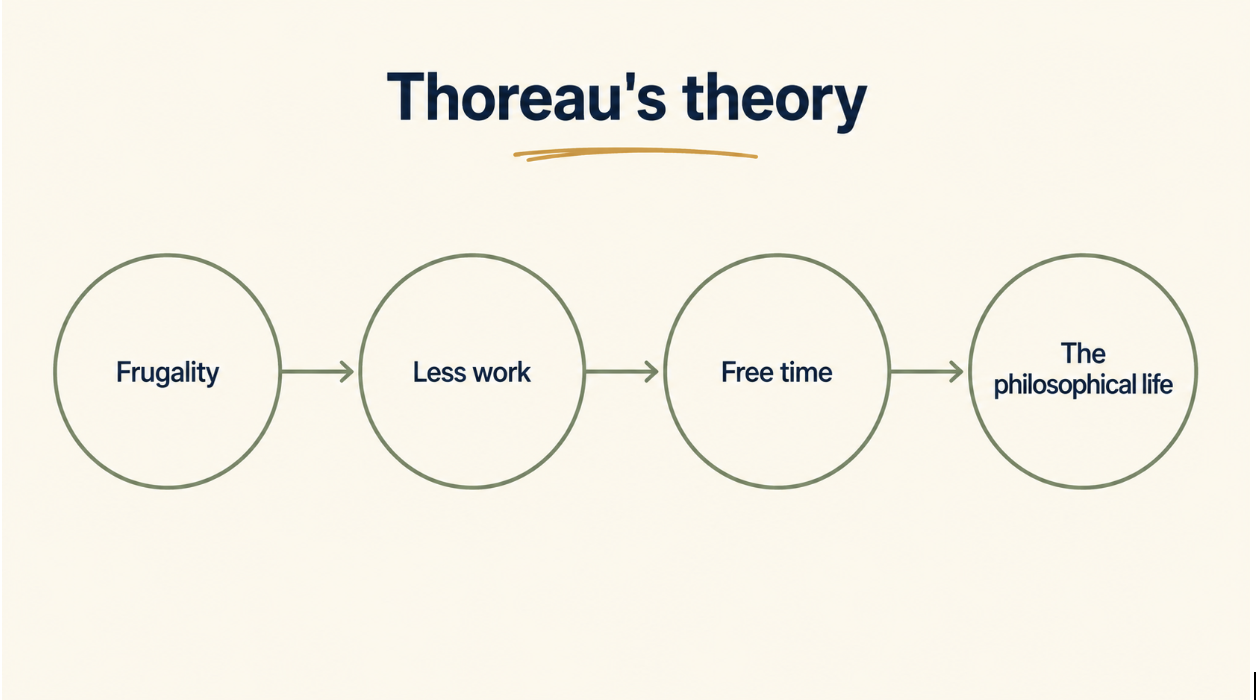
Lay the two ledgers side by side, and the flaw is clear. Thoreau’s book argues one chain – frugality leads to less work, which leads to free time, which leads to the philosophical life, i.e. a life spent on improving oneself.
The true chain, once the hidden assets are counted, is different. His structural capital – the family business, the Harvard degree, Emerson’s land, having no dependants, the standing way back into the elite – is what gives him the freedom to choose. Only that freedom lets him be frugal without sinking; and only then does frugality convert into free time and the philosophical life. In other words, all those hidden assets are the foundation that props frugality up.
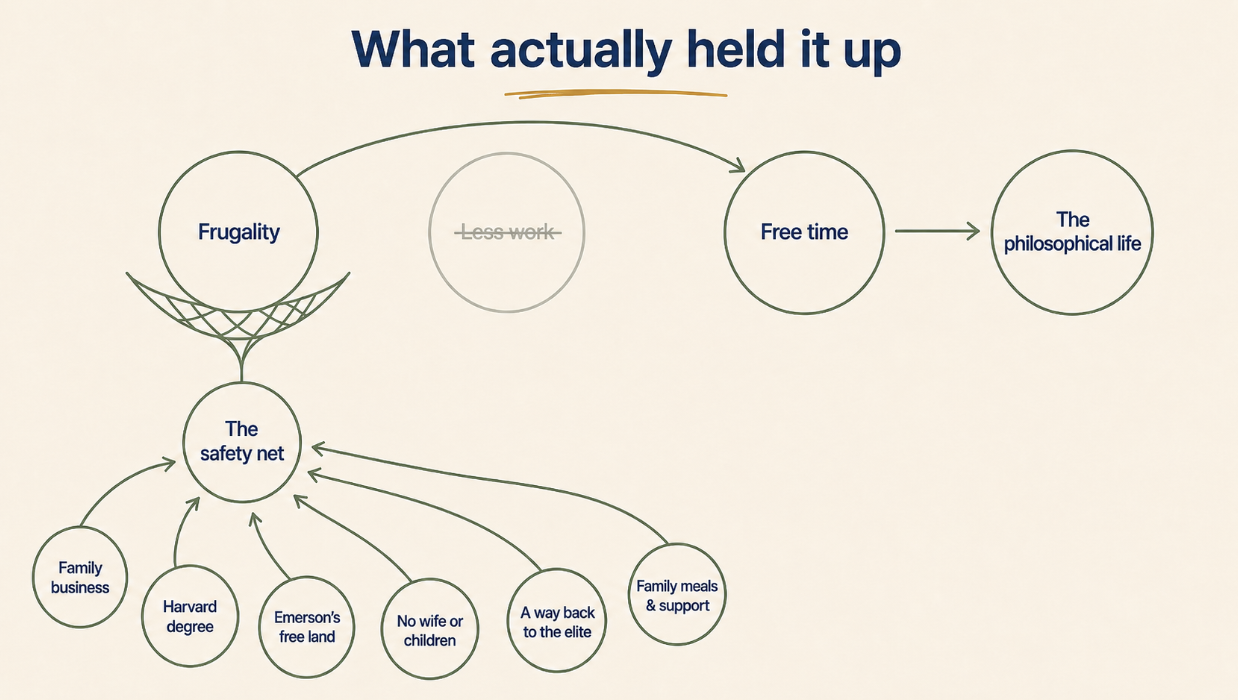
The difference is decisive. Thoreau’s version treats the freedom to choose as the reward for frugality – cut your spending and freedom will arrive. The true version treats it as the precondition – only once you already hold the safety net does frugality produce freedom; without the net, frugality just produces poverty. That is exactly what the Field chapter demonstrates. Thoreau believed frugality was enough on its own, so he believed Field only had to economise to be free. Field was unmoved, because he understood – perhaps not in words, but in his gut – that for him, frugality did not lead to freedom. It led to hunger.
The same missing entry, 170 years later
If this were only a 19th-century literary problem, it would be a matter for literary critics. It belongs in this series because the same accounting error reappears, almost unchanged, in today’s FIRE movement – “Financial Independence, Retire Early.”
Its most influential figure is Pete Adeney, who blogs as “Mr. Money Mustache” and retired at 30 on a story anyone can supposedly follow: frugality plus index funds. The fuller figures: he and his then-wife were both software engineers earning around $67,000 each, a household income near $134,000 – about 2.9 times the US median in 2005 – and they retired with roughly $600,000 invested plus a paid-off house. In his telling, two such salaries are simply “normal.” It is the exact blind spot of Thoreau calling his own safety net ordinary: the beneficiary treats his structural capital as a background constant, so it vanishes from the account. In fact Adeney’s blog itself reportedly earned around $400,000 a year – so his income from teaching people how to retire was several times his income from working. The chief spokesman for low-consumption living does not actually live it.
The pattern repeats across the movement. The bloggers behind “Frugalwoods” preached a 70%+ savings rate before retiring to rural Vermont – on the back of two high salaries, a $460,000 Cambridge house, and the rent it later threw off. A 2021 academic paper called FIRE “conspicuous non-consumption,” noting that its advocates typically start from privileged incomes and existing financial knowledge that ease the path to living off assets. The movement even coined a self-mocking variant, DIRE – Delay, Inherit, Retire, Expire – an honest admission that for most people without structural capital, the real route to early retirement is not thrift but inheriting from one’s parents. It is the one thing Thoreau never conceded.
Why the error refuses to die
Why has an error this visible survived from 1854 to today? Four mechanisms keep it alive:
- The writers are beneficiaries, genuinely blind to their own safety nets. Thoreau really believed his freedom came from thrift, as Adeney believes his came from his savings rate. It is a blind spot, not a con – it is hard to see the ground you are standing on.
- Readers prefer the self-help version. A story like “spend less and you’ll be free” is appealing because it puts the outcome in your own hands. “You need money and a safety net first” does the opposite, so it’s far less popular – whether or not it’s the truth.
- Simple ideas spread; accurate ones don’t. The idea of “Live simple, live free” is short and catchy. The accurate version comes loaded with conditions and caveats, and nobody shares something that long.
- Marketing rewards simple ideas. Minimalist blogs and FIRE bestsellers make their money by promoting an idea simple enough for everyone to understand. That income gives them every reason to keep the message simple, and none to complicate it with the accurate version.
A corrected minimalism
None of this is an argument against minimalism, or against Walden as literature – as an essay it is superb; it is only flawed as a report on whether its way of life can be copied. A corrected version needs two moves.
First, audit the hidden assets. Whenever you meet a “less is more” story – from Thoreau, from a FIRE blogger, from anyone – the first move is to look for what the account leaves out: family background, education, health insurance, whether the writer has dependants, whether they live somewhere they could re-enter a high-income career, and whether elite circles would take them back. Once those are visible, the story returns to its true scale – a workable solution under specific conditions, not a universal law.
Second, reverse the order. For an ordinary person – no inherited capital, no elite degree, dependants to support – the real advice is dull: build the hidden assets first (stable insurance, an emergency fund, in-demand skills you can re-enter, a support network, secure housing), and only then decide whether to strip your consumption down. Do it the other way round – cut spending first and wait for freedom – and, statistically, what you reach is not freedom but fragility.
Previously in this series: Was Madame Bovary a victim of Buy Now, Pay Later?
Next in this series: Why was Jane Austen’s Darcy rational instead of proud?