



On the occasion of its first anniversary in Saudi Arabia, Meituan’s overseas food delivery business Keeta is set to launch in Dubai, UAE this Saturday:

By the end of this week, Keeta will have expanded into three new Gulf markets within just two months – Qatar was launched in August and Kuwait on September 15.
It also seems that Keeta’s launch in Kuwait received strong support from many strong brands:

Affluent markets
The six GCC countries (Saudi Arabia, UAE, Qatar, Kuwait, Bahrain, and Oman) have a combined population of around 60 million, with an average GDP per capita of about US$34,000 (slightly higher than Japan and South Korea).
By contrast, the six major Southeast Asian countries (Singapore, Malaysia, Thailand, Vietnam, the Philippines, and Indonesia) together have 10 times the population of the Gulf States, but less than 2 times the total economic output. The consumption power of Gulf countries should not be underestimated.
The UAE, with a GDP per capita of more than US$49,000, has an economy slightly more than half times the size of Saudi Arabia’s. Of its 10 million residents, only about 12% are Emirati citizens, while around 60% are South Asians.
Many consumers in Dubai seem to have been anticipating Keeta’s launch already. On September 10, Keeta had already climbed to the top of Dubai’s app store ranking in the food & beverage category:

DeliveryHero’s granaries
For German delivery giant DeliveryHero, Talabat (focused on Dubai), HungerStation (focused on Saudi Arabia), and Baemin (in South Korea) are its three “granaries” – long supporting subsidies for its loss-making operations in other regions, including Foodpanda in Southeast Asia.
However, as we previously noted, these three “granaries” are now under pressure. In addition to Keeta’s competitive push against HungerStation in Saudi Arabia and now Talabat in Dubai, Coupang Eats – the food delivery business of Korean e-commerce platform Coupang – might have surpassed Baemin in Q2 this year to become Korea’s largest food delivery platform by order volume.
This year, Talabat went public in Dubai in a high-profile IPO. Its market cap has remained largely unchanged at around USD 7.3 billion.

Meanwhile, DeliveryHero – listed in Germany and holding 80% of Talabat – has a market cap of only EUR 7.38 billion (about USD 8.67 billion). While this is largely due to differences in bourses, it still leaves DeliveryHero’s executives quite frustrated.
Fair competition
Just this month, Dubai’s Consumer Protection & Fair Trade Authority (DCCPFT), based on the new 2023 Antitrust Law, issued regulatory guidance for the food delivery market. The main goal is to prevent players with dominant market positions from using non-transparent practices to squeeze out competitors.
At its early growth stage, Keeta certainly does not constitute a dominant market position – but it cannot be ruled out that competitors may take advantage of various laws and regulations to report or attempt to restrict Keeta’s development.
Beyond food delivery, Meituan’s overseas drone delivery business Keeta Drones has already obtained licenses and launched in Dubai:

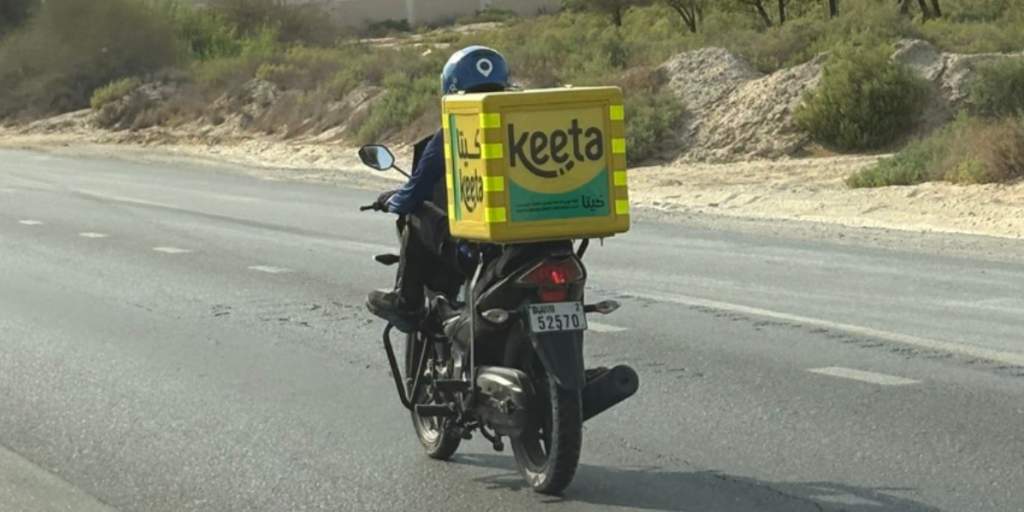
Meanwhile, photos of Keeta riders – probably after training sessions – have been widely circulated in many WhatsApp groups:

Finally, can anyone explain why Grab’s stock price has risen by nearly one-quarter over the past month?