




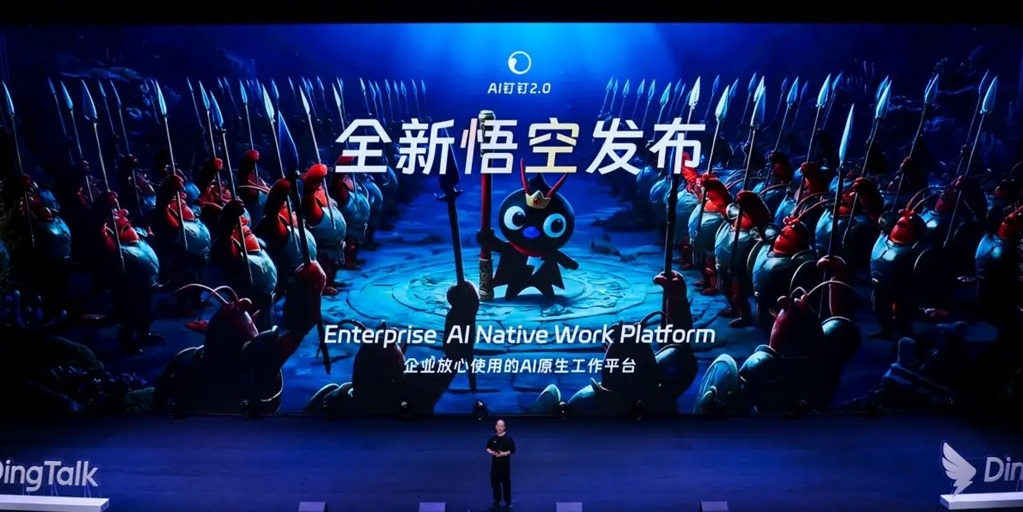
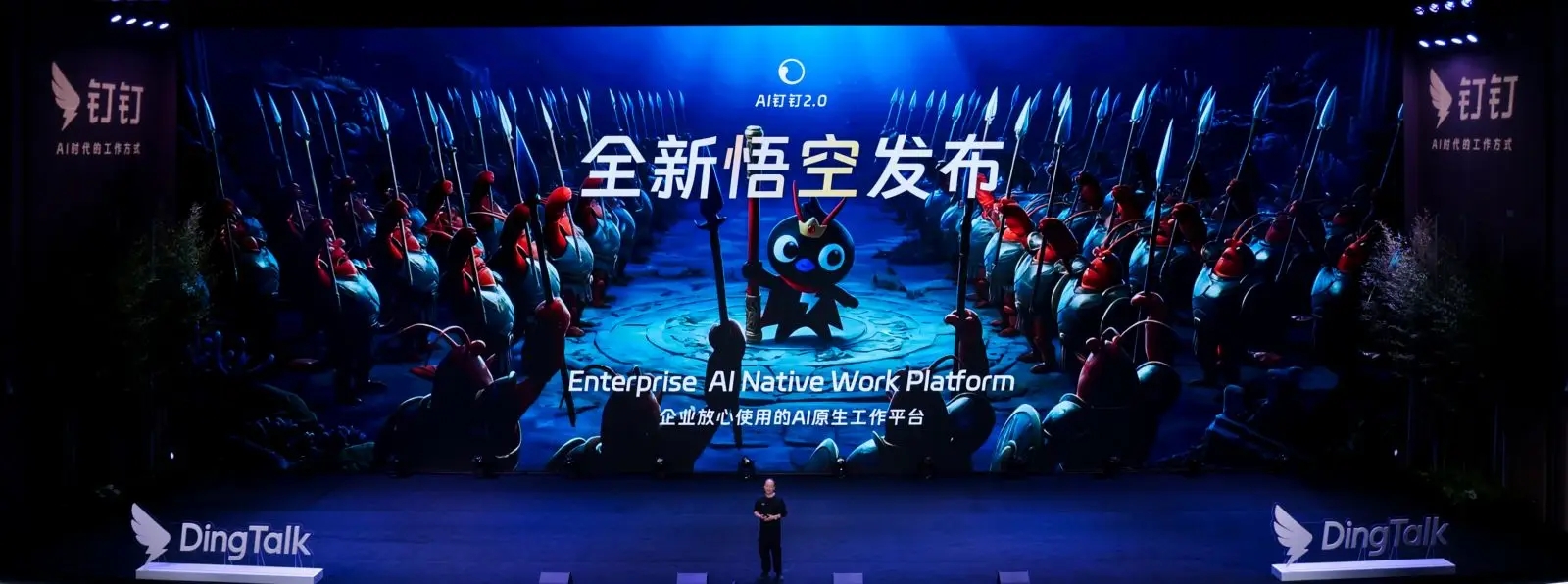
At a recent business conference, Chen Hang (陈航), founder and CEO of Alibaba’s productivity suite DingTalk, gave a keynote which sounded more like a manifesto on what AI is actually doing to companies.
DingTalk is a workplace collaboration platform developed and used by Alibaba, and claims to have hundreds of millions of users across Chinese enterprises. DingTalk covers messaging, video conferencing, approval workflows, document collaboration, HR and task management.
It has recently added an built-in AI agent called Wukong (悟空 – named after the mythical Monkey King in Chinese classic “Journey to the West”), and it plugs into Alibaba’s Bailian (百炼) platform, which allows deployment of AI applications on top of enterprise data.
Chen Hang himself is nothing short of a legendary figure. He joined Alibaba’s founding team in 1999 as the company’s 1st intern. Starting from 2000, he spent a decade in Japan building applications within large enterprises. Since his return to Alibaba, he led the creation of DingTalk in 2015.
In 2020, the then Group CEO Daniel Zhang merged DingTalk with Alibaba Cloud, which led Chen to leave and create his own startup building smart appliances for overseas markets.
In 2025, Alibaba acquired Chen’s company, returning him to again lead DingTalk and its AI transformation.
Chen himself has a hard core reputation and drove his team hard as well. In 2025, he caused controversy in the media by inspecting the office (to see if the team is at work) at midnight.
DingTalk faces significant competition from ByteDance and Tencent, which run their own versions of productivity stack Feishu (or Lark for overseas markets) and WeChat for Work (or Wecom for international markets) respectively.
Below we’re sharing some of the sharpest judgments and observations from Chen’s speech. We have paraphrased some quotes and added context for easier comprehension by non-Chinese readers.
Note that we do not necessarily agree with these points – but Chen’s hardcore drive might actually make a difference on how AI for enterprises are shaped:
- The core of the steam age was not about making horses run faster – it was about establishing the factory system. That was a change in the system itself and in how work was done. The core of the internet age was likewise not about information running faster – it was about a fundamental change in how information was produced and transmitted. The core of the AI age is not about making employees more efficient either. It’s about how an organisation, an enterprise, or even an individual restructures the relations of production, restructures the decision-making system, and restructures the entire mode of coordination. This is exactly what we argued earlier in our Momentum Works’ 10 predictions for Southeast Asia 2026: AI reshapes organisations before products.
- Right now many companies may still be buying software, or building their own. But it can be stated with certainty: the software era has come to a complete end. Because in the future, all software will be generated on demand, instantly. Software has become a “daily disposable” – just as people used to go to an optician to get fitted for glasses, but now mostly wear daily contact lenses, putting them on for different occasions and throwing them away after use. Software is heading in the direction of on-demand production and day-by-day evolution.
- In the past, in somewhat larger enterprises, the reporting chain from president to director to manager down to the execution level typically ran through 5 to 7 layers. Today, the middle layers of this system are gradually disappearing – management can connect directly with frontline employees, and the structure compresses to 1 to 3 layers. The transparency of data allows the decision-making layer to be directly linked to the data from frontline execution. This can truly be called a “God’s-eye view” – the boss doesn’t need middle-manager reports to know what every team is doing. The old situation of frantic reporting and discussion no longer exists; there is almost no delay in how information travels. The decision-making layer can clearly see how frontline staff are performing – across sales, production, service, design, and other positions. Everything is fully transparent.
- In the past, when an employee left a company, much of the company’s accumulated experience left with them. At the organisational level, this was because the company lacked any real vessel that could carry that experience or the company’s own identity. Now, every single thing that happens at a company – its associated memory is stored inside the company itself, and all the data is parsed by AI. For example, every meeting the company holds, every client visit by every employee, and the entire sales and service process is recorded by AI. Onboarding a new hire also becomes easier – the historical processes and decisions, as well as the rationale behind them, are stored, queryable, and expandable. If you spend time on GitHub, this will sound familiar: it maps closely to the emerging “skills” paradigm – portable, reusable capability packages like SKILL.md files. Chen is describing the same idea at the company level. The organisation itself becomes a library of skills, and it stops depending on any single person sticking around.
- Chen also made a strong claim: right now, some of the U.S. model companies and products – OpenAI, Gemini, and so on – look formidable on the surface, but the moment it comes to production, operations, and sales, they cannot compare with China. In manufacturing specifically, China’s leading position is beyond question. These are because China has a “highly concentrated manufacturing system and full-chain data accumulation” – a massive base of manufacturers, tightly clustered industrial belts, and the world’s richest industrial dataset covering design, production, distribution, and sales.
- Today’s AI believers look a lot like Taobao merchants circa 2004, when someone would suggest going to Taobao to do e-commerce. At the time, 99% of people thought Taobao was full of scammers and counterfeits. (Taobao’s early years had a real reputation problem – consumer trust was thin, payment infrastructure was nascent, Alipay’s escrow model was still proving itself out, and “going to Taobao to sell” sounded to most professionals like setting up at a flea market.) When Chen returned to China in 2010, Taobao had over 3,000,000 merchants, and nearly 400,000 of them were doing over 1,000,000 RMB in annual revenue. These people didn’t make any noise about it – they were quietly getting rich. AI today is the same: the people who truly believe in it, understand it, and are using it to rebuild their organisations are still a minority, and most of them are staying quiet about it.
- There has to be someone inside the company who truly believes in AI. If a boss spots a young person who is seriously digging into AI, empower them. Otherwise – take the many departments inside a company as an example – the people responsible for purchasing software and maintaining it will often claim the technology isn’t mature yet, that it has all kinds of problems. Look again 2 or 3 years later: if your competitors have managed to fully leverage their company data, the biggest gap between your company and theirs will show up as a gap in iteration speed. Their iteration cycle is measured in days, while yours is measured in months. At that ratio, the gap widens at a compounded speed.
- In the current era there are two kinds of people: those who have some understanding of AI, and those who lack an understanding of AI. Most people tend to listen to other people’s opinions, but rarely go and try it out for themselves.
- If a company wants to become an AI-native organisation, the most basic principle is to use AI to analyse and map out every process. This process no longer relies on people to organise, summarise, and archive – instead, it skips over the middle layers and goes directly to the frontline processes for analysis and guidance. The model of granular division of labor no longer applies, and “daily disposable” software will keep emerging. This kind of software can be generated automatically on demand – there’s no need to go to a software company for custom builds or fixes.