


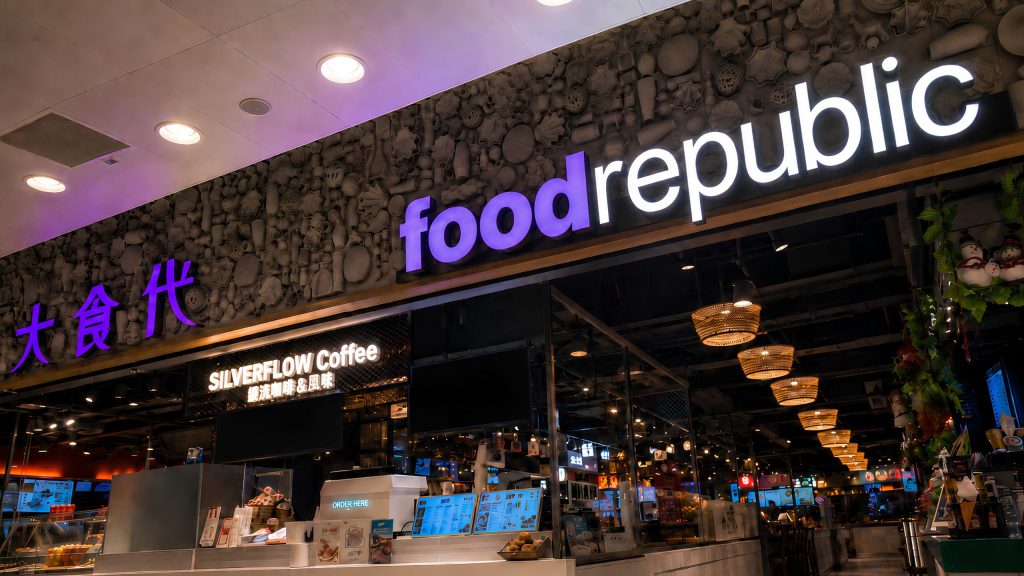
On 15 June, Food Republic, the food court chain operated by Singapore’s BreadTalk Group, will close the Oriental Plaza branch, its final outlet in Beijing.
That store, opened in 2000, was their first one in Beijing, ending the chain’s 26-year run in the capital where it began.
It is tempting to read this as another foreign consumer brand losing its place in China. That would be the obvious story. It is also not the most interesting one.
Food Republic’s Beijing exit matters because it shows how quickly a once-useful consumer format can become obsolete in China.
A format built for 2011, running in 2026
The food court was never really a restaurant business. It was an aggregator.
In 2011 it solved a specific set of problems for the Chinese mall-goer: choice was limited, quality was inconsistent, and a clean, well-lit space where you could get a decent meal at an affordable price felt good. Food courts captured the value of trust and convenience that individual stalls could not provide on their own.
Every one of those problems has since been solved – but not by the food court.
Walk into the same mall today and it is full of branded, standalone restaurant chains operating at the same price point the food court used to own. With this, the middleman’s logic collapses from both ends. The diner no longer needs an aggregator to feel safe about where to eat. The mall operators would rather sign the chains directly, as they pull their own crowds and are simpler tenants than a food court.
Two further shifts squeezed what was left.
First, people stopped going to malls primarily to eat. They go for experiences – entertainment, socialising, and things they cannot get through a screen. As malls increasingly compete on experiences, each tenant is expected to contribute to that proposition. A destination restaurant or novel café enhances the outing, but a food court doesn’t.
Second, and more quietly, food delivery took the cheapest and most frequent occasion of all: the solo lunch. This matters more than it seems. Chinese restaurants have never done single-person portions well, so the lone diner used to default to the food court. Now they just order in. The format is compressed from the premium end by branded experience and from the value end by delivery, with very little defensible ground in between.
Food Republic’s decline reflects the disappearance of the market conditions that once made food courts indispensable. Consumers, malls and restaurant operators all evolved, while the traditional food court proposition remained largely unchanged.
China is compressing the middle layer
This is the broader lesson.
China’s consumer market is increasingly unforgiving to businesses that sit in the middle without owning the customer, the product, or the speed of execution.
The food court is one version of that middle layer. It sits between malls and restaurants, aggregating concepts but rarely owning the strongest brands itself. That worked when consumers needed aggregation. It becomes much weaker when individual brands can pull traffic directly.
Foreign consumer brands often face a similar problem.
Many entered China through local partners, master franchisees or joint ventures. While the market was growing, this model worked well enough. The brand owner provided the name, product system and global credibility. The local partner handled real estate, operations, hiring and execution.
But when growth slows, the interests of brand owner and local operator can diverge quickly.
Who should invest more? Who should cut prices? Who absorbs the losses? Who controls product localisation? Who decides whether the brand should keep expanding, shrink, sell, or restructure?
Some “market exits” are not simply demand problems. They are partnership problems exposed by a tougher market.
This does not mean the Chinese consumer has stopped spending. The problem is more specific. Consumers are still spending, but they are spending in a market where the winners are faster, cheaper, more local, and more differentiated than before.
That creates two pressures foreign brands often struggle with.
The first is speed. Local Chinese brands now iterate at a tempo many foreign brands are not built for. New products, limited-time collaborations, format changes, pricing experiments and platform campaigns can happen almost monthly.
The second is price. Competition has pushed prices down across many mass-market categories. When prices fall, margins fall. A business that looked attractive in a higher-margin China can become much harder to sustain.
Neither pressure is temporary. China is unlikely to revert to the high-margin, low-competition consumer market foreign brands enjoyed a decade ago.
The market will keep rewarding speed, scale and local decision-making.
This is why the Yum China example is instructive. It is one of the few foreign-origin operators that continues to thrive in China, but structurally it no longer behaves like a foreign brand being managed from afar. It is locally run, locally listed, and able to make its own decisions for the Chinese market.
The pattern is clear. Localise the decision rights, not just the menu, and you have a chance. Keep China as a distant execution market, and the odds get worse.
Where a Singapore brand can still win
Foreign F&B and consumer brands still have a place in China. But the lane is narrower than before.
They are unlikely to win the mass market on the old terms. That game is increasingly about economies of scale, operating efficiency, supply chain depth, aggressive pricing and extremely fast iteration. It belongs to whoever can move fastest at the lowest cost.
Where Singapore brands may still have an edge is in niches that are differentiated, premium, and story-led.
TWG is the clearest example. It did not win by becoming a mass-market tea chain. It created a premium narrative around tea, gifting, heritage and experience. That story gives it a position that is harder to copy than another menu item or store format.
One founder, when asked how he competes with the flood of local brands, put it simply: “I don’t compete with them. I create stories they can’t create.”
That is one strategy. The caveat is that this lane is narrow. Chinese consumer perception can turn quickly. The hottest brand in one season can be forgotten the next. Even a strong story requires constant management, renewal and discipline.
Many of these premium foreign brands also function less as everyday consumption and more as gifts, souvenirs or identity products. That can be a real and defensible position. But it should not be mistaken for a route back to mass-market scale.
Food Republic’s Beijing exit shows the lesson first. In China, the brands and formats that survive are the ones that own a position no one can easily render obsolete.