



This series is adapted, with permission, from a Chinese-language series by our friend Marcus Ji, who looks at historical events through an economic lens. We have condensed and adapted the original for an international audience.
Between 1347 and 1351, plague swept along Europe’s trade routes and killed roughly a third of the population – between 30% and 60%, depending on the region. By any measure it was one of the worst catastrophes in European history.
But the ledgers of prices and wages record a second side to the disaster. In Western Europe, the ordinary workers who survived found their wages roughly doubled – giving them the best working conditions for the next 400 years. And yet in Eastern Europe, the very same plague produced the opposite result – peasants there ended up more tightly bound, not better paid. This split may seem strange, but explaining it shows what really forms the basis for the price of labour.
The survivors’ windfall in the West
More records of wages and prices survive from medieval England than from anywhere else in that era, so we can track them closely. Around 1300, an unskilled labourer earned about 2 pence a day. After the Black Death, the daily wage rose above 3 pence – and because the price of grain did not rise to match, the real purchasing power of a day’s work climbed by roughly 50-100% in the decades after the plague, and stayed high for about a century and a half.
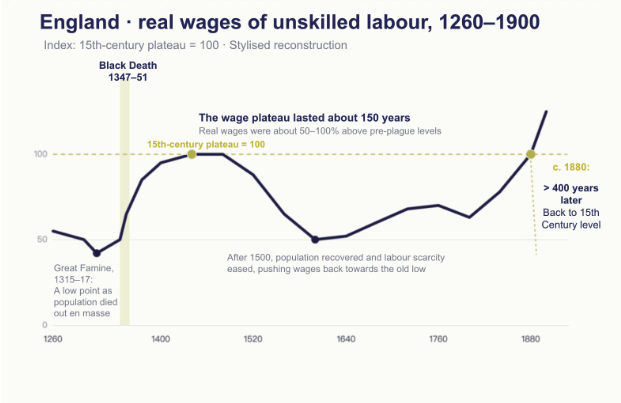
Two concrete anchors show how high that plateau sat. In 15th-century England, a day’s wage bought about 23 pounds of bread. And the famous Phelps Brown–Hopkins series for building workers shows that the real wage of the mid-15th century then fell for centuries – and was not reached again until around 1880, more than four hundred years later.
Why fewer people meant dearer labour
The mechanism is simple. The plague killed workers, but it did not destroy the land or the tools. Overnight, there were far fewer pairs of hands to tend the same amount of land. Lords began poaching each other’s tenants. For the first time, a peasant could bargain – for higher pay, lower rent, better terms; for the first time, he had real power over what his own labour was worth. The price of labour is set by how scarce labour is.
Two separate pieces of evidence confirm that it was scarcity driving wages up. The first is how rulers reacted: as wages climbed, the English crown passed the Ordinance of Labourers in 1349 and the Statute of Labourers in 1351, freezing wages at pre-plague levels by law, with fines and prison for breaking them. France passed almost identical laws the same year. This tells us the pressure was real – governments only build machinery like that to hold down a force that genuinely exists. And the suppression failed: over the following decades the market’s pricing of scarcity beat the letter of the law. The stored-up resentment broke out in England’s Peasants’ Revolt of 1381, when tens of thousands marched on London; it was put down within weeks, but the attempt to hold wages down was already failing, and wages kept climbing.
The second piece of evidence is what came before. The plague did what three centuries of technology had not. The high medieval period (roughly 1000-1300) was full of progress – the heavy plough, three-field crop rotation, water and wind mills, the horse collar all spread – yet real wages barely moved, and by 1300 they sat near a low as population pressed against the limit of the land (the Great Famine of 1315-17 is the marker of that low). The reason is what economists call the Malthusian trap, after Thomas Malthus: in a pre-industrial economy, any rise in food output is soon swallowed by population growth. Extra food became extra surviving children, and within a generation the ratio of people to land returned to where it started, taking wages back down with it. Three hundred years of better technology changed how much was produced, but not how it was shared. Three years of plague changed the sharing completely.
The same scarcity, the opposite result
If “fewer people means higher wages” were an iron law, it would hold everywhere. It did not. And the place where it broke down is exactly what reveals the real rule.
East of the river Elbe, the plague and the labour shortage were just as real, but the outcome ran the other way. Across the 15th to 17th centuries, the lords of Poland, Prussia and Russia did not raise wages to compete for scarce workers. They did the reverse: they increased forced labour, banned peasants from moving, and nailed them back onto the land. Historians call it the “second serfdom.” The same shortage that freed the Western peasant enslaved the Eastern one.
Why: scarcity is only potential
The economist Evsey Domar explained it in 1970. When land is plentiful and labour is scarce, he argued, that scarcity alone does not decide the outcome – it only sets up the conditions for one of two very different worlds. In one, labour is free and well paid; in the other, it is bound in place by force. Which world you get depends on a political question: whether workers can leave and make employers compete for them, or whether landowners have the power to stop them leaving at all.
In the West, they could. Cities were dense, lords were many and competed against each other, and royal power and noble power kept each other in check. If conditions were unpleasant, a peasant could become free by running to a different town and staying there for a year. “City air makes you free,” as the medieval saying went. This means employers will have to genuinely compete for workers. Only under those conditions can scarcity turn into bargaining power.
In the East, none of that held. The land was vast and thinly settled, the towns were weak, and the local lord held something close to a monopoly on force. There, the same scarcity did not hand workers leverage; it handed lords a stronger reason to lock the workers down, and the means to do it. When the only employer for a hundred miles also controls the courts and the soldiers, a shortage of workers is not your bargaining chip – it is his problem to solve by force.
What actually sets the price of labour
So scarcity, on its own, only creates the potential for bargaining power. Turning that potential into wages needs a set of institutions: workers who are free to move, employers who have to compete for them, and coercion that is held in check. Remove that second half and the same scarcity leads to bondage instead of wealth. The Black Death supplied identical scarcity to both halves of Europe; the West’s cities and competition cashed it out as wages, and the East’s manorial monopoly cashed it out as chains.
This is why the price of a person’s labour has never been mainly about how hard they work. It rests on two things multiplied together – how scarce the work is, and whether the institutions let that scarcity be priced. It is also why modern societies do not leave the second half to chance. Collective bargaining, minimum wages, labour law and social insurance are, in effect, a peacetime attempt to build and keep the leverage that the plague once handed workers by accident – to give ordinary labour the bargaining power that, left to institutions alone, appeared in Western Europe and never appeared in the East.
Previously in this series: How did fashion become essentially worthless?
Next in this series: What would humans do when work is no longer needed?