




I have been travelling frequently to China this year. Beyond the discussions during our China Executive Immersions, I’ve also been catching up with friends and visiting their companies.
One theme keeps surfacing in almost every conversation: how deeply AI agents are already embedded into workflows, decision making, and organisational structures.
Not as experiments. Not as innovation theatre. But as operating infrastructure.
And increasingly, these companies see AI not just as a productivity tool – but as something that could replace entire categories of software, teams, and even businesses.
Some verbatim from recent conversations:
“I have about 30 agents helping me with functions that previously required dedicated analysts. “Increasingly, these agents are feeding directly into workflows used by other CXOs.”
– CFO, consumer electronics group
“Our top management keeps asking: if we rebuilt the platform business entirely from scratch today, what would it look like? Everyone is deeply worried about AI disruption – and the only way to deal with that paranoia is aggressive adoption.”
– Business unit head, major ecommerce platform
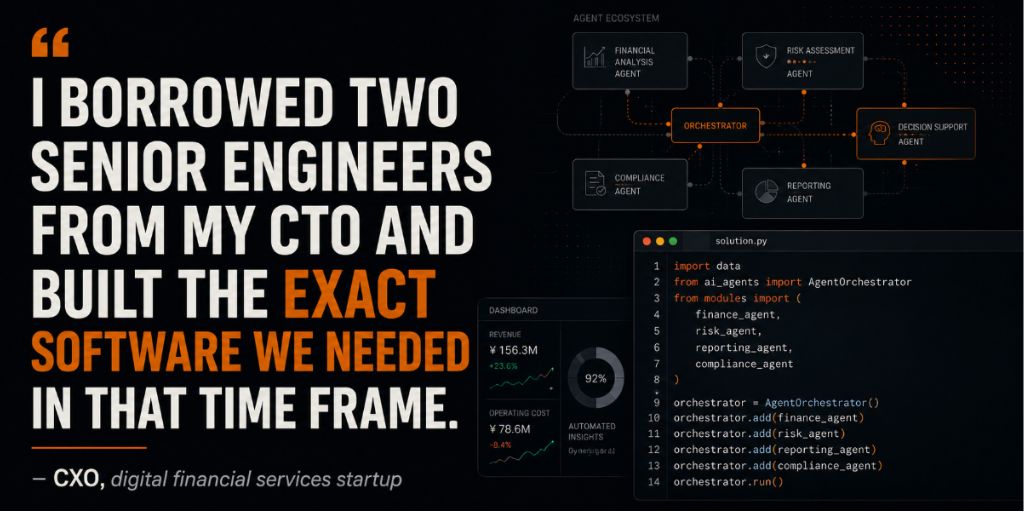
“An international SaaS company flew in, spent two hours presenting capabilities, and told me they could discuss implementation details the next time they were back in town – in six weeks! I borrowed two senior engineers from my CTO and built the exact software we needed in that timeframe, using agents.”
– CXO, digital financial services startup
“My industry is completely doomed. We should all pivot.”
– Co-founder, Series C SaaS company
“At the speed we are adopting agents, we are not far from becoming an AI-native organisation. The only functions AI still can’t do properly are office cleaning and operating forklifts in the warehouse.”
– CHRO, D2C consumer brand
Of course, the companies I spoke to are mostly young, aggressive, and highly adaptive by nature. Hypercompetition in China creates both urgency and paranoia – and many of these firms can redeploy engineering resources extremely quickly.
But the implication is hard to ignore.
The threat of AI may not be limited to jobs. Increasingly, companies believe it could make entire layers of enterprise software optional.
In Momentum Works’ Southeast Asia Predictions 2026, we wrote that “AI reshapes organisations before products”.
What I saw in China suggests something even more radical may already be happening.
P.S. Momentum Works will release the Quick Commerce in Southeast Asia 2026 report tomorrow. Some of the operational shifts discussed above are already visible among the region’s leading players – retailers, but more importantly, platforms.