





Recently, RedMart, a Singapore-based online grocer integrated with ecommerce platform Lazada, launched its own version of quick commerce.
Called RedMart Now, the service promises grocery deliveries to selected areas of Singapore in 30-45 minutes.

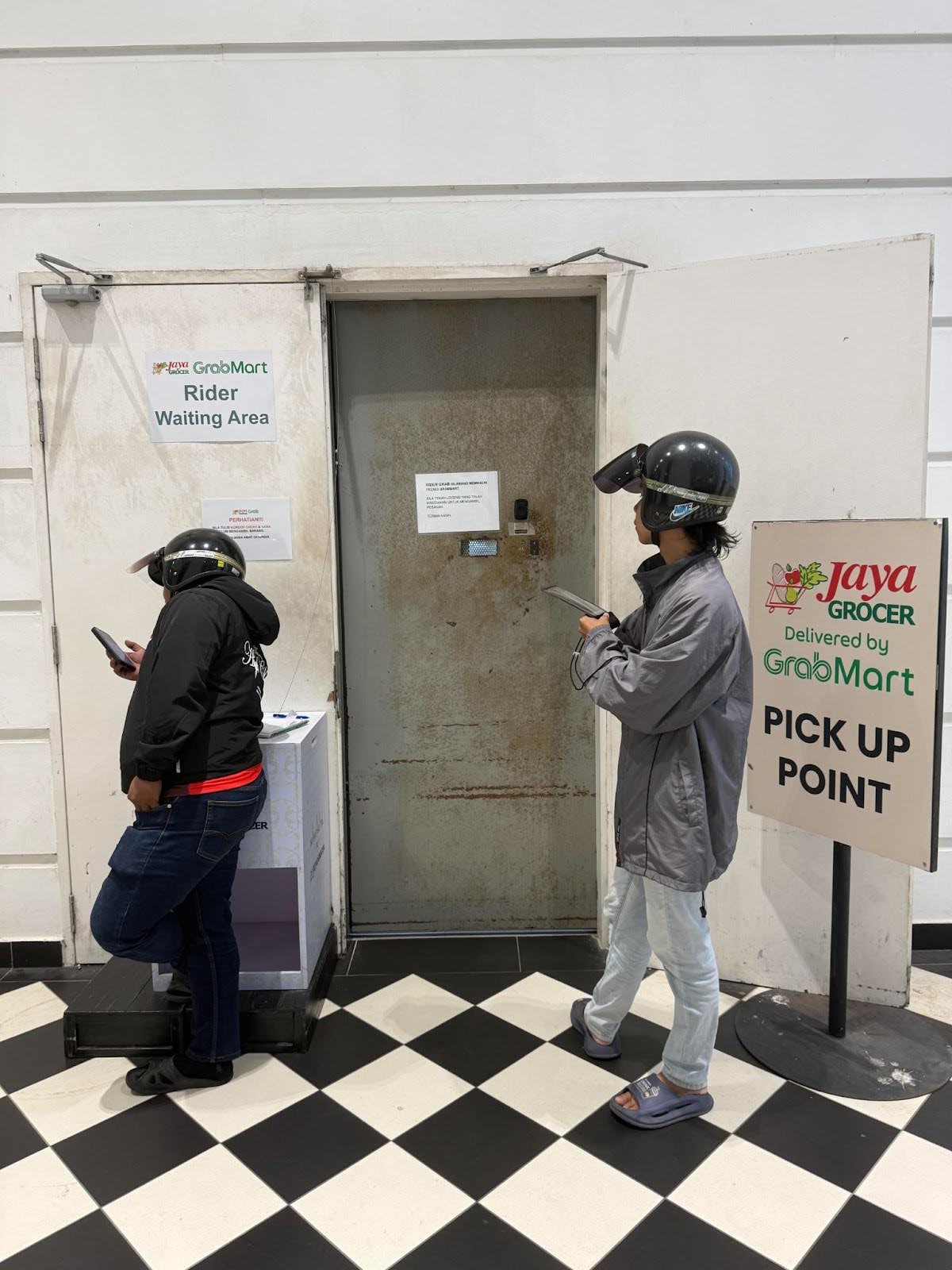
With this new offering, Lazada has effectively joined the increasingly-heated quick commerce scene in Southeast Asia, where Grab and Foodpanda leveraged their food delivery fleets to push into grocery and essentials; and Shopee sends its food delivery riders in some countries to pick up ecommerce orders to send directly to consumers.
Founded in 2011 and acquired by Lazada in 2016, RedMart was one of the earliest purely online supermarkets in Southeast Asia. It has built its operations on scheduled deliveries with a centralised warehouse model.
Since 2019, RedMart has been fully consolidated into the Lazada App, acting as an important entry point for the convenience-conscious customers who are also targets of Lazada’s brand-focused ecommerce value proposition. It has been a reliable grocery provider for many middle class consumers and expats who prefer to skip visits to grocery stores.

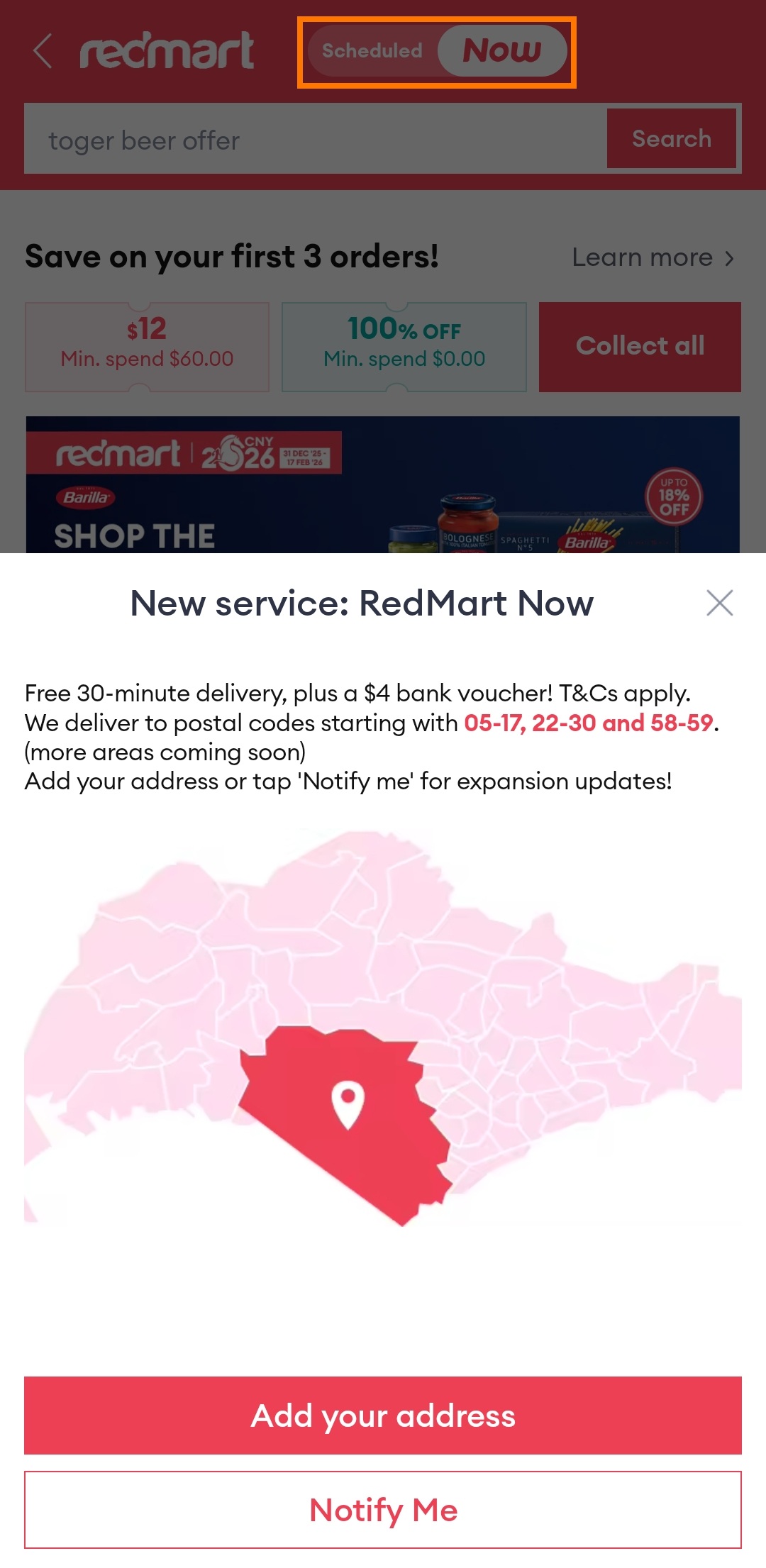
In the launch announcement of RedMart Now, Lazada said it currently operates daily from 10am to 9pm, covering selected areas in central and southern Singapore, with plans to expand islandwide over time. A free-delivery promotion for first-time orders was introduced alongside the rollout.
Within the app, RedMart Now is also clearly separated from RedMart’s scheduled delivery service, and users must first verify that their address falls within the serviceable zone before being able to place an on-demand delivery order.
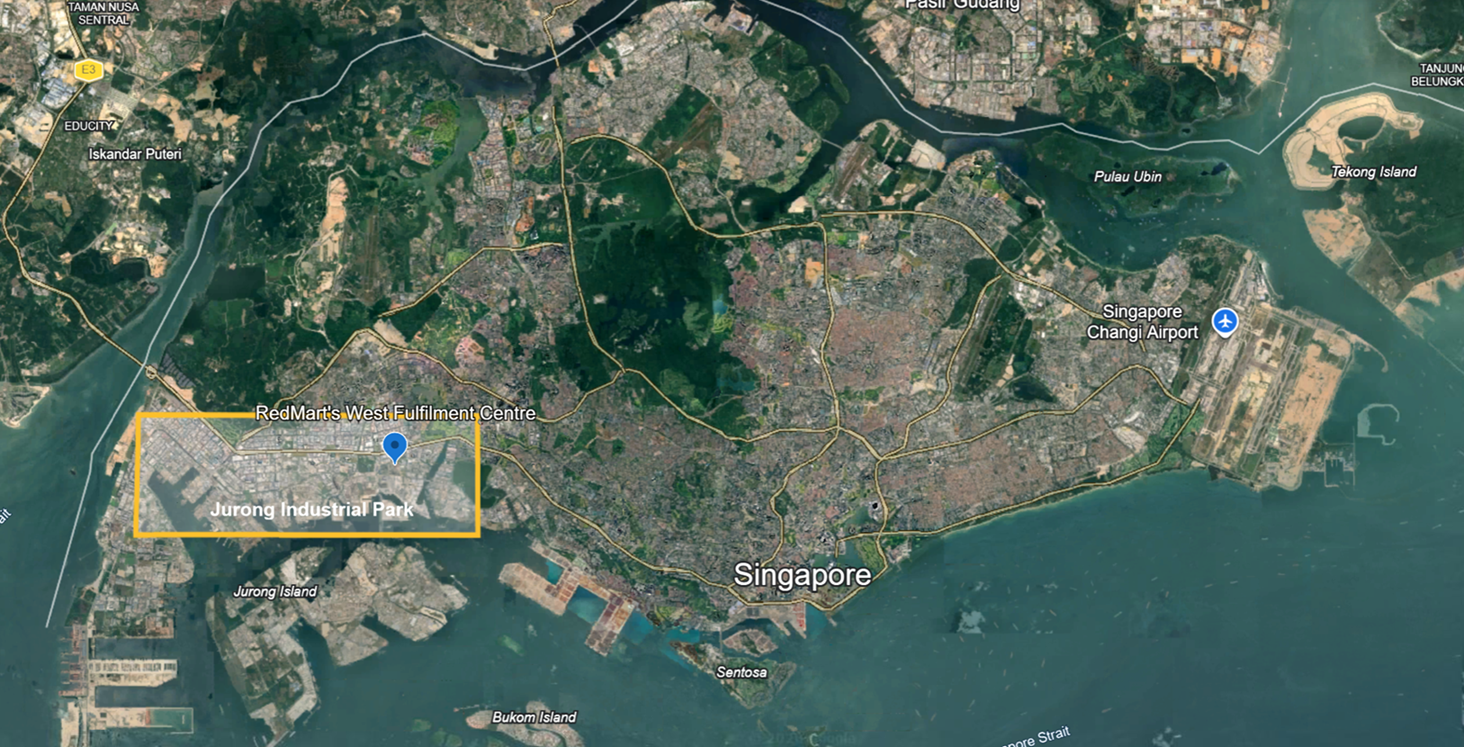
Historically, RedMart provided scheduled deliveries, offering 3 options: 6-hour delivery windows starting from the next day, 2-hour delivery windows starting from the next day, and a faster express delivery option, which could arrive as early as the same day. And these options are all fulfilled from its large West Fulfilment Centre (WFC) near Jalan Buroh, in Singapore’s industrial and logistics zone.
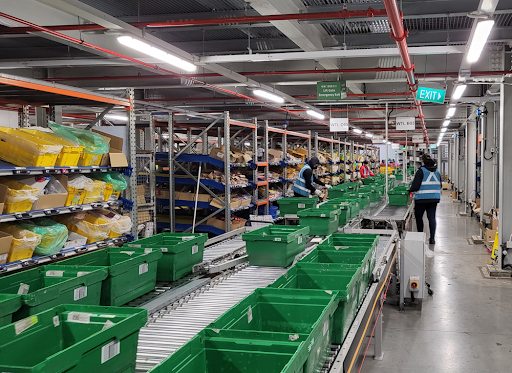
Officially unveiled in 2021 during RedMart’s 10th anniversary, the WFC warehouse spans approximately 32500 sqm and carries an estimated 100000+ SKUs across ambient, chilled and frozen categories. It has been operating in close coordination with the government during the pandemic, and has been a critical supply node for many Singaporean households.
In the scheduled delivery model, even an express delivery order placed at Changi Airport (on the other end of Singapore island) is picked and dispatched from this single centralised facility.
The newly-launched RedMart Now seems to be structurally different. The assortment is much smaller – officially described as a “curated selection of goods” – and the initial pilot areas are concentrated in central Singapore rather than near the western warehouse.
It turns out that RedMart Now is indeed built on a dark store model. On-demand delivery orders are dispatched from the dark store in the pilot region instead of the centralised warehouse. To provide islandwide delivery in the future, there will be more dark stores to be set up across Singapore.
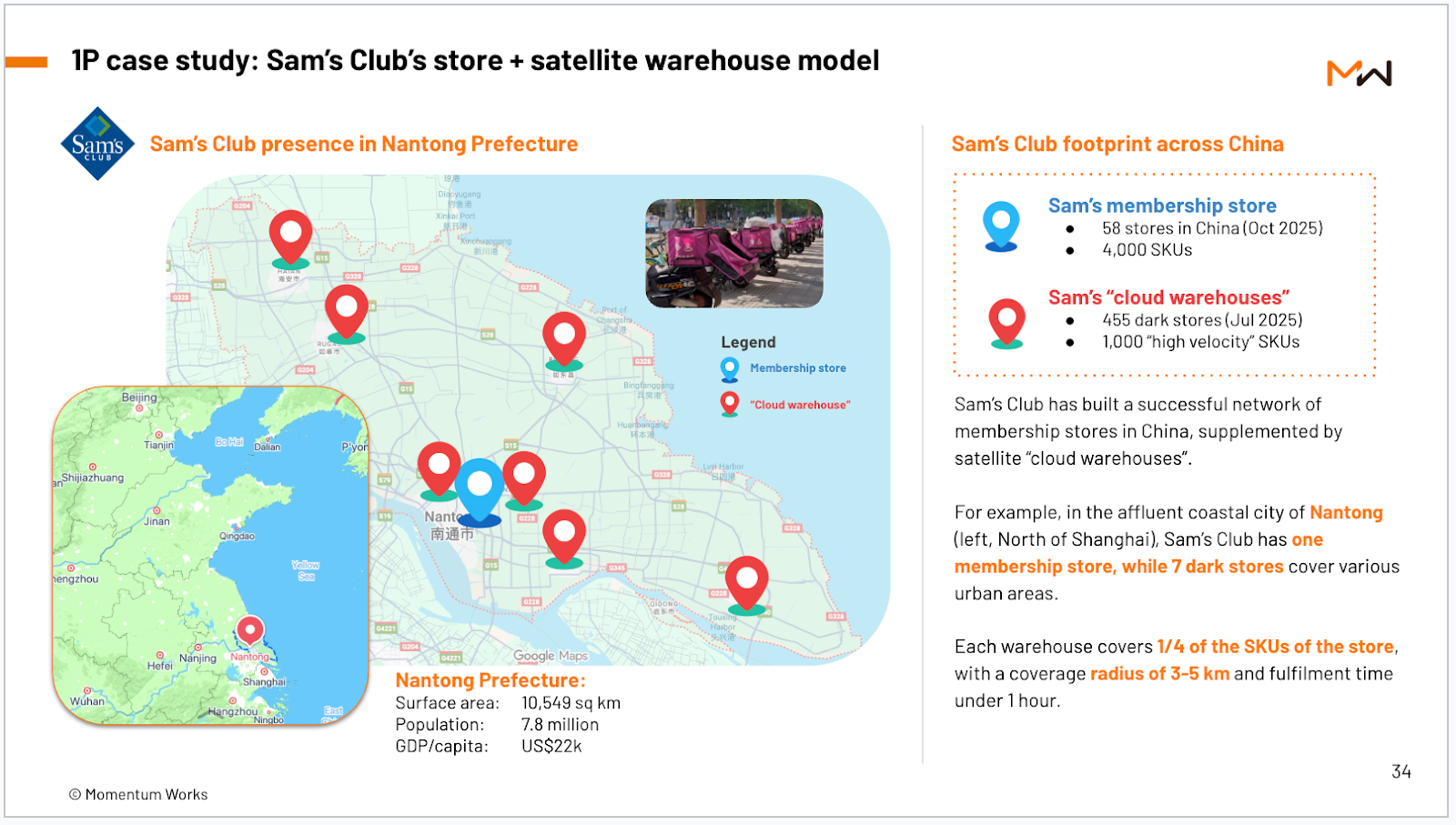
The Sam’s Club model in China, where a large offline store carrying 4000 SKUs each is augmented by satellite dark stores each carrying 1000 SKUs, is probably a good reference point for players in affluent cities such as Singapore (read Momentum Works’ Quick Commerce in China 2025 report for more).
RedMart executives revealed on social media that the strategic decision of RedMart Now had only been made only 100 days before its launch. Now its team had established its first dark store from scratch, started pilot operations, and stepped into the quick commerce arena like Grab and Foodpanda did.
Quick commerce gained strong momentum across many parts of Asia in 2025, with leading players (Alibaba & Meituan) in China locked in an expensive subsidy war, and Indian platforms (Blinkit, Instamart, Flipkart Minutes, Zepto etc.) expanding both SKUs and number of dark stores across major cities.
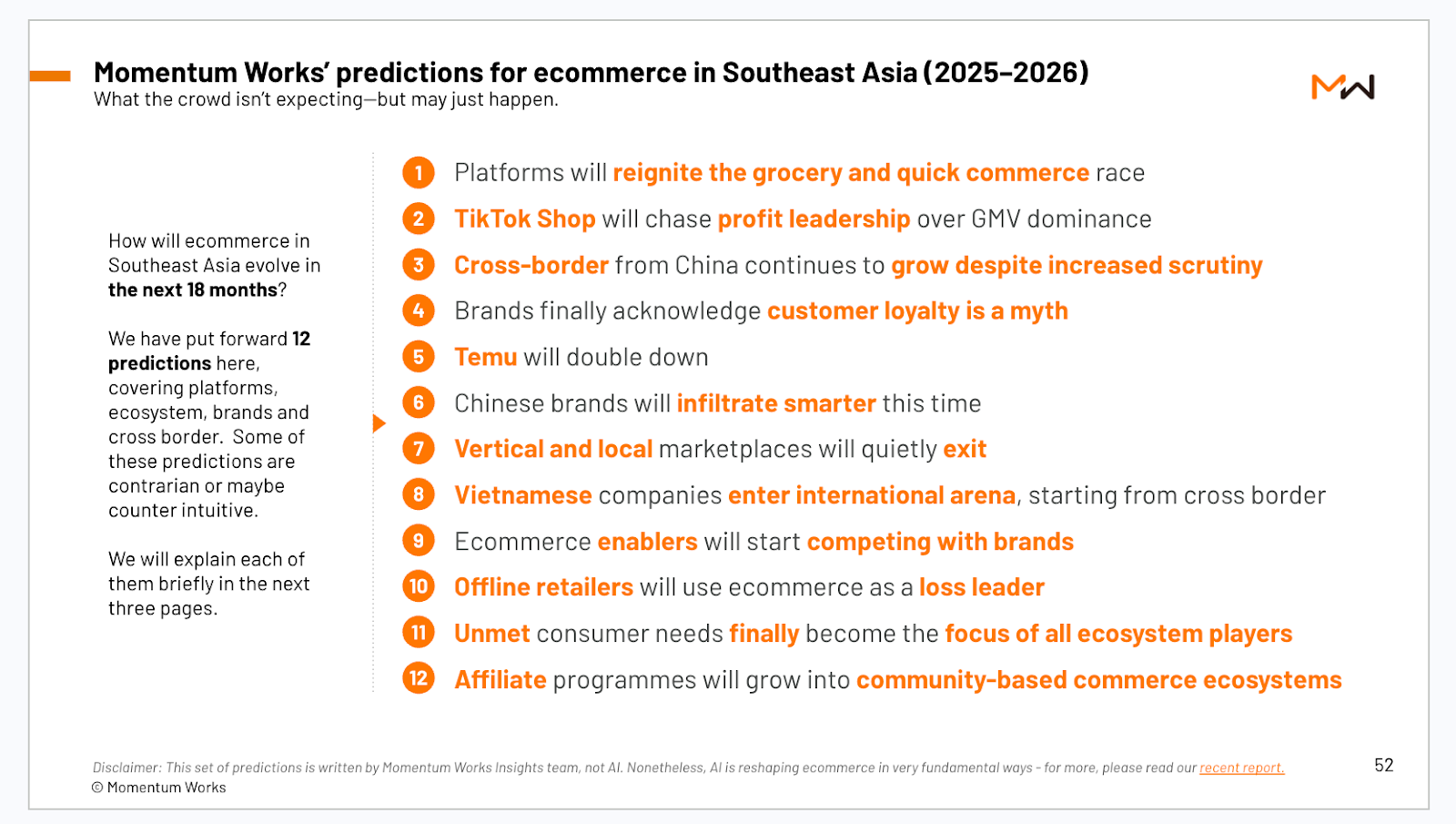
In our Ecommerce in Southeast Asia 3.0 report published last year, we put “Platforms will reignite the grocery and quick commerce race” as the first of 12 predictions for 2025-2026. This is indeed happening.
And RedMart Now is not the only new player in Singapore’s increasingly competitive quick commerce space. Stay tuned with Momentum Works for more updates on the sector!