



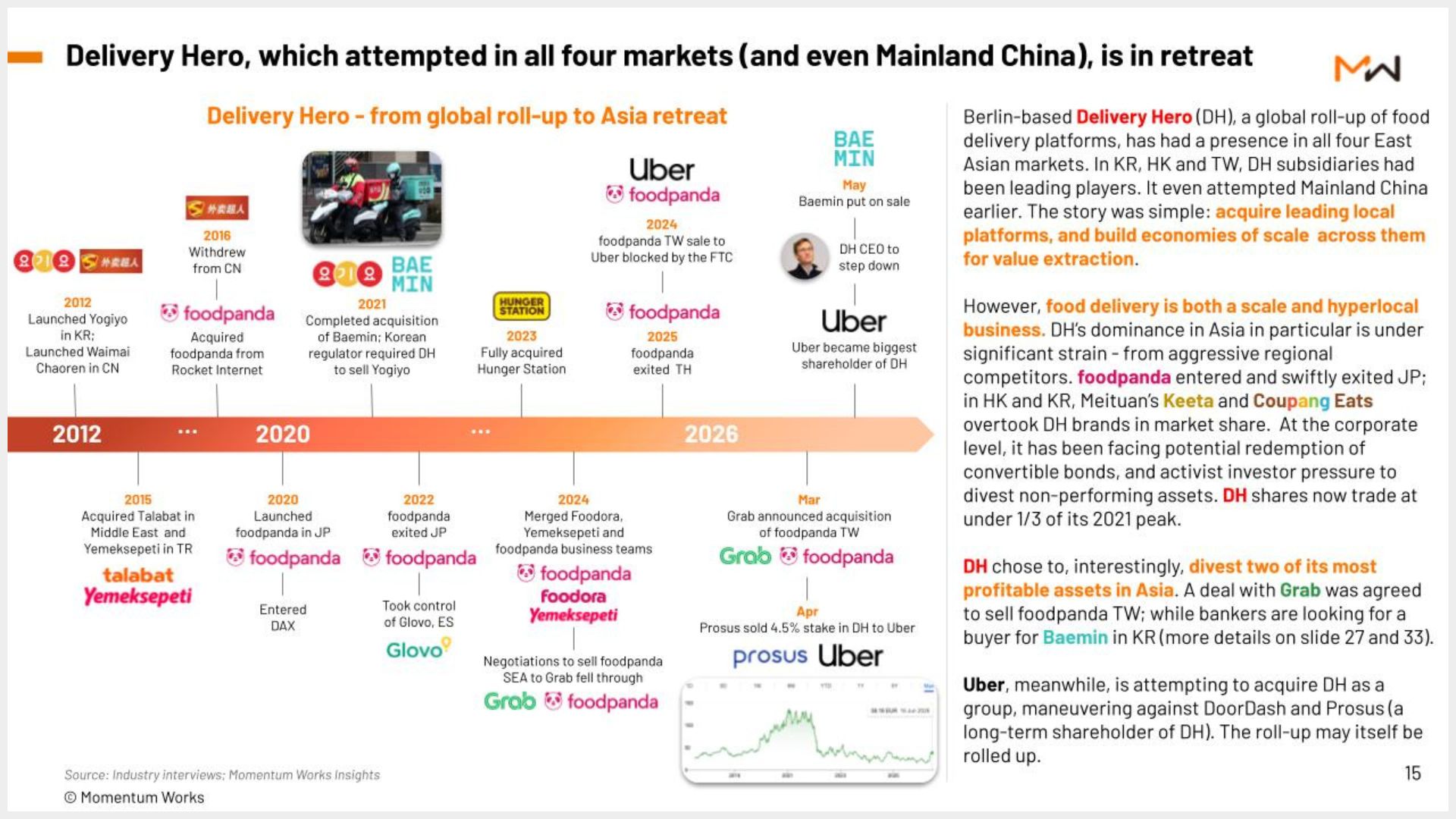
- Delivery Hero spent more than a decade assembling leading food delivery positions across Hong Kong, Taiwan, South Korea and Japan. Today, much of that portfolio is being unwound.
- Despite remarkably similar economic and demographic conditions, food delivery penetration ranges from just ~3% in Japan to over 20% in South Korea – suggesting that operator execution, not market readiness alone, determines market outcomes.
- Meituan, Coupang and Grab are rewriting the competitive playbook, bringing experience forged in some of the world’s toughest delivery markets.
- The next phase of East Asia’s food delivery industry will be shaped less by ownership changes and more by operators willing and able to grow their markets.
SINGAPORE, 7 July 2026 – Momentum Works today released Food Delivery Platforms in East Asia 2026, its first report dedicated to the four major food delivery markets of Hong Kong, Taiwan, South Korea and Japan.
East Asia’s food delivery industry is undergoing its biggest leadership transition in more than a decade.
For more than a decade, Delivery Hero built the region’s broadest portfolio of delivery businesses through acquisitions. Today, that strategy is unravelling. Foodpanda Taiwan is being sold to Grab, Baemin is on the market, foodpanda has lost leadership in Hong Kong, and the company has already exited Japan.
At the same time, a new generation of Asian operators – Meituan, Coupang and Grab – are reshaping competition with operating playbooks developed in far more competitive home markets.
The acquisition-led playbook that once made Delivery Hero dominant in Asia is now being challenged by operators built through competition rather than consolidation.
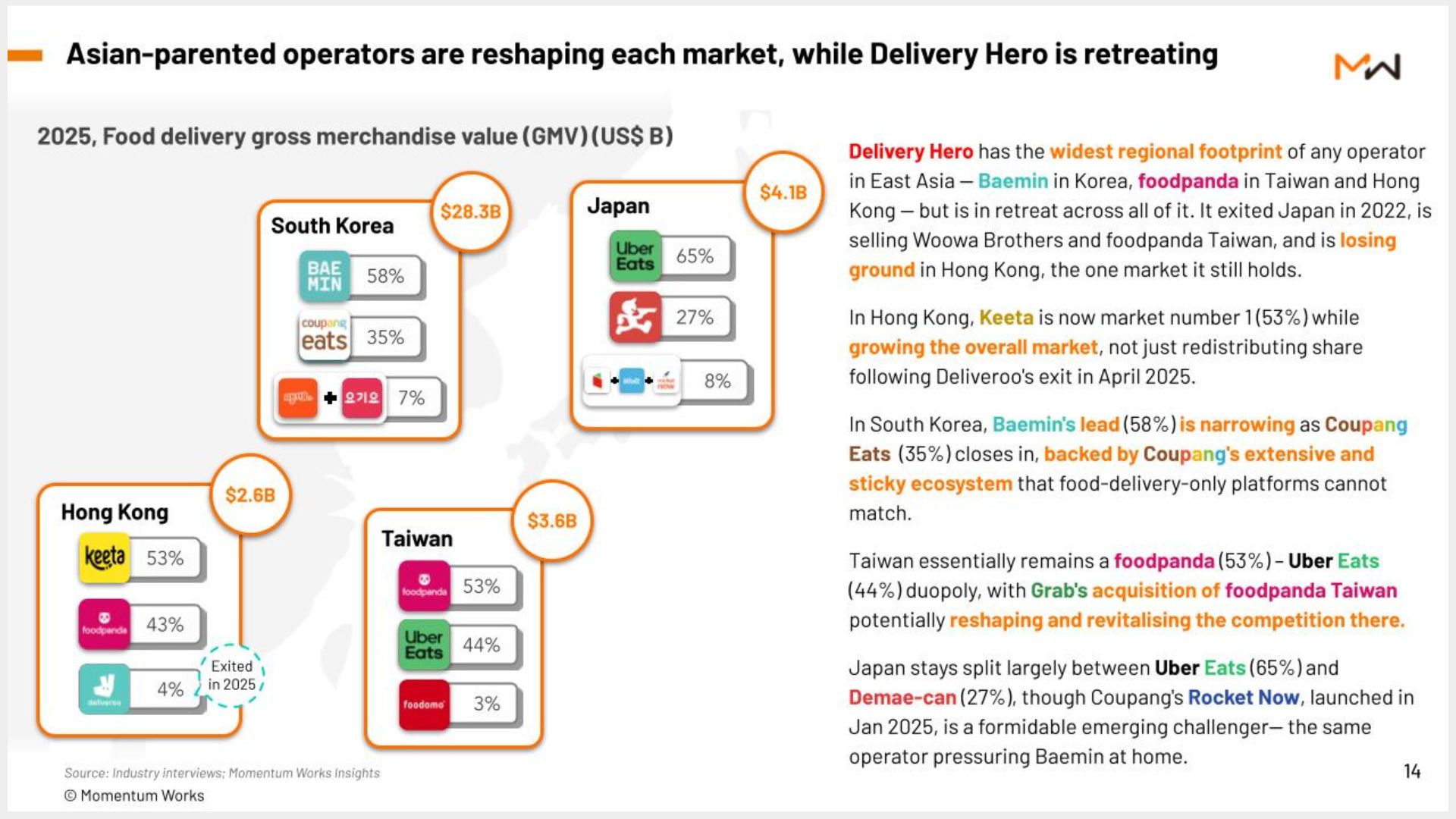
Together, the four East Asian markets generated an estimated US$38.6 billion in food delivery platform GMV in 2025. South Korea alone accounted for US$28.3 billion, or roughly 73% of the total, while Japan, Taiwan and Hong Kong generated US$4.1 billion, US$3.6 billion and US$2.6 billion respectively.
Yet, market size is only part of the story.
Despite sharing similar levels of urbanisation, income, foodservice development and demanding work cultures, food delivery penetration varies dramatically — from around 3% in Japan to more than 20% in South Korea.
“People often assume food delivery success is determined by how developed a market is. East Asia shows that isn’t true,” said Jianggan Li, CEO of Momentum Works. “These four markets look remarkably similar on paper, yet their outcomes are completely different. Market readiness is only the precondition. But markets don’t grow by themselves – operators’ relentless push grows markets.”
“Asian operators increasingly possess that capability after years of competing in some of the world’s most demanding food delivery markets,” added Li.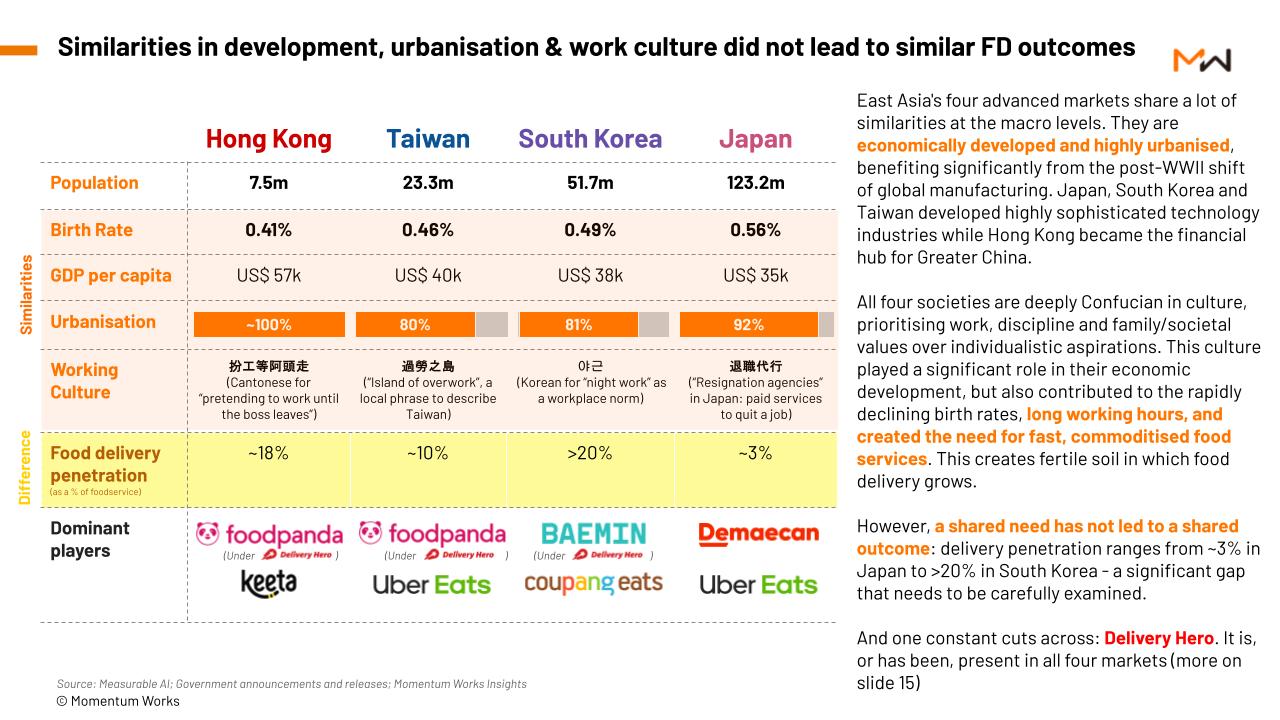
Key findings
-
- Delivery Hero’s acquisition-led strategy is reaching an inflection point
Delivery Hero once controlled leading platforms across Hong Kong, Taiwan and South Korea while maintaining operations in Japan. Today, much of that footprint is being dismantled. Delivery Hero’s acquisition-led model designed to consolidate markets is increasingly challenged by competitors that continue investing aggressively in growth and operational excellence. - Hong Kong: Keeta rewrote the market
Meituan’s Keeta entered Hong Kong in 2023 with a playbook centred around subsidised one-person meals and rapid network density expansion. Within 29 months, it became profitable, overtook foodpanda and fundamentally shifted competition from subsidy spending to operational efficiency. - Taiwan: Growth has slowed significantly as competition faded; Grab has the opportunity to reignite market growth
Taiwan has remained a profitable but comfortable duopoly for years, with market penetration flatlining around 10% for years and growth slowing to 5.5% as competitive push faded. Delivery Hero’s repeated attempts to exit, including the blocked 2024 sale to Uber Eats, show that the market’s competitive structure had reached a turning point. Grab’s experience competing in Southeast Asia gives it a credible opportunity to re-energise Taiwan’s food delivery market and return it to double-digit growth - South Korea: The world’s third-largest food delivery market faces a new challenger
South Korea’s US$28.3 billion market was built on decades of consumer delivery habits rather than platform creation. While Baemin remains the market leader, Coupang Eats continues to gain share by leveraging Coupang’s broader ecosystem, raising important questions for any future owner of Baemin. - Japan: The toughest market to crack
Despite its wealth, density and sophisticated food ecosystem, Japan’s food delivery penetration remains around 3%. Japan’s extensive convenience store infrastructure and deeply embedded solo-dining culture reduce many of the frictions food delivery solves elsewhere. Coupang’s Rocket Now is testing whether affordable solo delivery can unlock the next phase of growth. - Asian operators are rewriting the industry’s playbook
Unlike the previous generation of global consolidators, today’s Asian operators learned to compete before they learned to expand. Rather than simply acquiring assets, today’s leading Asian operators have developed capabilities through sustained competition in highly contested markets. The report argues this operational experience – around density building, unit economics, customer acquisition and ecosystem integration – is becoming a competitive advantage as these companies expand internationally.
- Delivery Hero’s acquisition-led strategy is reaching an inflection point
“Ownership changes the balance sheet. It doesn’t change the competitive dynamics,” Li added. “Whoever owns these assets will still have to compete against operators that have spent years learning how to win in highly competitive markets.“
Request the Full Report
A complimentary copy of the Momentum Works’ Food Delivery Platforms in East Asia 2026 report will be available to members of the press upon request. Traditional Chinese (正體中文), Korean (한국어) and Japanese (日本語) versions are also available on request. The report was originally prepared in English, which remains the reference version across translations.
###
About Momentum Works
Momentum Works is a Singapore-headquartered venture outfit that helps leaders make sense of, and act on, Asia’s fast-evolving digital markets.
Momentum Works is the go-to source for comprehensive expertise in navigating the evolving landscape of emerging markets, especially in ecommerce, new retail and F&B, as well as technology-driven transformation.
For more information
For further enquiries, please contact Weihan Chen, Insights Lead at Momentum Works ([email protected])