



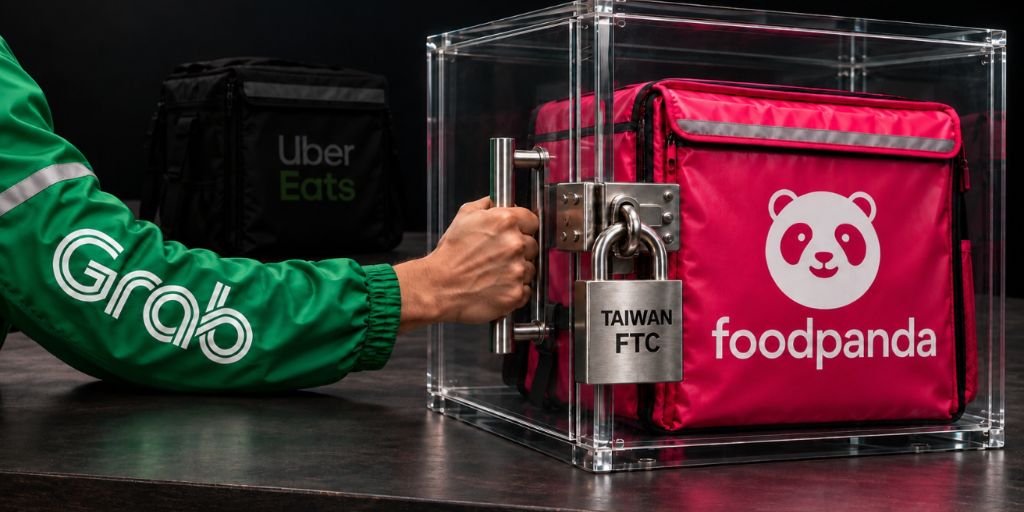
On 21 October, Taiwan’s Fair Trade Commission (FTC) blocked Grab’s proposed US$600 million acquisition of foodpanda Taiwan. We were surprised by the decision, and even more by the reasoning behind it.
This was the second failed attempt to sell the business. In December 2024, the FTC rejected Uber Eats’ proposed US$950 million acquisition, arguing that combining Taiwan’s two leading food delivery platforms would substantially reduce competition.
The Grab deal was different. Grab does not currently operate in Taiwan. Its acquisition would have brought in a new operator while leaving two major platforms in the market.
Yet the FTC still said no.
We find FTC’s reasoning curious
In the press conference, FTC commissioner Shih Chih-Chung raised four main concerns: Uber owns 13.1% of Grab, which could weaken Uber Eats’ incentive to compete with Grab; the shareholding could also affect Grab’s own competitive behaviour; the companies’ historical relationship could make coordination easier; and Taiwan has few other effective competitors to keep them in check.
There is an economic argument behind some of these concerns. A minority shareholder may have less incentive to compete aggressively with a company in which it owns a stake. But that possibility alone does not explain why this deal had to be prohibited.
Uber holds only around 3.9% of Grab’s voting rights and cannot dictate its strategy. Grab and its other shareholders have their own commercial interests. If Grab wants to grow in Taiwan, winning market share from Uber Eats would be an obvious way to do it.
The FTC’s reasoning also raises a more basic question: why assume that the existing market structure offers the best protection for competition?
In our Food Delivery Platforms in East Asia 2026 report, we described Taiwan as a comfortable, profitable duopoly: foodpanda and Uber Eats held an estimated 53% and 44% of market GMV respectively in 2025, with both generating positive contribution profit per order.
On the other hand, Food delivery penetration in Taiwan has remained around 10% for years, while GMV growth slowed to just 5.5% in 2025 – suggesting that neither incumbent has had much incentive to push the market further.
Our observations on the ground pointed to Grab’s preparations for a substantial overhaul of foodpanda’s product and operations. It appeared to be preparing to compete seriously, rather than simply take over an established business and maintain the status quo.
Interestingly, FTC’s decision was not unanimous. Acting chair Chen Chih-min favoured conditional approval, later saying that the evidence had not convinced him that an outright ban was necessary. Even within the FTC, there was disagreement over whether prohibition was justified.
The status quo wins – for now
The FTC has blocked a change in ownership. But Taiwan’s food delivery market still faces the same underlying problem: two profitable incumbents, limited growth and little pressure to expand the category.
Besides, Delivery Hero has already agreed to an acquisition by Uber – with Taiwan carved out of that transaction because of the ongoing deal with Grab.
Now the latter is blocked. Delivery Hero and Uber will need to decide what to do with foodpanda Taiwan – knowing that making it part of the overall acquisition will unlikely satisfy the FTC. There will not be a third time lucky here.
For deeper analysis of the deal, as well as the interests behind it, do read our full analysis on Momentum Works Intelligence.