




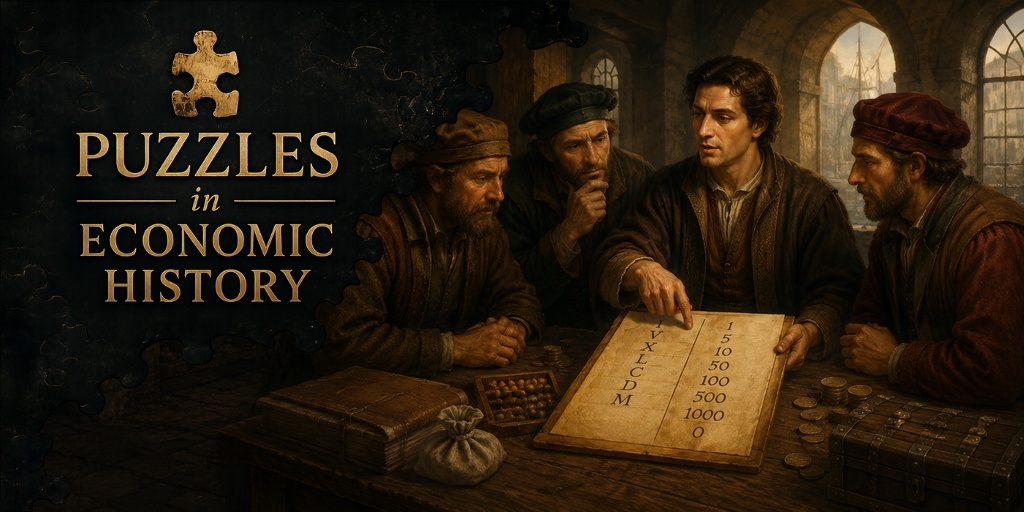
This series is adapted, with permission, from a Chinese-language series by our friend Marcus Ji, who looks at historical events through an economic lens. We have condensed and adapted the original for an international audience.
In 1299, Florence – then the most advanced banking city in Europe – passed a law banning a number. The money-changers’ guild, the body that governed the city’s bankers, forbade its members from using Indo-Arabic numerals in their ledgers: the 0, 1, 2, 3 … 9 that the whole world writes today. Amounts had to stay in Roman numerals or be spelled out in words.
The law never explained itself. The popular theory is fraud: on an easily altered parchment ledger, a “0” can be turned into a “6” or “9” with a single stroke, while Roman X, V and C are harder to doctor invisibly. Whatever the real motive, the fact is clear – a city that lived on the movement of money resisted the most efficient counting tool ever invented for more than a century. And the thing it resisted, the digit zero, took nearly 900 years to travel from its birthplace into European commerce. What it unlocked was far more than a tidier way to write numbers.
This article argues one specific thing: before zero and its offspring – place value, decimals, percentages – spread, a merchant could work out “how much did I make on this deal,” but not “what is my gross margin.” And “low margin, high turnover” as a strategy you can measure, compare, and deliberately pursue is, strictly speaking, a twentieth-century invention. Mathematical notation is not just a way to record business. It draws the outer edge of what business can be.
The world before zero
Merchants before zero were not bad at arithmetic. They ran a two-track system: they calculated on a counting board, and recorded in Roman numerals.
The Roman abacus was not the beaded frame we picture today – it was a grooved board on which you slid little pebbles to compute. (The Latin for those pebbles, calculi, is where “calculate” comes from.) When a column had no value, you simply left its pebbles pushed aside – an empty groove did the job a written zero does. Once the answer was reached, it was copied into the ledger in Roman numerals: 7 as VII, 90 as XC, 1,628 as MDCXXVIII.
The fatal flaw was this: the calculation left no trace. You cannot set out long multiplication or division on paper in Roman numerals – try drafting CCLXXIV × XXXVIII and you will see. All the work happened on the board, and the moment a pebble moved, the intermediate steps vanished. The ledger held only the final figure. If a partner came to check the accounts three days later and the numbers did not agree, there was no written record of who had erred, or where.
One comparison captures the gap. Write the number 248,832 in Indo-Arabic numerals and it takes six symbols; in Roman numerals it takes 257. And the Roman system had no decimals and no place value, so compound interest – a loan of 100 florins at 20% a year – could only be handled as clumsy fractions that left a growing error every year. With zero and place value, the same sum runs on a single line, every step visible for anyone to check. (For scale: 100 florins was around 1,000 days of a labourer’s wages then – three to four years of income. On a loan that size, one slip in the interest was months of wages, and the counting system could neither prevent the error nor prove who made it.)
Where zero was born
Zero has two identities, and history reached them in two separate steps.
The first is the placeholder – a mark meaning “this column is empty.” This appeared independently in several unconnected civilisations: the Babylonians, the ancient Egyptians, Chinese counting-rod arithmetic, and the Maya, who invented a shell-shaped zero for their calendar. Useful, but none of these let zero do anything.
The second identity is zero as a number in its own right – one you can add, subtract, multiply and divide. That happened in exactly one place: India. In 628 AD, the astronomer Brahmagupta defined zero as “a number minus itself” and set out the rules for calculating with it. Tellingly, he framed positive and negative numbers in the language of commerce – positives were “fortunes,” negatives were “debts,” and he wrote laws like “a fortune subtracted from zero is a debt.” He was the first to give “nothing” the right to take part in arithmetic.
Why India, and not Greece? Greek mathematics was geometric – a number was a shape, and a shape with zero area had no place in it – and Aristotle had argued that a vacuum was impossible, tying mathematical zero to a philosophical taboo against the void. Indian thought, by contrast, treated emptiness (śūnya) as a central and unthreatening idea. A culture’s comfort with “nothing” turned out to be the soil in which a working zero could grow.
How zero reached Europe
The route from India ran through Baghdad, where around 825 AD the scholar al-Khwarizmi wrote the book that introduced Indian numerals to the Arab world; the Sanskrit śūnya became the Arabic ṣifr, which travelled through Latin and Italian to become our “zero.” (The word “algorithm” is simply his name, Latinised.) That same root left a clue hiding in plain sight: ṣifr also became “cipher” – so “zero” and “code” are the same word. To a medieval European who only knew Roman numerals, this place-value system looked like a foreign secret script, and to this day “to decipher” literally means “to undo the zero.”
In 1202, Fibonacci – a Pisan merchant’s son who had learned the new numerals in North Africa – published Liber Abaci, showing European merchants their power through worked examples of currency exchange, lending and profit-sharing. For the next 300 years, commercial Europe split into two camps: the “abacists,” who kept the counting board and Roman numerals, and the “algorists,” who switched to pen, paper and the new digits.
The algorists did not win on speed – a skilled board-operator could match them on simple sums. They won on three things the board could never provide:
- A teachable method. The new arithmetic had fixed steps that could be printed in a textbook and taught to any apprentice, turning accounting from a guild secret into public knowledge.
- A written audit trail. Every step stayed on the page, so disputes could be settled by document rather than memory – the first time commercial trust could rest on paper instead of a person.
- Room to grow. Place value extends rightward into decimals, then into algebra and calculus, where the abacus was a dead end.
Knowing how much you made, not how fast
Now to the heart of it. Did ancient merchants really not understand ratios? They did – ratio arithmetic is far older than zero. China’s Nine Chapters handled exchange ratios; India and Egypt had the “Rule of Three” (given three numbers, find the fourth – “if 3 pounds of pepper sell for 20, what do 47 pounds fetch?”). A merchant could easily see that silk bought for 10 and sold for 15 returned half the outlay, while grain bought for 10 and sold for 11 returned only a tenth – but turned over in a month. The intuition for turnover existed before the common era.
But between an intuitive feel for ratios and systematic ratio management stand three technical thresholds, each of which needs zero:
- Arbitrary decimals. The Roman system had only fixed-denominator fractions. You could say “cost is five-sixths of the price,” but not “gross margin of 17.3%,” because precise decimals depend on place value extending past the decimal point. That step came astonishingly late – the standard way of writing decimals arrived only in 1585, with the Dutch engineer Simon Stevin, 957 years after Brahmagupta defined zero.
- The percentage. The “%” sign evolved from the Italian per cento, “per hundred,” settling into form in the 1600s. It forces everything onto a common denominator: pepper sold by the pound, silk by the bolt and loans by the florin can only be compared once all are restated as “per hundred.” Only then do different businesses stand on the same ruler.
- The ratio as a management tool. Having percentages is not enough; someone has to organise them into a decision. That landmark came in 1919, when F. Donaldson Brown, a finance manager at DuPont, broke return on investment into a product of two figures:
Return on assets = Profit margin × Asset turnover
This “DuPont formula” stated in one line that there are two roads to a high return: high margin and slow turnover (the luxury model), or low margin and fast turnover (the supermarket model) – and that the two can be directly calculated and compared. “My 3% margin turned over 30 times beats your 30% margin turned over twice” is a sentence no merchant before 1919 had the language to say precisely.
The counter-evidence is just as telling. A Cambridge study of merchant account books from 1680–1830 found that even two centuries after Venetian merchants developed double-entry bookkeeping – recording every transaction twice so the accounts must balance to zero – ledgers were still used mainly to track who owed whom rather than to measure profitability, about 98% of the records being debts and credits; and into the 1700s most merchants still did not separate inventory from sales, so they could not calculate turnover at all. A tool existing on paper and a tool becoming a habit of mind are separated by centuries.
Which explains a famous diagonal in the history of commerce. The long-distance spice trade of Roman and medieval times could yield margins of 300% to 1,000% – but a single voyage took two or three years. It was not that merchants preferred extreme markups; it was that in an age which could not calculate, compare, or raise finance against turnover, a single high-margin haul was the only business anyone could reckon clearly. Every later shift – the Italian city-states’ annual trade routes, the account-keeping voyages of the East India companies, factory production, twentieth-century chain retail turning over stock a dozen times a year, today’s single-digit-margin warehouse clubs – arrived only as a new piece of mathematical infrastructure fell into place. Ancient salt and grain traders ran “small margin, many sales” by instinct; but making low-margin, high-turnover into a model you can precisely optimise, finance on the capital markets, and write into a manual to replicate across borders needed the whole chain to be complete.
What this leaves us with
Three conclusions follow:
- Numbers are technology, not instinct. The gulf between a mere placeholder and an operational zero shows that treating nothing as a thing you can compute with was one of the least obvious leaps in human history.
- The counting system sets the boundary of commercial forms. Under Roman numerals and the abacus, calculation and record were split, the process could not be audited, and compound interest and arbitrary decimals could not be expressed – so business stayed at single-deal profit, high margins, and trust tied to individuals. As each new piece landed – zero, place value, decimals, percentages, double-entry, ratio formulas – a previously impossible way of organising business became possible: bills of exchange, joint-stock companies, actuarial insurance, chain retail.
- Resistance to a new notation follows a script. The 1299 Florence ban delayed adoption in the name of managing risk, even as merchants reportedly kept using Arabic numerals in their private drafts, because the advantage was simply too large to give up.
The last point may matter most to a reader today: the metrics you can think with set the limits of the strategies you can imagine. Medieval merchants did not fail to see the opportunity in “small margin, many sales” – their mathematical language had no coordinates for it. So it is worth turning the question on ourselves: the metrics we now take for granted – price-to-earnings, gross margin, turnover, annualised return – are they also, somewhere we cannot see, fencing in what we can imagine about business and investment? The “zero” we are missing – what would it be?
Previously in this series: Why was Balzac’s Grandet so stingy with candles?
Next in this series: Can anything stop the human desire for profit?