


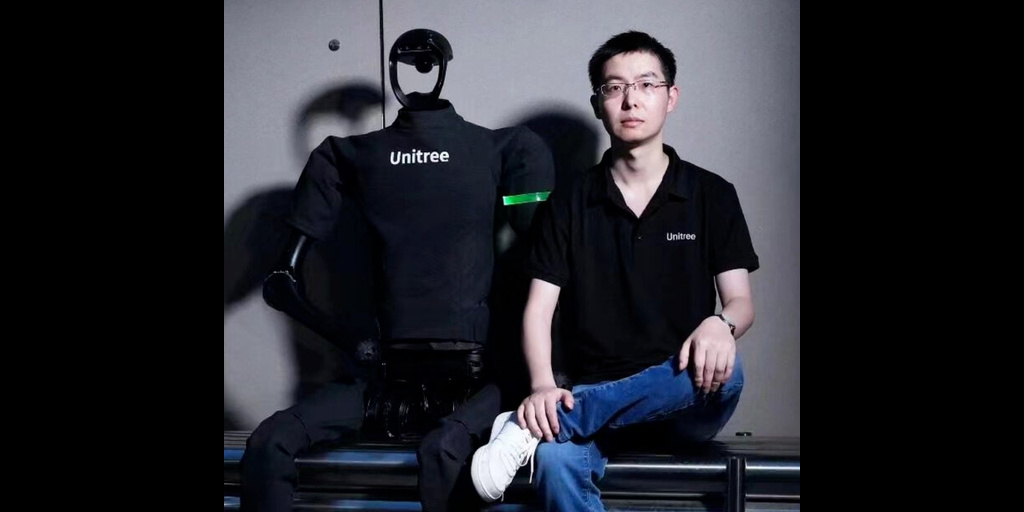
When China’s leading humanoid robotics company Unitree went public in Shanghai on 19 August, its shares closed about 460% above the offer price, valuing the company at more than US$50 billion.
Yet its founder, Wang Xingxing, barely smiled at the listing ceremony. As we noted last month in an Momentum Works Intelligence piece, He understood better than anyone how difficult the next stage would be: turning impressive robots into machines that customers would pay to put to actual work.
His investors, however, had plenty to celebrate about.
Hongshan Capital Group (HSG, formerly Sequoia China) marked the occasion by publishing the “one-pager” investment memo behind its first investment in Unitree in July 2019. (full translation at the end of this piece).
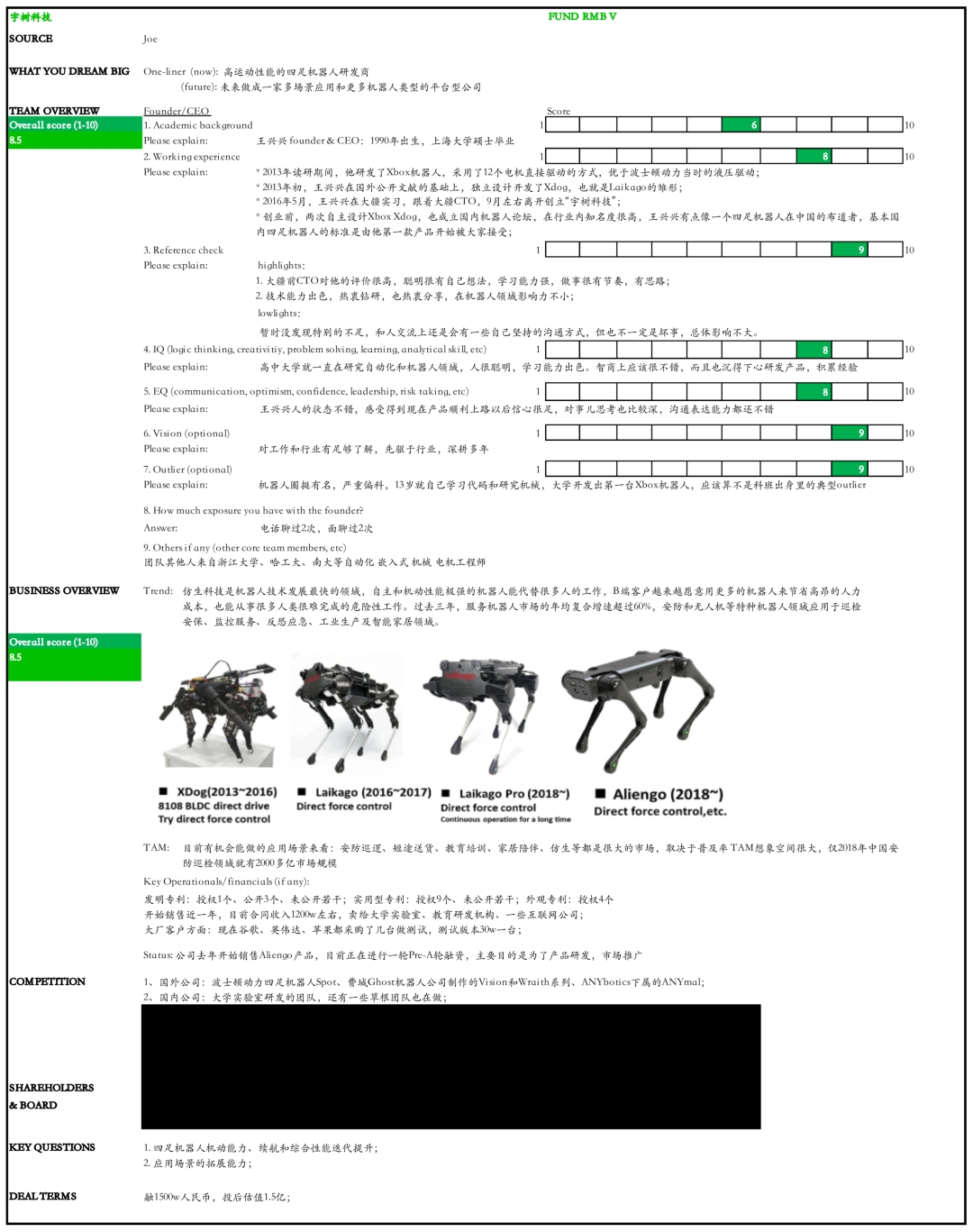
The memo offers a glimpse of how the investors assessed Wang when he was 29, his company was running short of cash, and the market for robot dogs was far from obvious.
In the memo, Sequoia China describes him as a “typical outlier” and an “evangelist” for quadruped (four-legged) robots in China. He received 9/10 for both “vision” and “outlier” in Sequoia’s scoring system, against an overall team score of 8.5/10.
Wang’s ambitions extended well beyond robot dogs. In the article accompanying the memo, Sequoia China recalls Wang telling its investment committee:
“I want to build a very large robot, bigger than [Japanese sci-fi hero] Ultraman, bigger than a mountain; a very small robot, at the micrometre scale, that can enter human blood vessels and remain there to treat different diseases; and I also want to use robots to build robots.”
According to HSG, it was not an easy investment to make. Wang’s academic performance was highly uneven, he had no top-tier university pedigree, and he had very little conventional work experience beyond a brief stint at DJI. The planned lead investor had withdrawn, and Unitree was running out of cash.
The business itself raised questions. Robotics was an unfashionable investment area, robot dogs looked like a niche product for enthusiasts, and there was no obvious large-scale application.
But HSG listed several reasons to back Wang and his company:
- Technical capability. Wang had been building robots since high school. By the time he founded Unitree, he had accumulated years of practical experience. Sequoia China says its product assessment found Unitree’s robot dog comparable to, and in some respects better than, Boston Dynamics’ product, at a small fraction of the cost.
- Passion that came with focus, independent thinking and quick learning capabilities. The memo records strong references from DJI’s then-CTO, who described him as intelligent, thoughtful, rhythmic, and resilient. It also notes his enthusiasm for both technical research and sharing what he knew, and his influence within the robotics community.
- Confidence grounded in building products. The investors found that Wang thought deeply about problems and communicated reasonably well. His unconventional background had not prevented him from developing a reputation in the field. He had also persisted through years of doubts and setbacks.
Therefore, HSG’s investment thesis is straightforward: when an early-stage business is still immature, it gives greater weight to the founder, and to how far that founder can take exceptional strengths. The uncertain market did not disappear from the discussion. The team decided Wang was worth backing despite it.
Here is the English translation of the published 2019 one-pager:
Unitree investment memo – July 2019
Source (name)
Joe.
What you dream big
| One liner | Now: | A developer of high-performance quadruped robots. |
| Future: | Become a platform company serving more application scenarios and offering more types of robots |
Team overview
Overall score: 8.5/10.
Founder/CEO:
| Assessment | Score |
|---|---|
| Academic background | 6/10 |
| Work experience | 8/10 |
| Reference checks | 9/10 |
| IQ: logical thinking, creativity, problem-solving, learning and analytical skills | 8/10 |
| EQ: communication, optimism, confidence, leadership and risk-taking | 8/10 |
| Vision | 9/10 |
| Outlier | 9/10 |
- Academic background
Wang Xingxing, founder and CEO, was born in 1990 and holds a master’s degree from Shanghai University.
- Work experience
- In 2013, while studying for his master’s degree, he developed an “Xbox” robot using direct drive from 12 motors, superior to the hydraulic drive Boston Dynamics uses.
- In early 2013, drawing on publicly available overseas papers, Wang independently designed and developed XDog, the precursor to Laikago.
- In May 2016, Wang interned at DJI, reporting to its then-CTO. Around September, he left to establish Unitree Technology.
- Before founding the company, he independently designed Xbox and XDog, and established a domestic robotics forum. He has considerable industry recognition. Wang can be regarded as an evangelist for quadruped robots in China; his first product effectively set a benchmark subsequently accepted by others in the domestic field.
- Reference checks
Highlights:
- DJI’s former CTO rates him highly: intelligent, with his own ideas, a strong ability to learn, a good working rhythm and resilience.
- Outstanding technical ability; passionate about research and sharing knowledge; considerable influence in the robotics community.
Lowlights:
No particular shortcomings identified so far. He does have certain ways of communicating that he insists on, but this is not necessarily a bad thing and the overall impact is limited.
- IQ — logical thinking, creativity, problem-solving, learning and analytical skills
He has been researching automation and robotics since high school. He is intelligent and an outstanding learner. His intellectual ability appears strong, and he has also concentrated on developing products and accumulating experience.
- EQ — communication, optimism, confidence, leadership and risk-taking
Wang is in a good state of mind. We can sense his strong confidence following successful product development. He thinks deeply about matters and communicates and expresses himself reasonably well.
- Vision
He understands his work and industry sufficiently well, is ahead of the industry, and has spent many years working deeply in the field.
- Outlier
Well known in robotics circles, with highly uneven academic strengths. He began teaching himself programming and researching aircraft at 13, and developed his first Xbox robot at university. He can be considered a typical outlier from outside the conventional training pathway.
- How much exposure have you had to the founder?
Two telephone conversations and two face-to-face meetings.
- Other information – including other core team members
Other team members come from Zhejiang University, Harbin Institute of Technology and Nanjing University, among others. Their expertise includes automation, embedded systems, mechanical engineering and motor engineering.
Business overview
Overall score: 8.5/10.
Trend
Biomimetic technology is among the fastest-developing areas of robotics. Robots with strong autonomy and mobility can replace people in many tasks. Business customers increasingly want to use robots to reduce high labour costs and perform dangerous work that is difficult for humans.
Over the past three years, the service-robot market has grown at a compound annual rate exceeding 60%. Special-purpose robotics, including security drones, have been applied to remote security, surveillance services, counterterrorism and emergency response, industrial production and smart homes.
Product development
| Product | Period shown | Features shown |
|---|---|---|
| XDog | 2013–2016 | 8108 brushless DC direct drive; experimentation with direct force control |
| Laikago | 2016–2017 | Direct force control |
| Laikago Pro | 2018 onward | Direct force control; continuous operation for extended periods |
| Aliengo | 2018 onward | Direct force control, etc. |
Total addressable market (TAM)
The application scenarios currently within reach include security patrols, short-distance delivery, education and training, home companionship and biomimetic applications. These are all large markets. Depending on adoption, the potential total addressable market is substantial. In China alone, the security-patrol segment had a market size exceeding RMB200 billion in 2018.
Key operational and financial information
- Invention patents: one granted, three published and several not yet published.
- Utility-model patents: nine granted and several not yet published.
- Design patents: four granted.
- Sales began almost a year ago. Contract revenue currently totals approximately RMB12 million, from sales to university laboratories, education and research institutions, and some internet companies.
- Large customers: Google, Nvidia and Apple have each purchased several units for testing, at a testing-version price of RMB300,000 per unit.
Status
The company began selling Aliengo products last year. It is currently conducting a Pre-A financing round, mainly to fund product research and development and market promotion.
Competition
- Overseas companies: Boston Dynamics’ quadruped robot Spot; the Vision and Wraith series made by Philadelphia-based Ghost Robotics; and ANYmal from ANYbotics.
- Domestic companies: university laboratory development teams, as well as some grassroots teams working in the field.
Shareholders and board
[Redacted in the published memo.]
Key questions
- The ability to iteratively improve quadruped robots’ mobility, endurance and overall performance.
- The ability to expand application scenarios.
Deal terms
Seeking RMB15 million in financing, at a post-money valuation of RMB150 million.