


This article was originally published on Momentum Works Intelligence. For a deeper read on how businesses in Asia operate, compete and grow, visit Momentum Works Intelligence for more analysis across commerce, logistics, food delivery, AI and robotics.
Grab’s third-quarter results marked an important milestone: for the first time, all three of its core businesses – mobility, deliveries and financial services – were profitable. The company achieved this while continuing to grow both user numbers and GMV.
Grab’s shares surged 22% over two trading days following the results. Strong earnings helped drive the rally, alongside falling oil prices and short covering.
The improvement in profitability appears to be driven more by operational efficiency than by extracting more revenue from each transaction. Deliveries, for example, has steadily improved its EBITDA margin even as its overall take-rate has remained broadly stable.
After years of building scale and fighting for profitability, Grab now has a business that generates meaningful profits and cash flow.
So what comes next?
The answer, judging from its recent moves, is both: continue improving the profitability of its existing businesses while looking for new sources of growth. But where can that growth come from?
Expanding beyond Southeast Asia is difficult
One obvious route would be geographical expansion beyond Southeast Asia. But building a presence from scratch requires substantial capital, time and local operating capabilities.
Acquisitions bring their own challenges: attractive assets can be expensive, integration is difficult, and regulatory approval cannot be taken for granted. Delivery Hero’s demise has proven how hard that route is; and even the almighty Meituan finds itself in mudfights during Keeta’s global expansion.
Grab’s proposed acquisition of foodpanda’s Taiwan business was therefore a rare and attractive opportunity. Taiwan is a relatively affluent market with established demand for food delivery, where the Uber Eats-foodpanda duopoly left a lot of untapped growth on the table. An acquisition would have given Grab an existing network of consumers, merchants and delivery partners, rather than requiring it to build everything from scratch.
The deal was ultimately rejected by Taiwan’s competition regulator.
Grab has spent more than a decade building its position in Southeast Asia. Its brand, relationships with regulators, merchant networks and local operating knowledge cannot simply be transplanted elsewhere.
While the company could still opportunistically hunt for opportunities such as Taiwan, expanding into adjacent businesses within its existing Southeast Asian markets is a much more practical route to growth.
Grab is moving into ecommerce territory
GrabMall is a good example.
The logic behind the product is relatively straightforward. Grab already has a large consumer base, relationships with merchants and brands, payment capabilities and an extensive last-mile delivery network. Extending its offering from food (GrabFood) and groceries (GrabMart) to branded retail products is a natural next step.
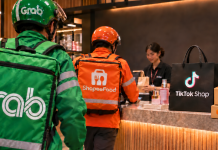
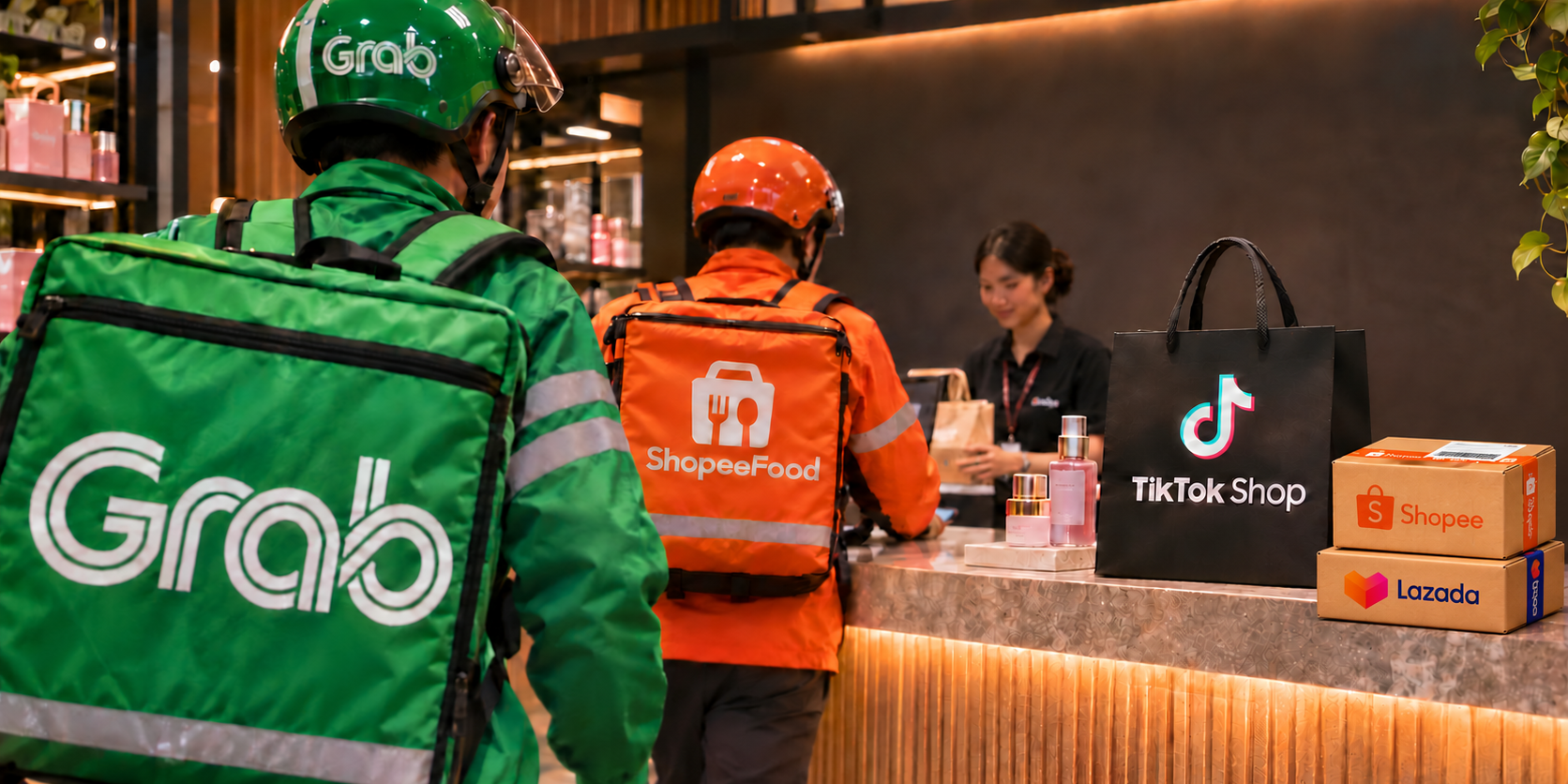
But it also brings Grab closer to the territory of Shopee and TikTok Shop.
The boundaries between these platforms are becoming less distinct. Grab is extending its immediate-delivery capabilities into more retail categories, while Shopee is moving in the other direction, bringing faster delivery and instant retail capabilities to its ecommerce business. TikTok Shop, meanwhile, is actively trying to move up its assortment to capture more established and emerging brands.
The competition is no longer confined to food delivery versus traditional ecommerce. The platforms are increasingly interested in the same consumer spending, even if they approach it from different starting points.
For Grab, the opportunity is clear: it can use its existing network to fulfil more types of transactions without having to build an entirely new distribution system.
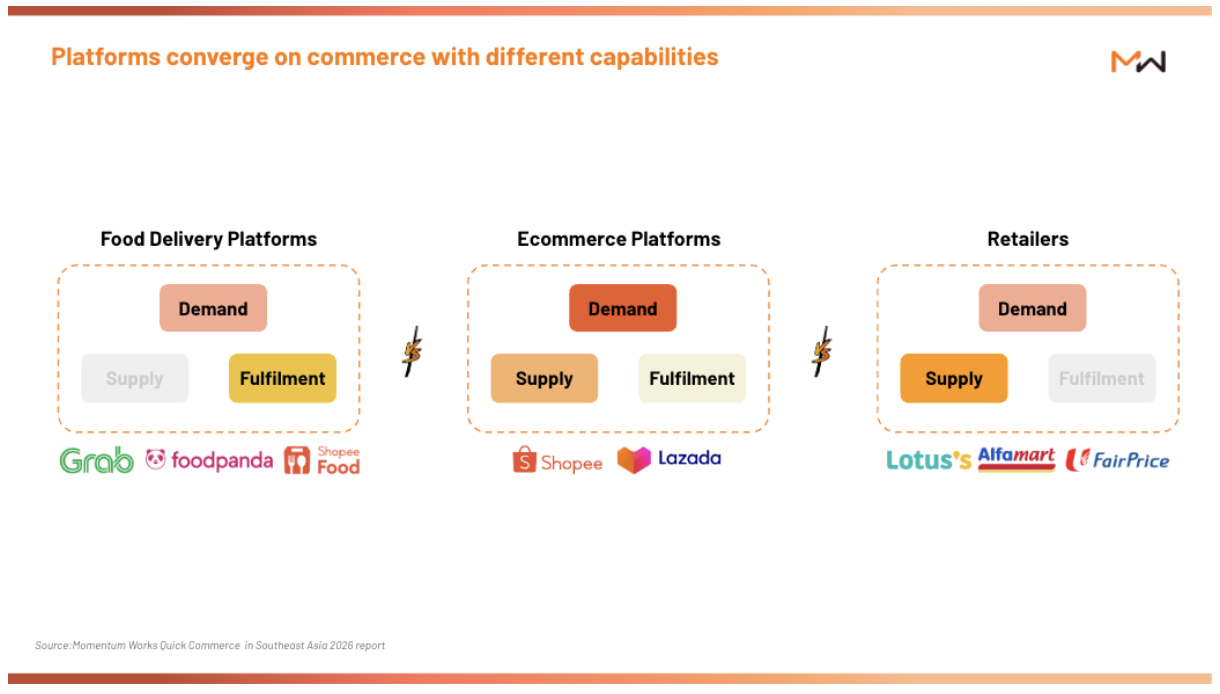
But a delivery network is only one part of what it takes to succeed in ecommerce.
Ecommerce requires a different set of capabilities
Running an ecommerce platform involves considerably more than connecting buyers with sellers and delivering their purchases.
It requires sophisticated algorithms for product discovery, search, recommendations and ranking. It requires pricing and promotion capabilities to keep products competitive. It requires merchant management, including assortment, inventory, seller quality and operational performance. And it requires deeper relationships with brands — going beyond selling them advertising space to helping them engage consumers, generate demand and encourage repeat purchases.
These capabilities take years to develop. During our Executive Immersions to China, we have had extensive discussions with executives of Alibaba’s Tmall, who recounted years of experimentation to eventually figure out how to get brands effectively onboard, at scale.
For example, when ecommerce accounted for only 10% of a brand’s total sales, how could Tmall help its ecommerce managers secure more resources and support from within their own organisations? Tmall developed an entire playbook around this challenge, refined through years of experimentation.
These are the kinds of capabilities that are easy to overlook when comparing ecommerce platforms from the outside.
Chinese platform operators we have spoken to generally describe the execution capabilities of Southeast Asian platforms as relatively weak compared with those of leading Chinese platforms. This is a subjective assessment, and overlooks China’s unique advantage as a large, single market with streamlined infrastructure.
It raises the question of whether the capabilities that helped Grab succeed in mobility and food delivery will be sufficient for its next phase, as it ventures deeper into digital commerce.
Yet this also presents an opportunity for Grab. Much of the expertise Grab needs has already been developed and refined by Chinese ecommerce and internet companies over many years. These capabilities have also travelled beyond China through talent, technology providers, merchant relationships and partnerships.
Shopee itself offers an interesting example. Although its organisation and execution may not match those of the leading Chinese platforms, it has absorbed and adapted a considerable amount of Chinese ecommerce expertise. It has benefited from capabilities developed in a much more competitive market, while applying them to the very different conditions of Southeast Asia. We see similar approaches in free shipping, search and recommendation algorithms, (the much-loathed) GMV Max, and even logistic planning.
Grab can potentially do the same. It does not need to recreate every capability from scratch, nor does it need to become a Chinese ecommerce company. It needs to identify what it can adopt from elsewhere, what it must build internally, and what it already does better than potential competitors.
Grab’s local network and understanding of Southeast Asian consumers are genuine advantages (and one of the key reasons why Meituan doesn’t prioritise Southeast Asia in Keeta’s global expansion).
What will winning look like?
There may be specific retail categories and occasions where Grab’s existing strengths provide a meaningful advantage: consumers who need something quickly, brands looking to drive local demand, and merchants with inventory that can be delivered immediately.
If Grab can generate incremental transactions through these use cases, while improving the utilisation of its existing delivery network and monetising brand relationships, GrabMall could become a valuable extension of its current business.
After all, you don’t necessarily need a Ferrari to drive on Southeast Asia’s muddy roads. A Land Rover may be more appropriate.