

This series is adapted, with permission, from a Chinese-language series by our friend Marcus Ji, who looks at historical events through an economic lens. We have condensed and adapted the original for an international audience.
In 965 AD, the Song dynasty court issued an edict that began dismantling a rule Chinese cities had lived under for a thousand years: the night curfew.
Before that, every major Chinese city shut down at dusk. In Tang dynasty Chang’an, drums signalled the closing of ward gates at nightfall; anyone caught on the streets after dark was flogged. Cities were, quite literally, dead at night.
Once the curfew was lifted, Kaifeng – then the imperial capital, with a population of over a million – became arguably the first city in human history that never slept. Night markets ran until roughly 2am, closed for five hours, and reopened for the morning trade.
We know this because of a minor official named Meng Yuanlao, who lived in Kaifeng from age 13 to 27. After the city fell to Jurchen invaders in 1127, he fled south as a refugee and wrote down everything he could remember of the capital in a memoir, Dongjing Meng Hua Lu (“A Dream of Splendor in the Eastern Capital”).
The book’s most striking revelation is almost a side thought: most residents of this city of a million did not cook at home. They ate out, or ordered in, every day.
Today we would call this the food delivery economy. We tend to assume it was invented by the internet. It wasn’t. It ran, at full scale, 900 years ago.
The first modern restaurants – four centuries before Paris
Historians of Western cuisine generally date the birth of the “modern restaurant” – menus, fixed prices, waiters, dishes cooked to individual order – to Paris in the 1760s.
By that definition, scholars of the Song period argue, Kaifeng had fully-formed restaurants roughly 400 years earlier. The city had 72 officially registered premium restaurants (zhengdian) and thousands of smaller establishments. What distinguished them from the inns and taverns that came before, anywhere in the world, was precisely the things we now consider defining: you ordered what you wanted from a menu, at a posted price, and it was cooked for you.
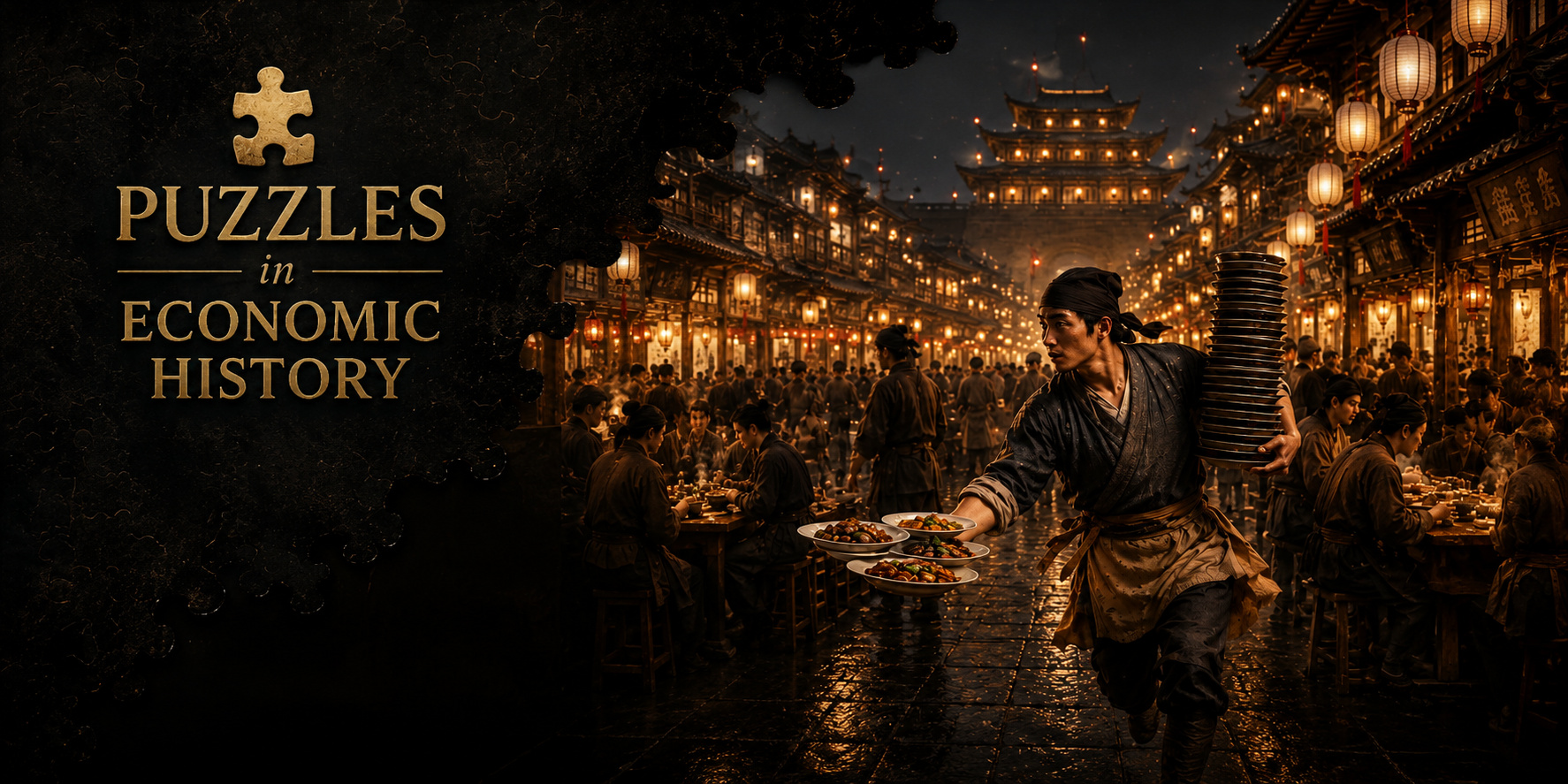
The service level is the detail that sticks. Meng records that Kaifeng diners were famously demanding – a single table might call out dozens of dishes, some hot, some chilled, some lean, some fatty. The waiter memorised everything, sang the order out to the kitchen, and returned moments later carrying three dishes in his left hand and around twenty bowls stacked from his right hand up to his shoulder, distributing them table by table without a single error.
That is not a circus act. It is what service specialisation looks like when demand density is high enough to force it.
Delivery had a name: suohuan
Meng’s memoir contains a four-character phrase describing Kaifeng’s food scene: “逐时施行索唤,咄嗟即办” – order anytime, and it is delivered at once. Suohuan (“call and demand”) was Song dynasty food delivery. Kaifeng is the earliest city we know of with systematic, on-demand meal delivery and a structured three-meals-a-day eating-out culture.
Delivery worked in Kaifeng because three conditions stacked on top of each other: high urban density, deep specialisation of labour, and instant demand. Readers will recognise this immediately – it is the exact formula underpinning Meituan, Grab, and Deliveroo today, unchanged. What the internet transformed was the efficiency and scale of matching, not the behaviour itself. Kaifeng demonstrated 900 years ago that once a city is dense enough and labour divided finely enough, people stop cooking.
The economics closed for the same reason they close today: eating out was cheap. Night-market stalls sold snacks, meats, soups and desserts for a few copper coins – affordable to virtually every resident. For an urban worker, outsourcing the kitchen was cheaper and easier than running one. Song dynasty urbanites and today’s office workers did the same arithmetic and reached the same answer.
What things actually cost
Converting ancient prices into today’s money is treacherous. The common shortcut – convert copper coins to silver, silver to gold, gold to dollars – produces answers that vary by a factor of five to eight, because every ratio in that chain has drifted over the centuries.
The one ratio that stays stable across 900 years is what something costs as a share of an ordinary worker’s daily wage. A Kaifeng labourer earned roughly 100 copper coins a day; we anchor everything to that.
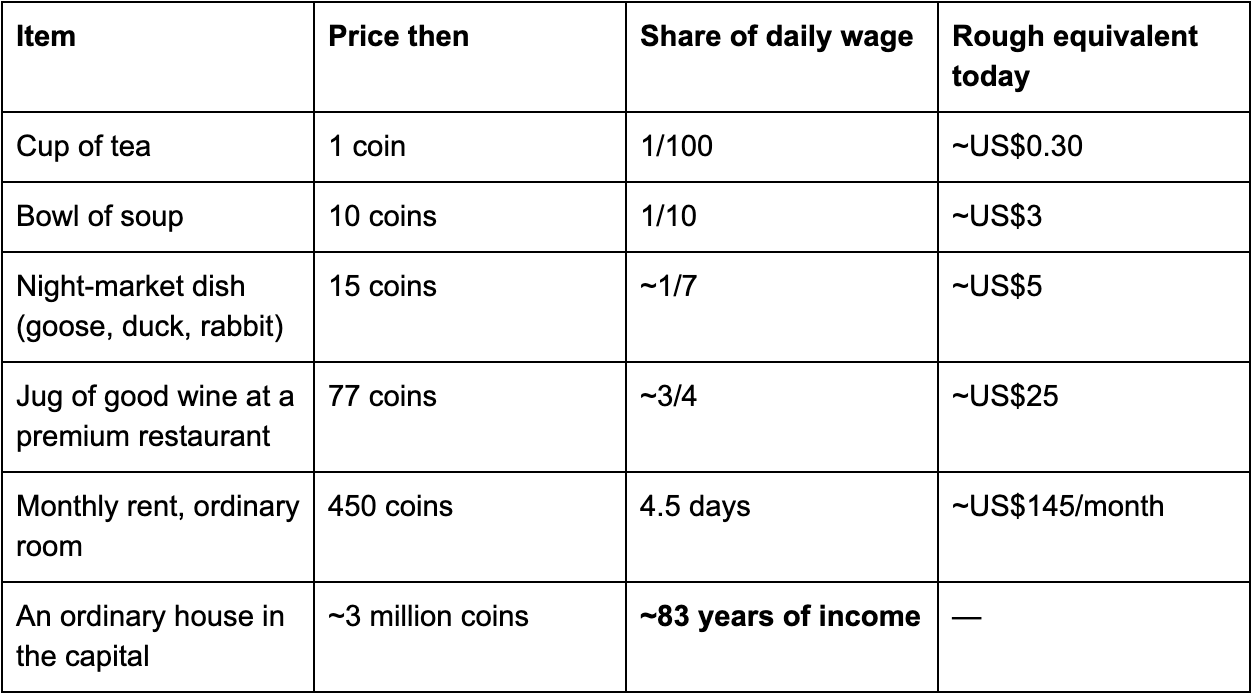 Read the third column and two things jump out.
First, the night market was priced for ordinary people – and the price of a delivered meal, expressed in labour time, has barely moved in nine centuries. A hot dish cost about one-seventh of a day’s wage then; a standard food-delivery order costs about the same fraction now. That is not a coincidence: mass-market food seems to have a pricing ceiling permanently pinned at “a small fraction of a day’s pay.”
Second, housing was already in a different universe. An ordinary home in the capital cost 83 years of a labourer’s income. A chancellor’s monthly salary equaled 100 months of a commoner’s. Ordinary people could never buy property in the capital city where they lived and worked – a ratio that reads uncomfortably familiar 900 years later.
Contemporary observers also noted, disapprovingly, that Kaifeng’s working families “earned a hundred coins in the morning and spent them all by nightfall.” Zero savings, full consumption. When upward mobility is invisible, spending today is more rational than saving for a tomorrow that looks identical – an insight about consumer behaviour that did not need to wait for the 21st century.
The cold water: the boom was fiscal, not organic
Here is the part of the story that matters most – and that a casual telling leaves out.
Kaifeng’s consumer boom was real. Ordinary residents genuinely participated. But it rested on one enormous precondition: the imperial fiscal system continuously pumped money into the capital.
The Song state was historically unusual. By the late 11th century, economic historians estimate that around two-thirds of government revenue came from non-agricultural sources – above all, state monopolies on salt, wine and tea, the most profitable businesses in the empire. The largest profit pools in the economy were never in the market at all; they belonged to the state.
That revenue flowed into Kaifeng as salaries for the bureaucracy, pay for hundreds of thousands of soldiers, and court expenditure. Those salaried hundreds of thousands – not farmers, not merchants – were the true customer base of Kaifeng’s restaurant and delivery economy. Their stable incomes trickled down to feed the food stalls, theatres, rentals and workshops.
Kaifeng, in other words, was a funnel economy: taxes drawn up from the whole empire, concentrated in the capital, and spent downward. Meng’s memoir never once mentions the countryside – where, in the same years, tenant farmers were paying 50-60% of their harvest in rent. The glittering night city was a heavily subsidised capital, not a portrait of the country.
Anyone analysing today’s capital-city consumption booms will recognise the structure. The night market survives on its own; the density and the price points do not. Remove the salaried base, and both collapse.
The two-year erasure – and what it proves
In 1127, enemy armies breached Kaifeng’s walls. Two emperors were carried off into captivity; the court fled south to Hangzhou. A consumer metropolis of over a million people – the delivery runners, the 72 licensed restaurants, the iced-drink stalls with their summer queues, the waiter with twenty bowls on one arm – was erased in roughly two years, from peak to ruin.
The speed is not just tragic; it is diagnostic. A market-grown economy degrades when shocked – trade reroutes, merchants relocate, some base level of commerce persists. A fiscally transfused one simply stops. Kaifeng’s restaurant and delivery economy was downstream of state salaries, so when the state fell, there was no organic base left to rebuild on. The two-year erasure is the strongest evidence for how the boom actually worked.
Meng Yuanlao wrote his memoir in exile, from memory. What he recorded was the final operating state of a precision machine, just before it was smashed.
Food delivery, restaurants, cold-drink queues, living paycheck to paycheck – everything we label “modern,” that city already had. The one thing in Meng’s book that resists easy modern comparison is how completely, and how quickly, it all disappeared – and what that revealed about the machine while it ran.
Next in this series: Why did the last mass job displacement take 200 years to complete?