




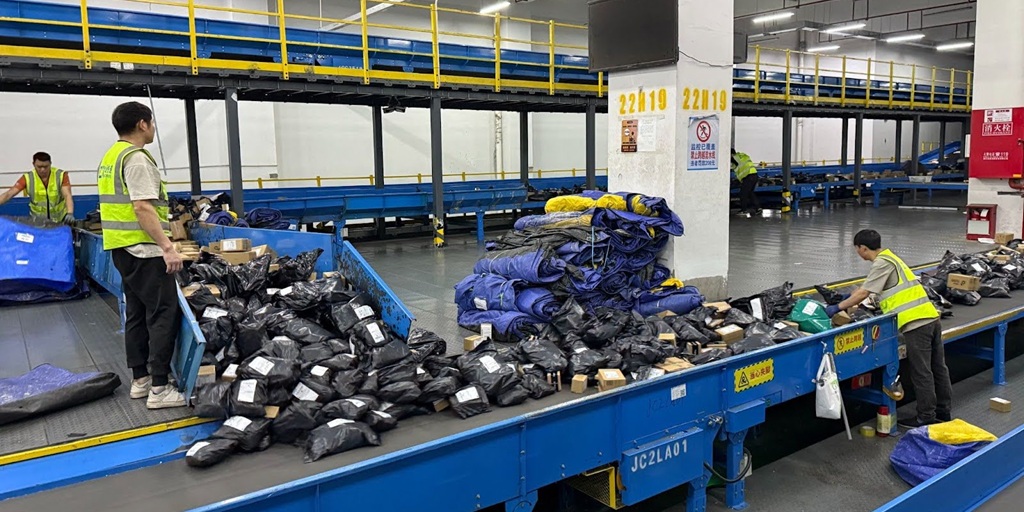
China crossed another logistics milestone this week. As of 30 November, the country has shipped more than 180 billion express parcels in 2025, already exceeding the entire volume of 2024 (175.08B).
At the current pace – with an average of 16 billion parcels per month, daily peaks reaching 777 million, and more than 6,200 parcels processed every second – China is on track to end the year well above 200 billion.
The number is announced by the State Post Bureau, the central government agency responsible for regulating the country’s courier sector.
This comes just a year after the industry celebrated its “150-billionth parcel” milestone. The acceleration shows how deeply ecommerce is now woven into China’s economy.
Growth is increasingly structural: driven not only by major shopping festivals, but by the rise of discount ecommerce, factory-to-consumer models, community group buying, and the digitisation of local retail.
But the real story is also technological. China’s express network has quietly shifted from automation to full-stack AI integration, according to the State Post Bureau.
- In warehousing, unmanned workflows are becoming standard: robots, custom containers and automated inbound–outbound stations now handle picking, racking and retrieval with minimal human intervention.
- In sorting centres, AI vision models attached to nationwide camera networks make millisecond-level decisions that sharply reduce mis-sorts, damage and loss.
- In transport, vertical domain LLMs are being deployed to optimise routing and multimodal coordination in real time.
- And at the last mile, drones, autonomous vehicles and delivery robots are expanding pilot operations across cities and rural regions, lowering variable labour costs during peak seasons.
A second shift is geographical. Parcel growth is no longer concentrated only in coastal hubs. In the first ten months of the year, the share of express revenue from Central and Western China rose 0.6 and 0.3 percentage points year-on-year, while their share of parcel volume grew 1.1 and 0.6 points respectively.
Free-shipping support in remote Western areas has accelerated network build-out, turning Inner Mongolia, Xinjiang and Tibet into emerging logistics hotspots.
This article by Momentum Works earlier this year shows how the logistics network is built to deliver ecommerce parcels to remote areas in Inner Mongolia.
Ecommerce logistics is also a key sector we cover during the Momentum Works China Immersions. This year, we have visited major facilities belonging to 4 out of the 6 leading ecommerce logistics companies in China.
As a key executive from Cainiao told us during one of Momentum Works’ immersions: “We are solving ‘billion’ problems, not ‘million’ problems. The key is to cater to the volume and density first, then optimise along the way. Then we build something that is globally competitive.”
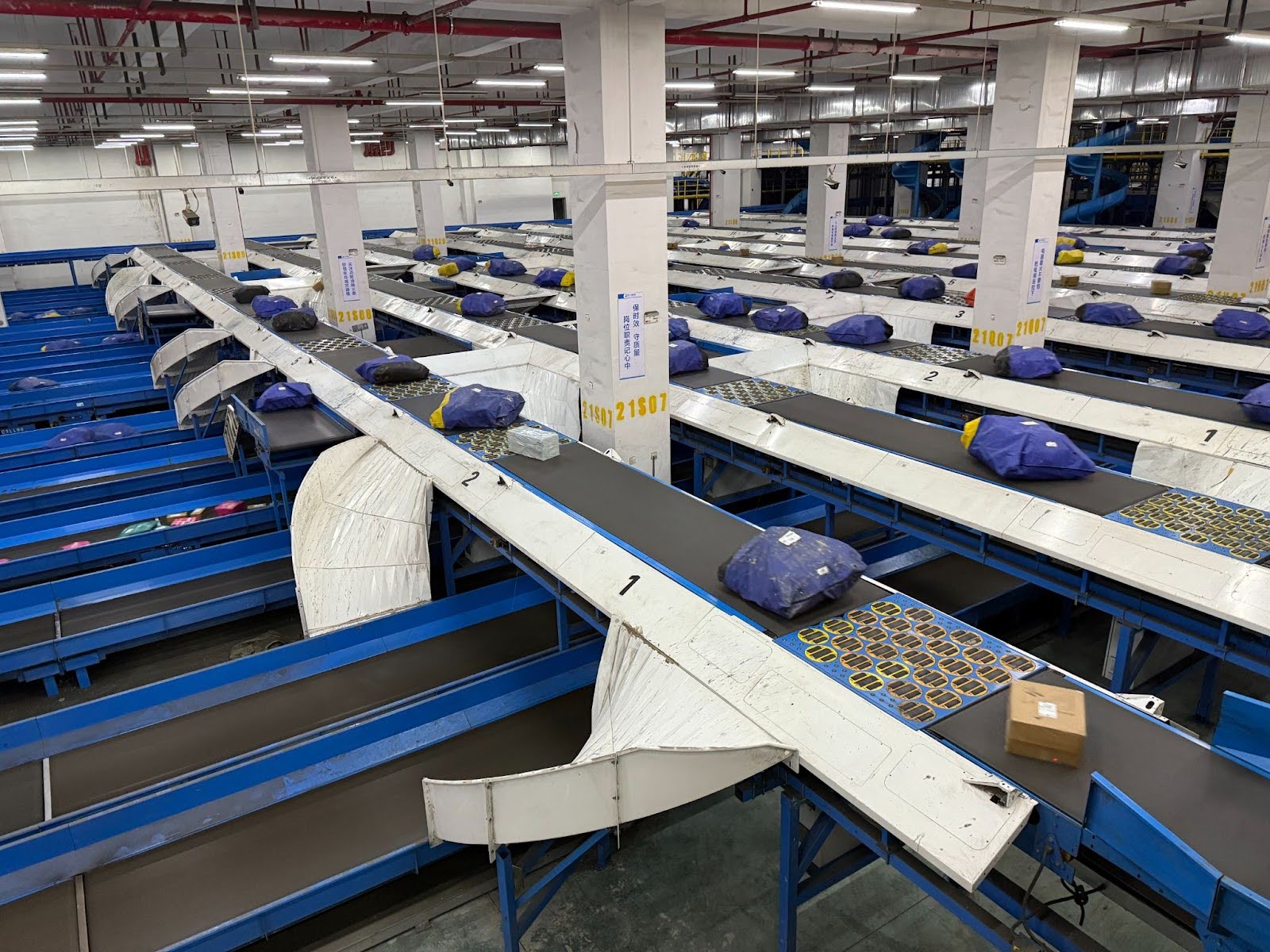
We took the following picture in one of the largest ecommerce sorting centres in the country , processing more than 14 million inbound and outbound parcels every day.
Each blue bag here contains hundreds of parcels:
You can also make reference to the following Momentum Works reports and articles for more:
- Ecommerce in Southeast Asia 3.0
- Quick Commerce in China 2025
- Food delivery in Southeast Asia 5.0
- TikTok Shop in the U.S. H1 2025
- Temu: 2 years on