




Editor’s note: The author of this article, Sheji Ho, is the co-founder and former CMO of aCommerce, one of Southeast Asia’s earliest ecommerce enablers. He is now founder & CEO of HD, a healthcare platform focused on the Thai market.
In 2023, Sheji published a piece discussing the “Fried Chicken Theory“. This article is Sheji’s follow-up commentary written against the backdrop of AI’s disruption of the SaaS industry.
An edited version of this article was previously published on TechinAsia, a news site. TheLowDown has been authorised by the author to publish the original version. The views expressed are those of the author, which we might or might not agree with.
It’s 2018 and we’ve just launched BrandIQ at aCommerce.
BrandIQ (now known as EcommerceIQ) was our ecommerce analytics SaaS product. It crawled marketplaces like Shopee and Lazada, tracking sales, pricing, categories, and SKU-level performance over time. All neatly visualized in dashboards.
Peak SaaS.
Peak dashboards.
Peak software margins.
We rolled it out across our Fortune 500 brand clients and watched the MRR climb. Finally, we thought, SaaS works in Southeast Asia too.
Then reality hit.
The requests started rolling in via WhatsApp and email:
“Hey can you quickly pull this report for me?”
“Can you summarize the key action items?”
“Can you help us prepare recommendations for management? Meeting is in one hour.”
That’s when it clicked:
Southeast Asia didn’t actually want SaaS.
At least not in its pure, glorified Silicon Valley form.
People didn’t really want software. They wanted someone to do the work for them.
And honestly? None of this should have been surprising. Chinese SaaS had already hit many of the same walls a decade earlier, with companies often devolving into “managed services in disguise,” as Lillian Li described in Why Are There No Massive Chinese SaaS Companies?
Emerging markets in SEA were built on labor arbitrage for decades. Entire industries evolved around service layers — agencies, operators, account managers, distributors, coordinators, offline relationship managers, etc.
The cultural expectation was never:
“Give me tools.”
It was always:
“Solve the problem for me.”
For years, this was viewed as a weakness of emerging markets. Investors and founders repeatedly tried to import Silicon Valley SaaS playbooks into SEA, only to get confused when the unit economics failed to translate — assuming enterprise or SME buyers even wanted pure SaaS to begin with. Even the peak Covid-era startup bubble of 2021, arguably the largest tech bubble in SEA history, couldn’t brute-force mass SaaS adoption across the region.
Ironically, AI may turn this “weakness” into SEA’s biggest structural advantage.
Quick refresher on the Fried Chicken Theory
Back in 2023, I posted on Momentum Works what I jokingly called the “Fried Chicken Theory”:
On a long enough timeline, every startup in emerging SEA (excl. Singapore!) will either:
1) become an ecommerce enabler or add an enabler / managed service component to its business; or
2) become an offline fried chicken or some other F&B brand
IYKYK
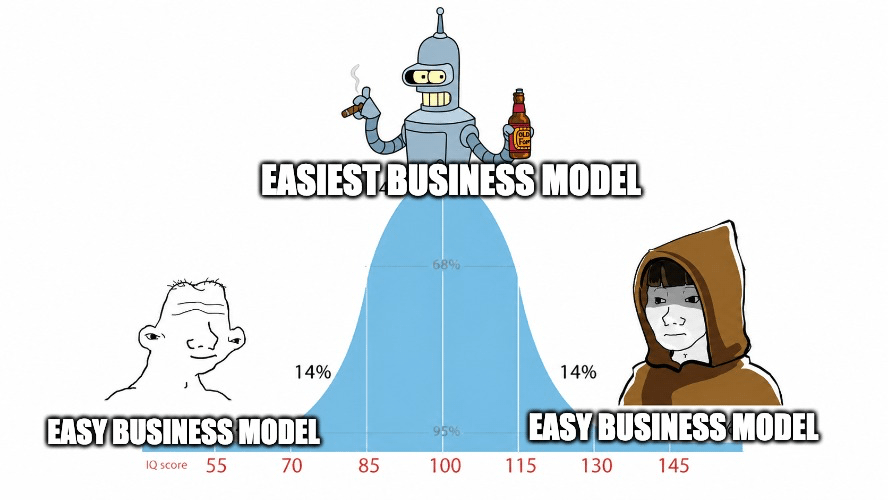
The thesis being:
Startup business model opportunities in emerging SEA follow a barbell distribution, instead of a normal distribution.
The reason is structural. Emerging markets are messy. Infrastructure gaps create operational gaps. Operational gaps create service layers. Service layers eventually become the actual moat.
Which is why so many SEA “tech companies” eventually drift toward operations, logistics, enablement, fulfillment, offline infrastructure, and managed services.
The software itself often becomes secondary.
Execution becomes the product, with software as a means to an end.
Silicon Valley is power-law pilled. Southeast Asia is barbell-pilled.
Like biology and ecology, startup ecosystems converge toward repeating distribution patterns.
In Silicon Valley, that popular pattern is obviously the power law. A handful of companies absorb nearly all the value — search, social, operating systems, cloud, and now foundation models.
The AI era is amplifying this even further. Foundation models are pure power-law businesses (see: OpenAI, Anthropic, Google). Others like Perplexity are jokingly called ‘Temu Anthropic’.
Meanwhile, the AI application layer increasingly looks like a crowded normal distribution — note takers, meeting recorders, summarizers, generic copilots, medical scribes, and “AI wrappers” competing on microscopic UX differences.
Everyone crowding into the middle. Everyone slowly turning into the same company.
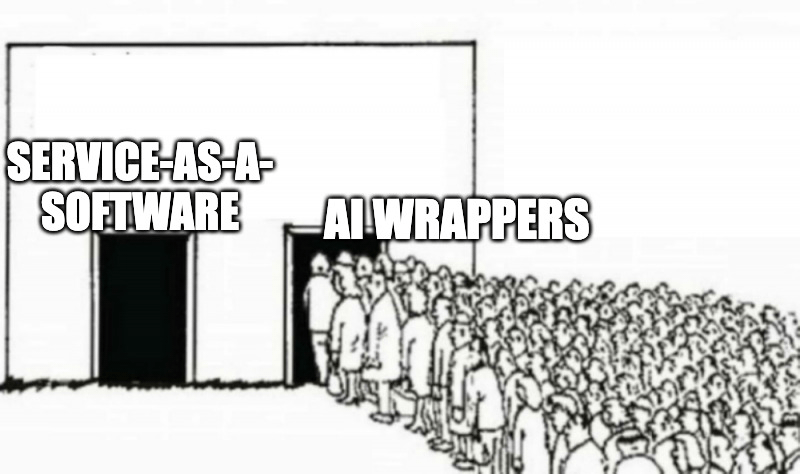
And thanks to vibe coding and accelerators, this compression is happening faster than ever.
In SEA though, the dominant pattern has historically looked very different. It’s the barbell. And lately, we’re seeing it everywhere.
The Southeast Asian consumer barbell
Lightspeed Venture Partners in 2025 wrote about the ‘Southeast Asian Consumer Barbell’ — the idea that startups increasingly need to target either:
- Affluent consumers, or
- Lower-middle income consumers
The middle gets squeezed.
Which honestly explains a lot of SEA startup history in hindsight.
For years, founders and VCs chased the mythical “mass affluent SEA middle class”. Turns out a lot of that TAM was PowerPoint GDP, not actual purchasing power.
A lot of people got burned chasing that narrative.
Today, the surviving companies increasingly sit at the extremes — premium products for affluent consumers, or hyper-efficient products for value-conscious users. Chinese brands are rapidly dominating the latter end of the barbell, from EV makers flooding SEA streets to ultra-efficient F&B chains like Mixue expanding aggressively across the region. Their knives were sharpened in one of the most competitive consumer markets in the world.

Again, the barbell.
Even the founder ecosystem is barbelled now
The founder layer looks the same way.
The middle “touristy founder” cohort — massively inflated during Covid and ZIRP — disappeared almost as quickly as your tokens after a new Anthropic Claude model release.
What remains is increasingly two camps:
- Singapore-based founders building for mature markets and eventually relocating to the US or developed Asian markets.
- Founders deep in local SEA markets, Forrest Gump praying-for-shrimp style, grinding through local consumer and operational problems.

The VC ecosystem is starting to mirror this too.
Unfortunately.
AI changes the equation
Here’s where it gets interesting.
AI might actually “fatten” the middle of the SEA barbell.
Imagine it’s 2018 again and we’re scaling BrandIQ. A Fortune 500 client urgently needs a marketplace analysis before an 11.11 campaign launch.
Traditionally, this meant:
- account managers
- analysts
- PowerPoint decks
- WhatsApp chaos
- and probably an all-nighter
Now imagine the same output being generated in five minutes by an AI Account Manager Agent operating through email or messaging apps:
- pulling the data
- generating scenario analysis
- recommending promotions
- summarizing action items
- setting up paid Shopee and Lazada ad campaigns
- and responding conversationally in real time
What we used to call “managed SaaS” is now evolving into something else entirely:
Service-as-a-Software.
Instead of selling tools, you sell outcomes.
And ironically, this fits SEA perfectly. Because SEA was never optimized for pure self-serve software abstraction in the first place. It was optimized for services. AI just changes the scalability equation.
Southeast Asia may actually be the ideal AI market
This is why I increasingly believe the Service-as-a-Software opportunity may be even bigger in emerging markets like SEA than in the US.
For decades, SEA startups survived by brute-forcing operational complexity with humans — onboarding teams, coordinators, support staff, ops teams, account managers, offline sales forces.
AI suddenly compresses the cost structure behind all of this.
And unlike mature markets, SEA buyers are already culturally conditioned to expect service-heavy relationships. They don’t want another dashboard. They want outcomes.
The irony is that SEA founders who spent the last decade suffering through operationally-heavy businesses may now be perfectly positioned for the AI era.
Because they actually understand the (often hyperlocal) workflows. They understand the edge cases. They understand the operational mess. They understand the human coordination layer.
That operational pain now becomes training data and the oh-so-valuable context layer for AI.
Belly fat – the good type that is
For years, the middle of the SEA startup ecosystem was uninvestable territory:
- too operational for software margins
- too fragmented for pure scale economics
- too human-intensive for venture math
AI changes that. It allows startups to industrialize services, scale expertise, compress labor, and deliver outcomes instead of tools.
In other words: AI may finally make SEA’s messy middle venture-scalable.
After spending a decade being told SEA was “hard mode” and impossible to scale, many SEA founders may now discover that hard mode was actually the moat all along.
A lot has already been written about AI-powered services — Sequoia Capital’s “Services: The New Software,” Kevin Brockland’s “Why SaaS Is Dying and Service-as-Software Is Rising,” and now even OpenAI and Anthropic partnering with major private equity firms to deploy AI directly into enterprise operations.
The rise of “forward-deployed engineers” — essentially AI-era consultants embedded inside businesses — suggests the industry may be coming full circle: the companies that vaporized SaaS market caps are increasingly evolving toward AI-powered service models themselves. After all the hype, the frontier labs may ultimately end up looking less like pure software companies — and more like the next generation of IBM.
Because after crawling the same internet alongside everyone else, the last truly defensible layer of training data may ultimately reside inside corporations themselves: buried within messy real-world workflows, operational edge cases, and human coordination layers. In that context, it becomes easier to understand why companies like Meta are reportedly becoming increasingly aggressive about tracking internal workflows and employee activity: operational exhaust is quickly becoming AI fuel.
But I suspect the implications are even larger in emerging markets. Because for the first time, SEA founders can combine:
- operational depth
- service-oriented buyer culture
- labor-heavy workflows
- and AI scalability
The result probably won’t look like traditional SaaS. It’ll look messier. More hybrid. More operational. More embedded in the real world.
But that’s precisely where the opportunity is.

Emerging markets like SEA have always exhibited leapfrogging behavior in technology. We saw it with smartphones leapfrogging desktop computing, mobile commerce leapfrogging traditional retail, and fintech leapfrogging credit cards and legacy banking infrastructure. Now, we may be witnessing a once-in-a-generation opportunity for SEA to leapfrog traditional SaaS altogether.
In Forrest Gump, Lieutenant Dan and Forrest were among the only shrimp boats “foolish” enough to stay out at sea during Hurricane Carmen. While the storm wiped out much of the established fleet, their boat survived because they were already in the water when the disruption hit. What looked irrational beforehand became the very thing that positioned them to dominate afterward. In many ways, SEA founders may find themselves in a similar position today: after years of grinding through operational chaos, “hard mode” may finally become the ultimate advantage.

As one of the few founders still left building in SEA: what are you building in “Service-as-a-Software”?
Would love to hear your thoughts.